All species › Waders, gulls and terns › Sandpipers and snipes › Common Snipe
Common Snipe | Gallinago gallinago
Watersnip | Agachadiza común
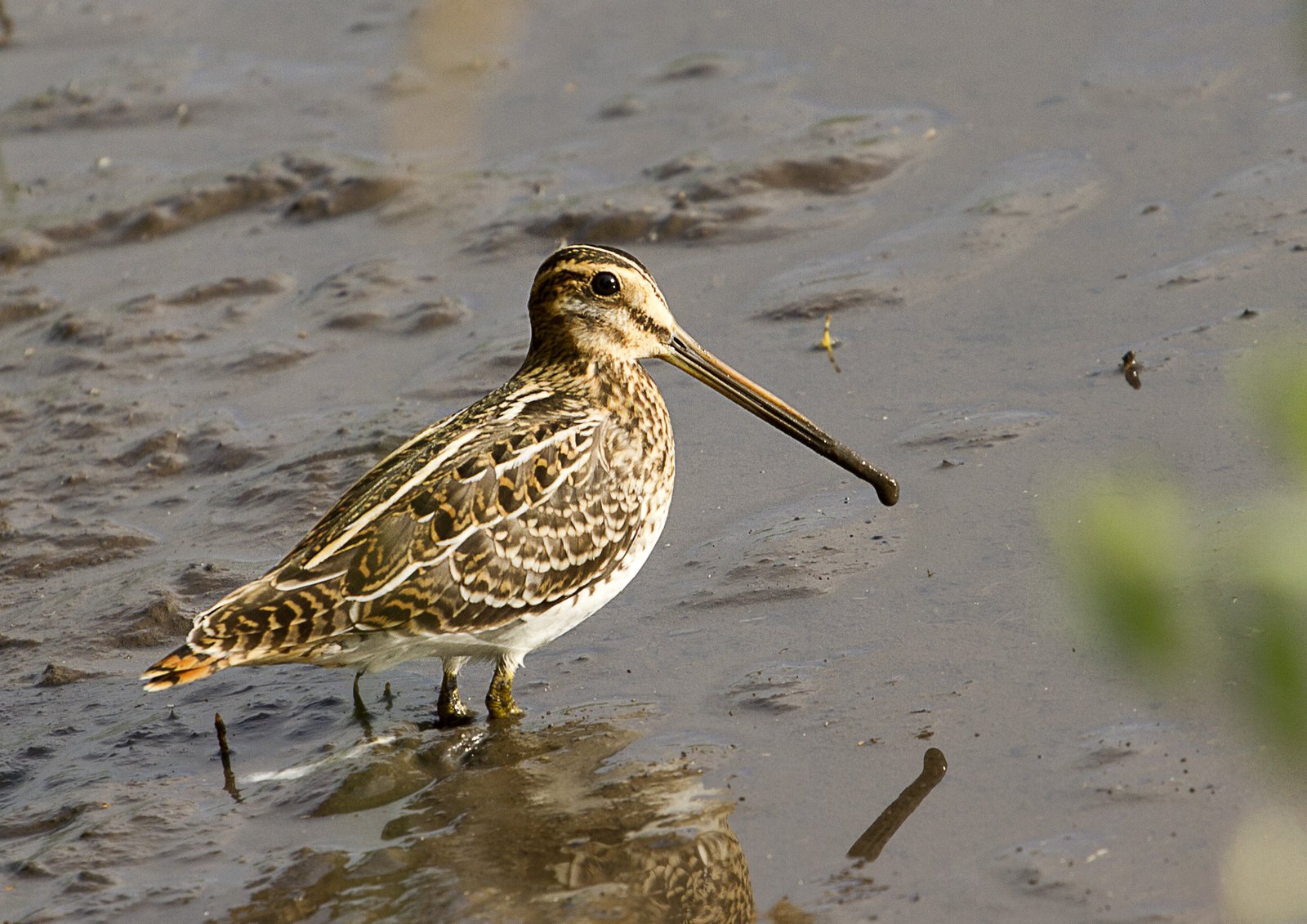
The ordinary snipe of marshes and wet fields, with a very long straight bill and a striped, cryptic plumage. It breeds north of the region but in winter can be found in almost every wetland, from the merjas of Morocco via the Nile Delta to the Mesopotamian marshes and the oases of Arabia.
Voice
When flushed a harsh, rasping scaap, often repeated. In the breeding season a ticking chipper-chipper and the 'drumming' of the outer tail feathers in the display dive; in the region heard at most in early spring.
Recording: Stanislas Wroza — CC BY-NC-SA 4.0 · converted to mono · xeno-canto
Identification
A medium-sized, stocky wader with short greenish legs and a bill about twice the head length. The head has dark lateral crown stripes either side of a pale central stripe, a pale supercilium and a dark eye-stripe. The back is dark brown with four striking pale longitudinal stripes; the breast is spotted, the flanks barred and the belly white. In flight it shows a clear white trailing edge to the secondaries and a white belly; it flies off in rapid zigzags and climbs high.
Confusion species
Great Snipe (Gallinago media) is heavier, with a shorter bill, a barred belly, white-tipped wing-coverts and much white in the tail; it flies low and straight. Pin-tailed Snipe (Gallinago stenura) in eastern Arabia lacks the white trailing edge and has a dark, densely barred underwing. Jack Snipe (Lymnocryptes minimus) is much smaller, with a short bill, and flushes only at your feet. Greater Painted-Snipe (Rostratula benghalensis) has a drooping bill tip and a white 'spectacle' pattern.
Habitat
Freshwater marshes, muddy shores of lakes, rivers and canals, wet meadows, rice fields, flooded fields and irrigated fodder crops; also oases, sewage pools and the edges of reservoirs. Feeds by probing soft mud with rapid sewing-machine movements and likes to stay close to cover.
Where the bird is most at home, classified by the habitats of North Africa and the Middle East.



Range and movements
A widespread winter visitor. In the Maghreb common in the wetlands of Morocco (Merja Zerga, Sidi Bou Ghaba, Loukkos, Oued Massa), northern Algeria (El Kala) and Tunisia (Ichkeul, Cap Bon); fewer in Libya along the coast and in the oases. In Egypt common in the Nile Delta and Valley and in the Fayoum. In the Middle East common in Israel (Hula, Jordan Valley), Lebanon (Bekaa), Syria and Jordan (Azraq), and in large numbers in the marshes of southern Iraq. On the Arabian Peninsula a common winter visitor and migrant on irrigated farms, treatment ponds and wetlands in Kuwait, Saudi Arabia, Bahrain, Qatar, the Emirates, Oman and Yemen. Migrants also stop over in Saharan oases. Beyond the region it breeds from Iceland and western Europe to eastern Siberia and winters in Europe, Africa and South Asia.
- Resident
- Winter visitor (c. Apr–Sep)
- Passage (Mar–Apr, Oct–Nov)
- dark = core range, pale = thinly spread
How and when to look
Often you only see the birds when they flush, zigzagging and calling; scan the muddy edges of reedbeds with a telescope, where they sit motionless among the stems. At Eilat, in the Hula Valley and on the Wamm Farms (Emirates) they are easy to find in winter, and in Morocco along the bunds of Merja Zerga.
Conservation status
Not globally threatened, although breeding populations are declining in much of Europe through drainage. In the region wintering sites are lost to drainage and drying out, while new irrigation projects and treatment ponds in Arabia locally provide new habitat. The species is hunted in North Africa and the Middle East.
Scientific name
Gallinago gallinago | (Linnaeus, 1758)
Linnaeus described the species in 1758 as Scolopax Gallinago; because it was later moved to another genus, the author and year stand in brackets. The genus Gallinago was introduced in 1760 by Brisson. Gallinago is New Latin for a snipe, from Latin gallina 'hen' and the suffix -ago 'resembling'. The specific name repeats the genus name. The specimen the first description was based on came from Sweden.