All species › Waterfowl › Ducks, geese and swans › Cotton Pygmy-Goose
Cotton Pygmy-Goose | Nettapus coromandelianus
Coromandeleend | Gansito asiático
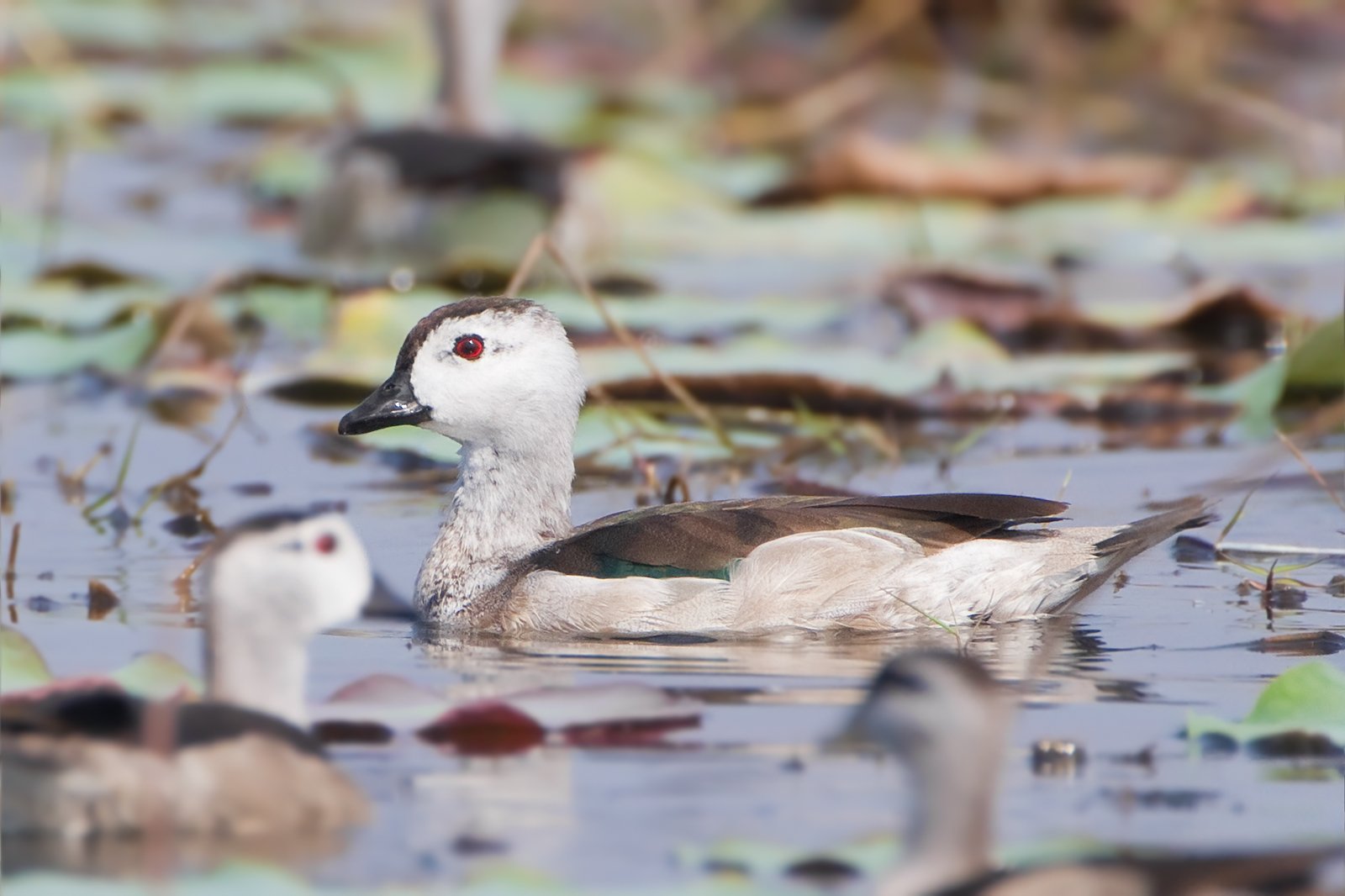
A tiny, goose-like duck with a short bill and a bright white head and neck, the smallest duck likely to turn up in the region. At home in South and South-East Asia; in Arabia a scarce visitor, mainly to Oman, on ponds with floating plants.
Voice
The male gives a crackling, cackling quack-quack-quackquack or carr-wak in flight; the female a soft quack. Often silent outside the breeding season.
Recording: Sam Hambly — CC BY-NC-SA 4.0 · converted to mono · xeno-canto
Identification
30–37 cm, round and compact with a short, deep, goose-like bill. The breeding male has a white head and neck with a black crown, a narrow black collar, a glossy dark green back and white underparts with grey-vermiculated flanks. In eclipse and in the female the collar is lacking; the female has a dark eye-stripe, a dingy white head and dull brown upperparts. In flight, fast and low over the water, the male shows a broad white band along the trailing edge of the wing; in the female only a narrow white trailing edge is visible.
Confusion species
Hard to confuse within the region. Females might be taken for Garganey (Spatula querquedula) or Eurasian Teal (Anas crecca), but these have a longer, flat bill, a streaked brown head and a different wing pattern. African Pygmy Goose (Nettapus auritus), a relative from beyond the region, has a green neck patch and a yellow bill.
Habitat
Ponds, pools and lakes with abundant floating and submerged plants, such as water lilies and water hyacinth, as well as rice fields and irrigation pools. It feeds while swimming on seeds and plant matter at the surface, rarely diving. In Oman mainly on coastal lagoons and ponds, sewage lagoons and oasis pools.
Where the bird is most at home, classified by the habitats of North Africa and the Middle East.


Range and movements
Within the region most regular in Oman, as single birds or small groups in the north and in Dhofar; also a few records in the United Arab Emirates, Saudi Arabia, Yemen and Iraq. Beyond it found from Pakistan and India across Bangladesh and Sri Lanka to southern China, Indochina, the Indonesian archipelago and north-eastern Australia. It wanders after the monsoon.
- Winter visitor (c. Apr–Sep)
- dark = core range, pale = thinly spread
How and when to look
In Oman, search the margins of vegetated ponds and lagoons, for example the sewage lagoons near Muscat and the coastal lagoons of Dhofar. The birds often sit motionless among floating leaves and only catch the eye when they fly and show the white wing pattern.
Conservation status
Not threatened and widespread across its large range. In the region a scarce, irregular visitor to Oman with no proven breeding, and a vagrant elsewhere.
Scientific name
Nettapus coromandelianus | (Gmelin, 1789)
Gmelin described the species in 1789 as Anas coromandeliana; because it was later moved to another genus, the author and year stand in brackets. The genus Nettapus was introduced in 1836 by Brandt. Nettapus comes from the Greek nētta, 'duck', and pous, 'foot' — 'duck-foot', for these small, goose-like ducks. coromandelianus means 'of the Coromandel Coast', the southeast coast of India. The specimen the first description was based on came from Coromandel Coast, India.