All species › Waterfowl › Ducks, geese and swans › White-Headed Duck
White-Headed Duck | Oxyura leucocephala
Witkopeend | Malvasía cabeciblanca
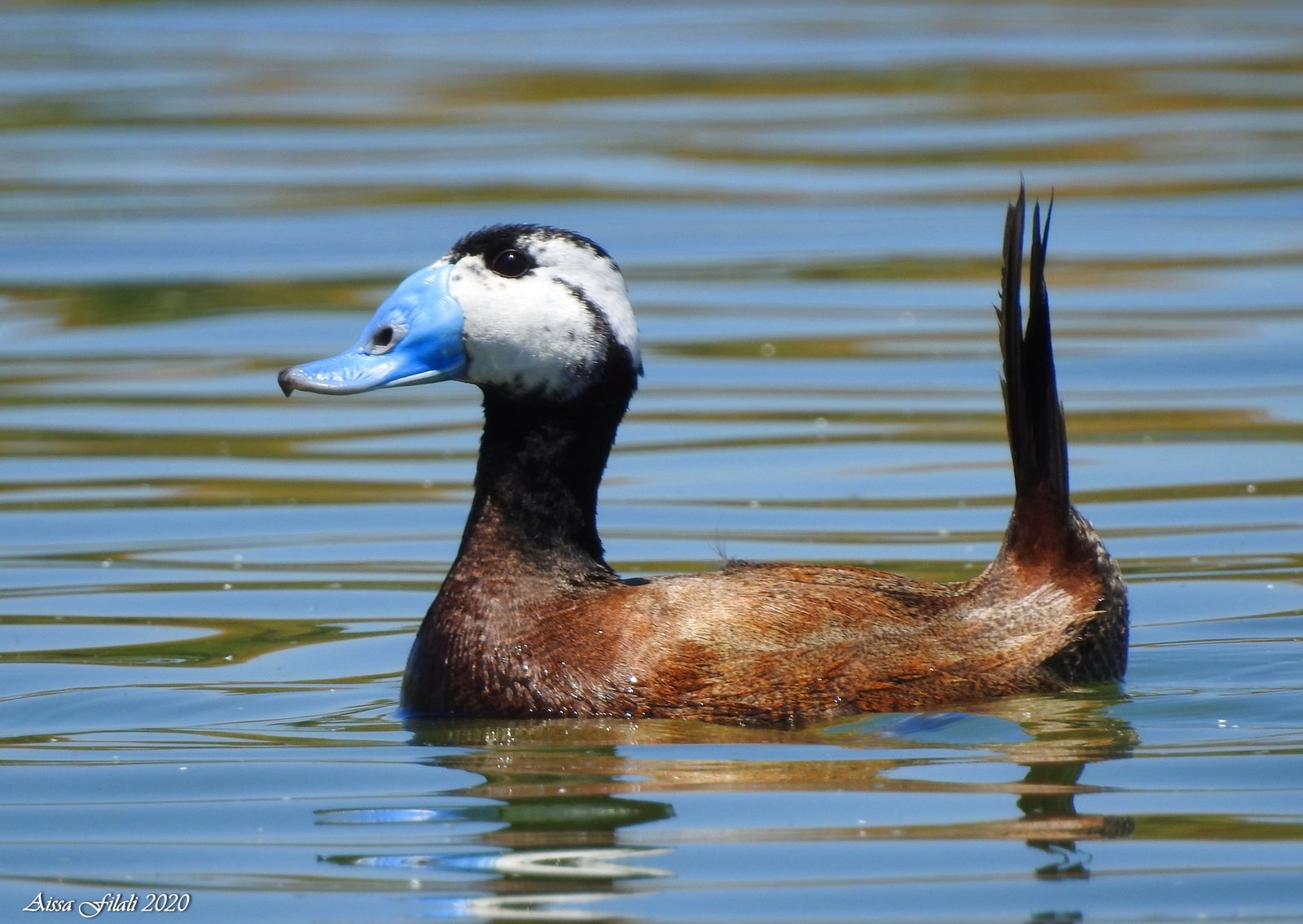
A stocky stiff-tailed duck with a heavy, swollen-based blue bill and a stiff tail often cocked upwards. The male has a white head with a black cap. The lakes of northern Algeria, Tunisia and Morocco, together with Spain, are the last strongholds of the western population.
Voice
Almost silent outside display. Displaying males tap the bill against the inflated neck and give a low, rolling prrrt that hardly carries; females give a short, hoarse kek when disturbed.
Recording: Geoffrey Monchaux — CC BY-NC-SA 4.0 · converted to mono · xeno-canto
Identification
43–48 cm, small and compact, with a thick neck, a large head and a pointed tail of stiff feathers. The male has a white head with a black crown that does not reach the eye, a narrow black neck ring and a sky-blue bill with a strongly swollen base; the body is warm rufous-brown with a finely speckled back. In winter the bill turns grey-blue, but the shape remains. Females and juveniles are dark brown with a dark crown, a pale cheek and a single dark stripe across it; they too show the swollen bill base. It sits low in the water, dives a lot and rarely flies.
Confusion species
Ruddy Duck (Oxyura jamaicensis), feral in Europe from captive stock and occasionally seen in Morocco, is the main pitfall. In the male the black of the crown extends below the eye, leaving only a white cheek; the bill base is much less swollen and the undertail white. Hybrids are intermediate. In females the cheek stripe of Ruddy Duck is narrower and sharper, but bill profile remains the best feature. Female Ferruginous Duck (Aythya nyroca) and Common Pochard (Aythya ferina) lack the stiff tail and cheek stripe.
Habitat
Permanent, fairly deep lakes, reservoirs and lagoons with fresh to brackish water and a broad fringe of reed and reedmace. It dives in open water for midge larvae, small crustaceans and the seeds of aquatic plants. In winter it uses larger open waters, including slightly saline lakes and reservoirs. Shallow pools that dry out in summer are unsuitable.
Where the bird is most at home, classified by the habitats of North Africa and the Middle East.


Range and movements
In the Maghreb it breeds in small numbers in northern Morocco, on the lakes of north-east Algeria around El Kala and on the high plateaux, and in northern Tunisia; numbers rise in winter, when hundreds gather on a few Tunisian and Algerian reservoirs and lakes. In Libya and Egypt, where large numbers once wintered on the Nile Delta lakes, it is now rare. In the east of the region a scarce winter visitor to Syria, Iraq and Israel, with isolated records in Saudi Arabia. Beyond the region an eastern population breeds from Turkey and southern Russia to Kazakhstan and western Mongolia, wintering mainly in Turkey, Greece and Pakistan; a second western stronghold is in Spain.
- Resident
- Summer visitor (c. Oct–Mar)
- Winter visitor (c. Apr–Sep)
- Passage (Mar–Apr, Oct–Nov)
- dark = core range, pale = thinly spread
How and when to look
In Tunisia and north-east Algeria the winter months are best, when groups gather on reservoirs; scan the open centre of the water with a telescope for small dark ducks with cocked tails that stay under for a long time. Note the cheek and bill shape of every male, as hybrids with Ruddy Duck are a concern here too.
Conservation status
Endangered (EN). The world population declined steeply in the twentieth century through drainage, hunting and drowning in fishing nets, and in North Africa mainly through the loss and salinisation of lakes. The Egyptian wintering population has largely vanished. Protecting the Algerian and Tunisian waters and preventing hybridisation with Ruddy Duck are the main tasks.
Scientific name
Oxyura leucocephala | (Scopoli, 1769)
Scopoli described the species in 1769 as Anas leucocephala; because it was later moved to another genus, the author and year stand in brackets. The genus Oxyura was introduced in 1828 by Bonaparte. Oxyura is Greek, from oxys 'sharp' and oura 'tail', after the stiff tail feathers the bird can hold upright. leucocephala is Greek, from leukos 'white' and kephalē 'head', for the white head of the male. The specimen the first description was based on came from northern Italy.