All species › Waterfowl › Ducks, geese and swans › Whooper Swan
Whooper Swan | Cygnus cygnus
Wilde zwaan | Cisne cantor
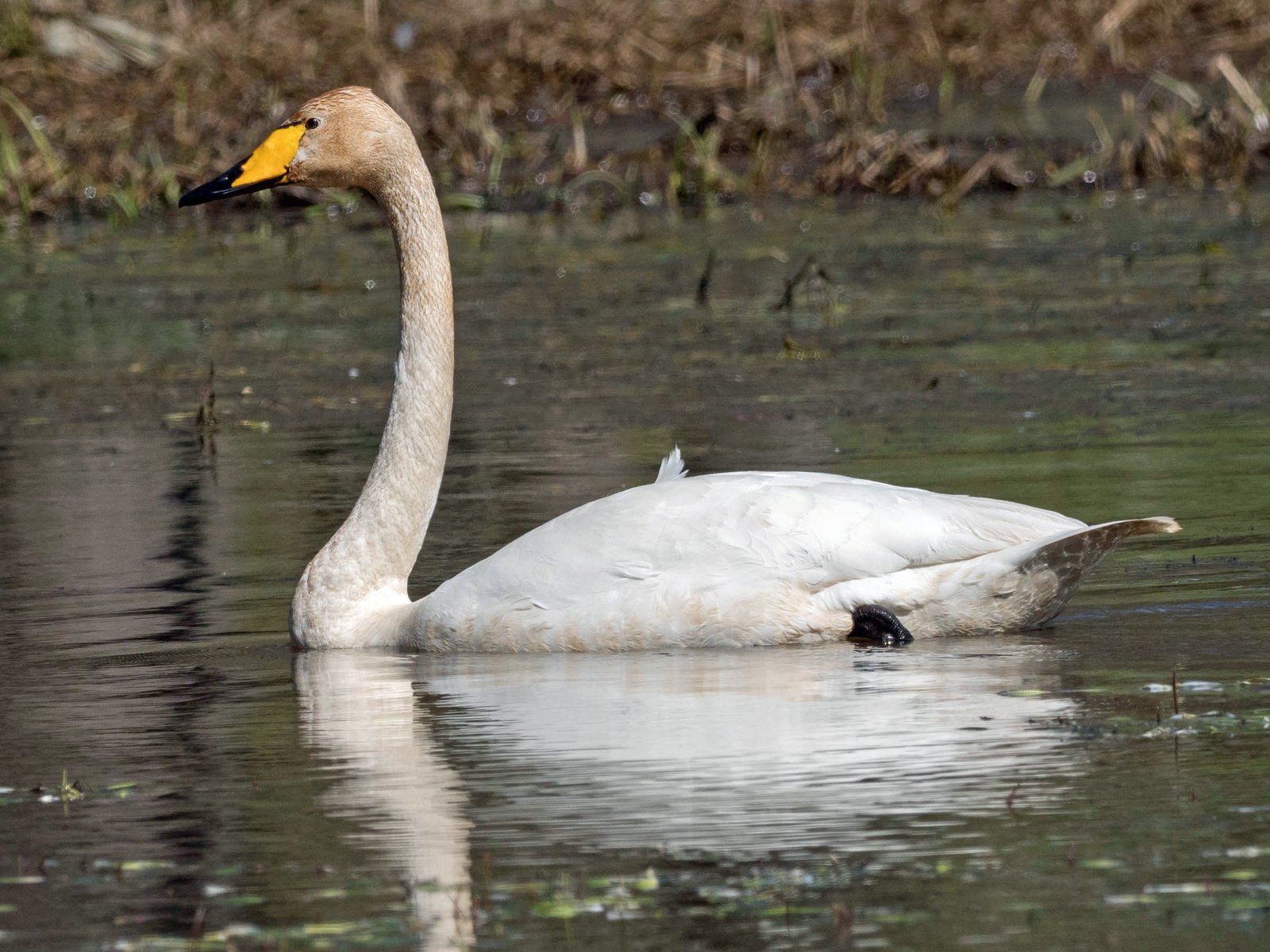
A large, upright-swimming swan with a wedge of lemon yellow on its black bill and a trumpeting call. It breeds in the taiga of northern Europe and Siberia; in the region it occurs only in winter on the north-eastern edge, and even there rarely.
Voice
Loud and trumpeting, often in threes: a bugling whoop-whoop-whoop or kloo-kloo-kloo with a metallic ring that carries far, mainly in flight and on landing.
Recording: Stanislas Wroza — CC BY-NC-SA 4.0 · shortened to the first 60 s, mono · xeno-canto
Identification
140–165 cm, as big as Mute Swan but with a straight, stiffly held neck and a flat, angular head profile. The bill is black with an extensive lemon-yellow base that runs forward in a sharp wedge past the nostril. First-winters are grey-brown with a dull pink bill base that turns yellow during the winter. In flight long-necked and heavy-bodied, without the throbbing wing noise of Mute Swan.
Confusion species
Bewick’s Swan (Cygnus columbianus) is smaller, shorter-necked and rounder-headed, with a smaller, rounded yellow bill patch that does not reach forward in a point past the nostril. Mute Swan (Cygnus olor) has an orange bill with a black knob, an S-curved neck and a cocked tail.
Habitat
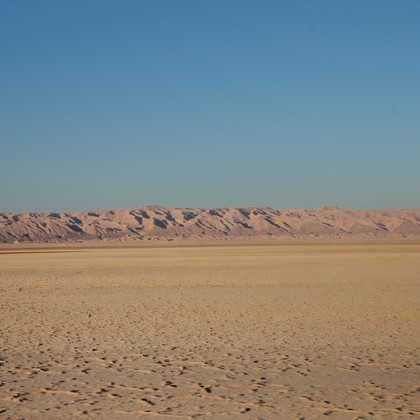
In winter on large lakes, river deltas and marshes, feeding on wet grassland and winter cereal fields; roosts on open water. It upends in shallow water for aquatic plants.
Where the bird is most at home, classified by the habitats of North Africa and the Middle East.


Range and movements
Within the region a rare winter visitor to Iraq, especially in the north and the Mesopotamian marshes, and to Syria. Elsewhere a vagrant, with records in Israel, Egypt, Morocco, Saudi Arabia, Oman and the United Arab Emirates. Beyond the region it breeds in Iceland and from Scandinavia through the taiga to eastern Siberia, wintering in north-west Europe, around the Black Sea and the Caspian, and in East Asia.
- Winter visitor (c. Oct–Mar)
- dark = core range, pale = thinly spread
How and when to look
The best chances come with harsh winters, when birds from the Caspian and Turkey move south; then search the large lakes of northern Iraq and Syria. Listen for the trumpeting call in flight, and with a lone bird check the shape of the yellow on the bill to rule out Bewick’s Swan.
Conservation status
Not threatened; stable or increasing in Europe and Asia. In the region a rare winter visitor in small numbers on the north-eastern edge and a vagrant elsewhere; lead poisoning, hunting and the drying out of marshes in Iraq are threats.
Scientific name
Cygnus cygnus | (Linnaeus, 1758)
Linnaeus described the species in 1758 as Anas Cygnus; because it was later moved to another genus, the author and year stand in brackets. The genus Cygnus was introduced in 1764 by De Garsault. Cygnus is Latin for 'swan', a variant of cycnus and borrowed from Greek kyknos with the same meaning. The specific name repeats the genus name; the whooper swan is the type species of Cygnus. The specimen the first description was based on came from Sweden.