All species › Passerines › Sylvia warblers › Eastern Orphean Warbler
Eastern Orphean Warbler | Curruca crassirostris
Oostelijke orpheusgrasmus | Curruca mirlona oriental
The Eastern Orphean Warbler is the largest and heaviest warbler of the Levant, with a thick bill, a black hood and a pale eye. It breeds in open woodland and orchards from Israel to Iraq and migrates through Arabia and Egypt to north-east Africa; its long, flowing song is a familiar sound of spring in the hills of the Levant.

Voice
The song is longer and more varied than that of the western species: a flowing stream of clear, fluty, thrush-like motifs interspersed with scratchy passages, sometimes for minutes on end. The call is a hard chek, a rattling series when alarmed.
Recording: Stanislas Wroza — CC BY-NC-SA 4.0 · shortened to the first 60 s, mono · xeno-canto
Identification
15–16 cm. Large, with a long, thick, pointed bill and a long tail with bright white outer tail feathers. The male has a black hood extending well below the eye, sharply demarcated from a white throat and a grey mantle; the iris is white to pale yellow in older birds. Underparts white, with a faint grey or buffy tinge on the flanks. Females have a greyer hood with less contrast; juveniles are grey-brown, with a dark eye and little contrast.
Confusion species
Western Orphean Warbler (Curruca hortensis) occurs in the region only in the Maghreb; it has a greyer hood, a creamy to pink-tinged breast and a shorter, simpler song. Arabian Warbler (Curruca leucomelaena) has a dark eye, short, rounded wings without primary projection, a duller hood and a longer tail that it waves. Barred Warbler (Curruca nisoria) has no dark hood. Sardinian Warbler (Curruca melanocephala) and Rüppell's Warbler (Curruca ruppeli) are much smaller; the male of the latter has a black throat with a white moustache.
Habitat
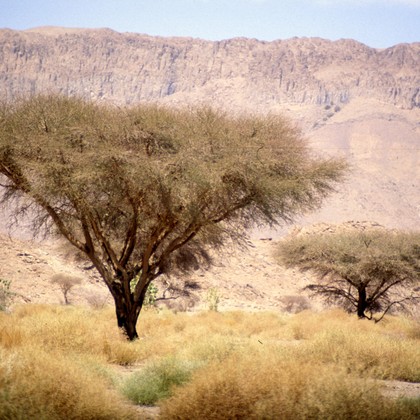
Open, dry woodland and scrub with scattered trees: light oak and pistachio woodland in the hills, juniper and acacia scrub, olive groves and fruit orchards and bushy mountain slopes, in Lebanon up to about 2000 m. On passage in any scrub with trees, in oases, gardens and acacia wadis. Eats insects and in late summer berries.
Where the bird is most at home, classified by the habitats of North Africa and the Middle East.


Range and movements
Summer visitor, from April to September, in Israel (Galilee, the Golan, Mount Carmel, the hills of Samaria and Judea and locally in the Negev highlands), Jordan (the western highlands), Lebanon, Syria and northern Iraq (Kurdistan). On passage, in March–April and September–October, through Egypt (especially Sinai and the Red Sea coast), Saudi Arabia (fairly common in the west, scarce on the Gulf), Kuwait, the Gulf states, Yemen and Oman; a few birds winter in the UAE and Oman. Almost unknown in the Maghreb. Most winter in north-east Africa (Sudan, Eritrea, Ethiopia), the eastern form jerdoni in India. Beyond the region it breeds from the Balkans and Turkey through the Caucasus and Iran to Central Asia and Pakistan.
- Summer visitor (c. Oct–Mar)
- Winter visitor (c. Apr–Sep)
- Passage (Mar–Apr, Oct–Nov)
- dark = core range, pale = thinly spread
How and when to look
In April and May in the open oak woodland of the Golan, Mount Carmel or Galilee, or in the olive groves of northern Jordan near Ajloun; listen for the long, fluty song from a treetop. On passage at Eilat and in the acacia wadis of Sinai, and in Saudi Arabia mainly in March and April along the west coast.
Conservation status
Not globally threatened. Locally declined in the Levant through the loss of open woodland and traditional orchards, agricultural intensification and building; on migration also a victim of trapping. Western and Eastern Orphean Warblers are now widely treated as separate species.
Scientific name
Curruca crassirostris | (Cretzschmar, 1830) (GBIF: Sylvia crassirostris)
Cretzschmar described the species in 1830 as Sylvia crassirostris; because it was later moved to another genus, the author and year stand in brackets. The genus Curruca was introduced in 1802 by Bechstein. Curruca is Latin, the name of an unidentified small bird mentioned by the Roman poet Juvenal. crassirostris is Latin, from crassus 'thick' and rostrum 'bill': thick-billed. The specimen the first description was based on came from Nubia.