All species › Passerines › Sylvia warblers › Lesser Whitethroat
Lesser Whitethroat | Curruca curruca
Braamsluiper | Curruca zarcerilla
The Lesser Whitethroat is a small grey warbler with a dark ear-mask and one of the most numerous passage migrants of the Middle East. Many birds winter in Arabia, and it breeds in the mountains of the Levant. The series of pale forms from Central Asia makes it a tricky species in winter, even for the advanced birder.

Voice
The song consists of a soft, muttering warble followed by a dry rattle on one pitch, tel-tel-tel-tel-tel; migrants sing regularly in spring. The call is a hard tek, and when alarmed also a soft, rasping cherrr.
Recording: David Darrell-Lambert — CC BY-NC-SA 4.0 · converted to mono · xeno-canto
Identification
12.5–13.5 cm. Compact and rather short-tailed, with grey-brown upperparts lacking a rufous wing panel, a grey crown, a dark grey-black ear-mask contrasting with a bright white throat, and white underparts with a creamy wash on the flanks. Outer tail feathers white; legs dark slate-grey. Sexes alike. The eastern forms that winter in Arabia, such as halimodendri, are paler and sandier grey, with a less sharply defined mask and more white in the tail; the even paler Desert Whitethroat (minula) is smaller, with a fine bill.
Confusion species
Greater Whitethroat (Curruca communis) is larger and longer-tailed, with a rufous wing panel and pale legs. Asian Desert Warbler (Curruca nana) is sandy with a yellow iris and a rufous tail. Hume's Whitethroat (Curruca althaea), a rare migrant and winter visitor in eastern Arabia, is darker grey, with a dark crown barely contrasting with the mask, and a heavier bill. The female Ménétriés's Warbler (Curruca mystacea) has a pale eye-ring, pale legs and no dark mask.
Habitat
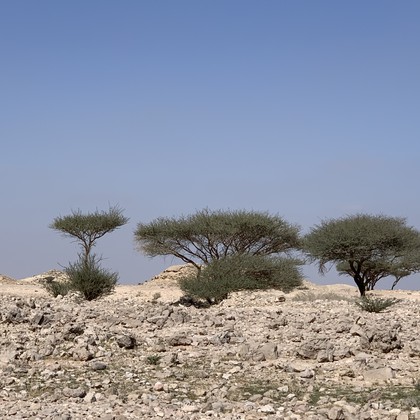
Breeds in dense scrub on mountain slopes, in the Levant mainly above about 1000 m: scrub oak, juniper, wild almond and thorn scrub. On passage and in winter in any scrub with some cover: acacias and tamarisk in wadis, thorn scrub of the Arabian plains, oases, gardens and parks, and even roadside plantings in the Gulf states.
Where the bird is most at home, classified by the habitats of North Africa and the Middle East.


Range and movements
Breeds in Lebanon (Mount Lebanon and Anti-Lebanon), on Mount Hermon, in western Syria and in the mountains of Kurdistan in northern Iraq. Passage migrant throughout the region, common in the east: Egypt (especially Sinai and the Nile Valley), Israel, Jordan, Syria, Iraq, Saudi Arabia and the Gulf states; scarcer in Libya and the Maghreb and mainly in spring. Winters in Saudi Arabia, Yemen, Oman, the UAE, Qatar and Bahrain, and in small numbers in south-east Egypt; in the UAE the pale Central Asian form halimodendri is the commonest winter visitor. Beyond the region it breeds from England and France across Europe and Siberia to Mongolia, and winters in north-east Africa (Sudan, Chad, Ethiopia) and South Asia.
- Resident
- Summer visitor (c. Apr–Sep)
- Winter visitor (c. Oct–Mar)
- Passage (Mar–Apr, Oct–Nov)
- dark = core range, pale = thinly spread
How and when to look
In March and April at Eilat or in Sinai, where dozens may sit in the bushes at once; in winter in the parks and golf courses of Dubai and Abu Dhabi or the gardens of Muscat. In spring listen for the rattling song, and in wintering birds note the colour of the upperparts and the sharpness of the mask.
Conservation status
Not globally threatened. The taxonomy of the complex is in flux: Hume's Whitethroat (Curruca althaea) is treated as a separate species by some lists and in this guide, and the status of the Central Asian forms (halimodendri, minula) is still the subject of genetic research. Whether Desert Whitethroat (minula) actually winters in Arabia is uncertain.
Scientific name
Curruca curruca | (Linnaeus, 1758) (GBIF: Sylvia curruca)
Linnaeus described the species in 1758 as Motacilla Curruca; because it was later moved to another genus, the author and year stand in brackets. The genus Curruca was introduced in 1802 by Bechstein. Curruca is Latin, the name of an unidentified small bird mentioned by the Roman poet Juvenal. The specific name repeats the genus name. The specimen the first description was based on came from Sweden.