All species › Birds of prey › Hawks, eagles and kites › Egyptian Vulture
Egyptian Vulture | Neophron percnopterus
Aasgier | Alimoche común
The Egyptian Vulture is the smallest vulture of the region, white with black flight feathers and a bare yellow face. In ancient Egypt it was so common that it served as the hieroglyph for a sound of the alphabet. On Socotra and in Oman it still lives in dense resident populations, while migrants from Europe and Turkey travel to the Sahel via Gibraltar, Sinai and Bab-el-Mandeb.

Voice
Almost always silent. At the nest and at carcasses hoarse grunts, hisses and a soft, mewing meow; young beg with a repeated chee-chee.
Recording: Mischa Keijmel — CC BY-NC-SA 4.0 · converted to mono · xeno-canto
Identification
55–65 cm, wingspan 146–175 cm. A slim, dirty-white vulture with black flight feathers: from below in flight white with a wholly black trailing edge to the wing and a white, sharply wedge-shaped tail. Head and throat bare and yellow to orange-yellow, with a shaggy, pointed mane of white neck feathers; slender bill with a blackish tip. Walks on the ground with a slightly rolling gait. The juvenile is dark chocolate-brown with a grey face and becomes gradually paler and blotchy over four to five years. Birds that bathe in red soil are rust-tinged.
Confusion species
The white adult high in the sky resembles a White Stork (Ciconia ciconia), which however holds neck and legs outstretched and lacks a wedge tail. Young birds resemble Black Kite (Milvus migrans), which has a forked or square tail, never a wedge, and a young Bearded Vulture (Gypaetus barbatus), which is much larger with a long, narrow tail. A distant Cinereous Vulture (Aegypius monachus) has much broader wings and a short tail. In southern Arabia and the Sahel Hooded Vulture (Necrosyrtes monachus) may turn up: dark brown with a pink face and a short, rounded tail.
Habitat
Breeds on ledges and in holes in cliffs, gorges and wadis, in Arabia also on tall buildings, masts and in trees. Forages over steppe, semi-desert and mountains with livestock and is numerous at rubbish dumps, slaughterhouses, fishing harbours and villages; on Socotra and in Oman it walks between the houses. Eats carrion, refuse, dung, eggs and small animals, and breaks large eggs with a stone.
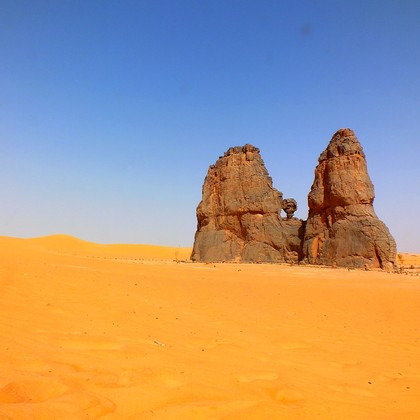
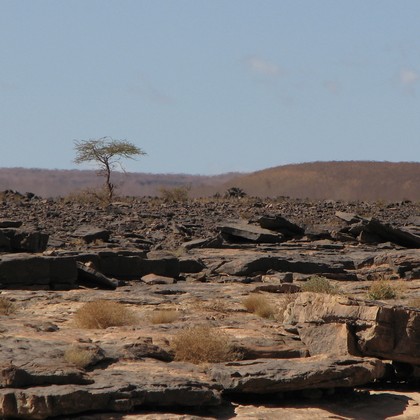
Where the bird is most at home, classified by the habitats of North Africa and the Middle East.

Range and movements
Breeds in Morocco (mainly in the Atlas and the north, much reduced), scarce in Algeria and Tunisia, in Egypt along the Nile, in the Eastern Desert and in Sinai, and in small numbers in Israel, Jordan, Syria and Lebanon. In Arabia widespread in the mountains of the west and south, in Oman (including Masirah) and in the Hajar mountains of the Emirates, with the highest density in the world on Socotra. Migrants pass in large numbers at Gibraltar and Jbel Moussa, over Sinai and Eilat and at Bab-el-Mandeb. Beyond the region from Iberia and the Balkans to Central Asia and India, and in the Sahel and East Africa.
- Resident
- Summer visitor (c. Apr–Sep)
- Winter visitor (c. Oct–Mar)
- Passage (Mar–Apr, Oct–Nov)
- dark = core range, pale = thinly spread
How and when to look
On Socotra and in Oman it is impossible to miss at any rubbish dump or fishing harbour. Migrants are best seen in March and in September – October over Jbel Moussa on the Strait of Gibraltar and in spring at Eilat, often among Black Kites and Griffon Vultures.
Conservation status
Endangered. Within a few decades the species has declined sharply in Europe, North Africa and the Levant through poisoned bait, veterinary drugs in carcasses, electrocution on power poles, collisions with wind turbines and shooting along the flyways. The resident populations of Socotra and Oman are among the most important in the whole range.
Scientific name
Neophron percnopterus | (Linnaeus, 1758)
Linnaeus described the species in 1758 as Vultur Perenopterus; because it was later moved to another genus, the author and year stand in brackets. The genus Neophron was introduced in 1809 by De Savigny. Neophron is taken from Greek mythology: Neophron was turned into a vulture by Zeus. percnopterus is Greek, from perknos 'blue-black' and pteron 'wing': 'black-winged', after the black flight feathers in the otherwise white wing. The specimen the first description was based on came from Egypt.