All species › Pelicans, herons and ibises › Herons and bitterns › Eurasian Bittern
Eurasian Bittern | Botaurus stellaris
Roerdomp | Avetoro común
A large, stocky brown heron of dense reedbeds, famous for the male's deep, far-carrying boom. In the region it is mainly a scarce winter visitor and passage migrant; as a breeder it is restricted to a few marshes in the Maghreb and the marshes of southern Iraq.
Voice
In spring, mainly at dusk, the male gives a deep booming call audible for kilometres, u-hoomp, like blowing across a bottle. In flight a hoarse, crow-like kau or krow.
Recording: Stanley Baldauf — CC BY-NC-SA 4.0 · converted to mono · xeno-canto
Identification
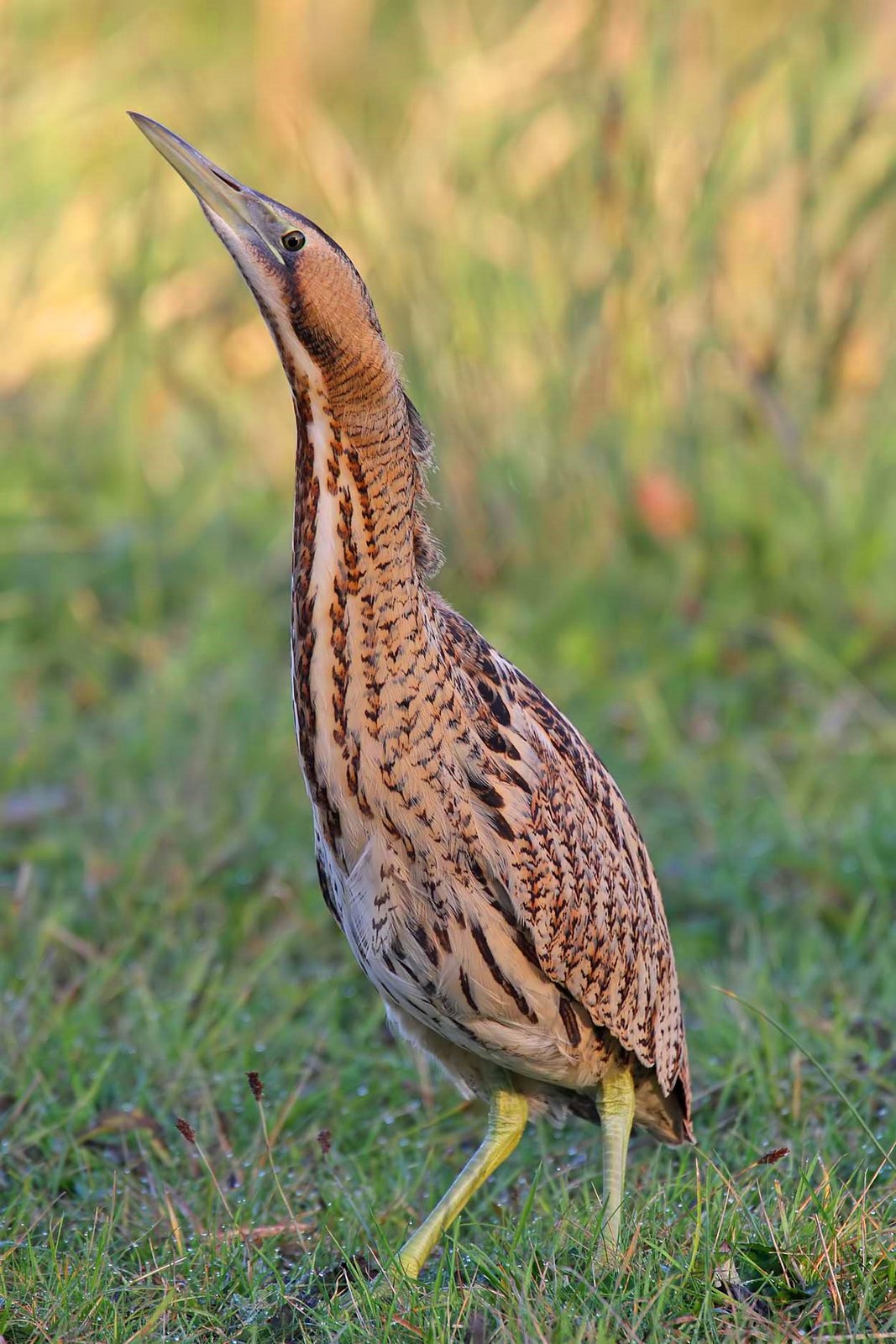
Stocky, with a thick neck and short legs; golden brown throughout with fine black spots, streaks and barring. Black crown and a black moustache beside the whitish throat; the dagger-shaped bill and the legs are greenish yellow. When alarmed it adopts the bittern posture, bill pointing skywards, swaying with the reeds. Owl-like in flight, with broad, rounded wings whose flight feathers are more darkly barred than the coverts; head drawn in and legs trailing.
Confusion species
Juvenile Black-crowned Night-Heron (Nycticorax nycticorax) is smaller and greyer brown, with white drop-shaped spots on the upperparts and an orange eye, and lacks the black crown and moustache. Juvenile Purple Heron (Ardea purpurea) is also brown but far slimmer, with a long thin neck and bill. Little Bittern (Botaurus minutus) is much smaller and has a pale wing patch.
Habitat
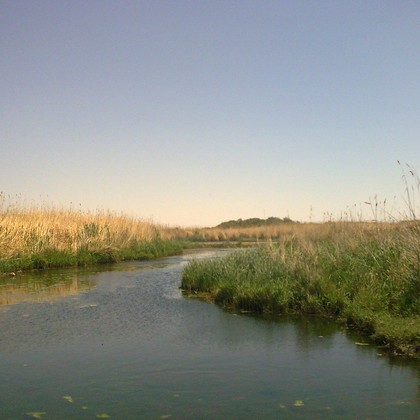
Extensive, mature reedbeds and bulrush marshes with shallow, preferably fresh water; outside the breeding season also narrow reed fringes along canals, fishponds, sewage ponds and irrigation ditches. It lives hidden and hunts stealthily along the reed edge for fish, frogs and invertebrates.
Where the bird is most at home, classified by the habitats of North Africa and the Middle East.

Range and movements
A rare and local breeder: a few pairs in the marshes of north-east Algeria (Lac Tonga and the El Kala area), in northern Tunisia (Ichkeul) and possibly still in northern Morocco, and in southern Iraq in the restored Mesopotamian marshes. In Israel it formerly bred in the Hula Valley; it is now a fairly regular winter visitor there to the fishponds of the Hula and Beit She'an valleys. Otherwise scarce from November to March in the Maghreb, the Nile Delta and Libya, and rare to scarce on passage and in winter in Jordan, Lebanon, Syria, Kuwait, Saudi Arabia, Qatar, the Emirates and Oman. Beyond the region it breeds from western Europe to Japan, with a separate population in southern Africa; northern birds winter in southern Europe, Africa and South Asia.
- Resident
- Winter visitor (c. Apr–Sep)
- Passage (Mar–Apr, Oct–Nov)
- dark = core range, pale = thinly spread
How and when to look
The fishponds and reedbeds of the Hula Valley (Agamon Hula) offer the best chance in winter: search the reed edges at first and last light, especially in cold weather or at low water. In Tunisia, Ichkeul is the place to listen for booming males in spring. In the Emirates it turns up fairly regularly in winter in reed fringes at sewage ponds.
Conservation status
Not globally threatened. In North Africa the small breeding population is vulnerable to drainage, reed burning, grazing and water abstraction; the restoration of the Iraqi marshes after 2003 has returned breeding habitat, although these depend on an erratic water supply.
Scientific name
Botaurus stellaris | (Linnaeus, 1758)
Linnaeus described the species in 1758 as Ardea stellaris; because it was later moved to another genus, the author and year stand in brackets. The genus Botaurus was introduced in 1819 by Stephens. Botaurus is Medieval Latin for a bittern; the word combines Latin bos 'ox' with taurus 'bull', after the booming call (compare butire 'to boom'). stellaris is Latin for 'starred', from stella 'star', referring to the speckled plumage. The specimen the first description was based on came from Sweden.