All species › Waders, gulls and terns › Plovers and lapwings › Eurasian Dotterel
Eurasian Dotterel | Eudromias morinellus
Morinelplevier | Chorlito carambolo
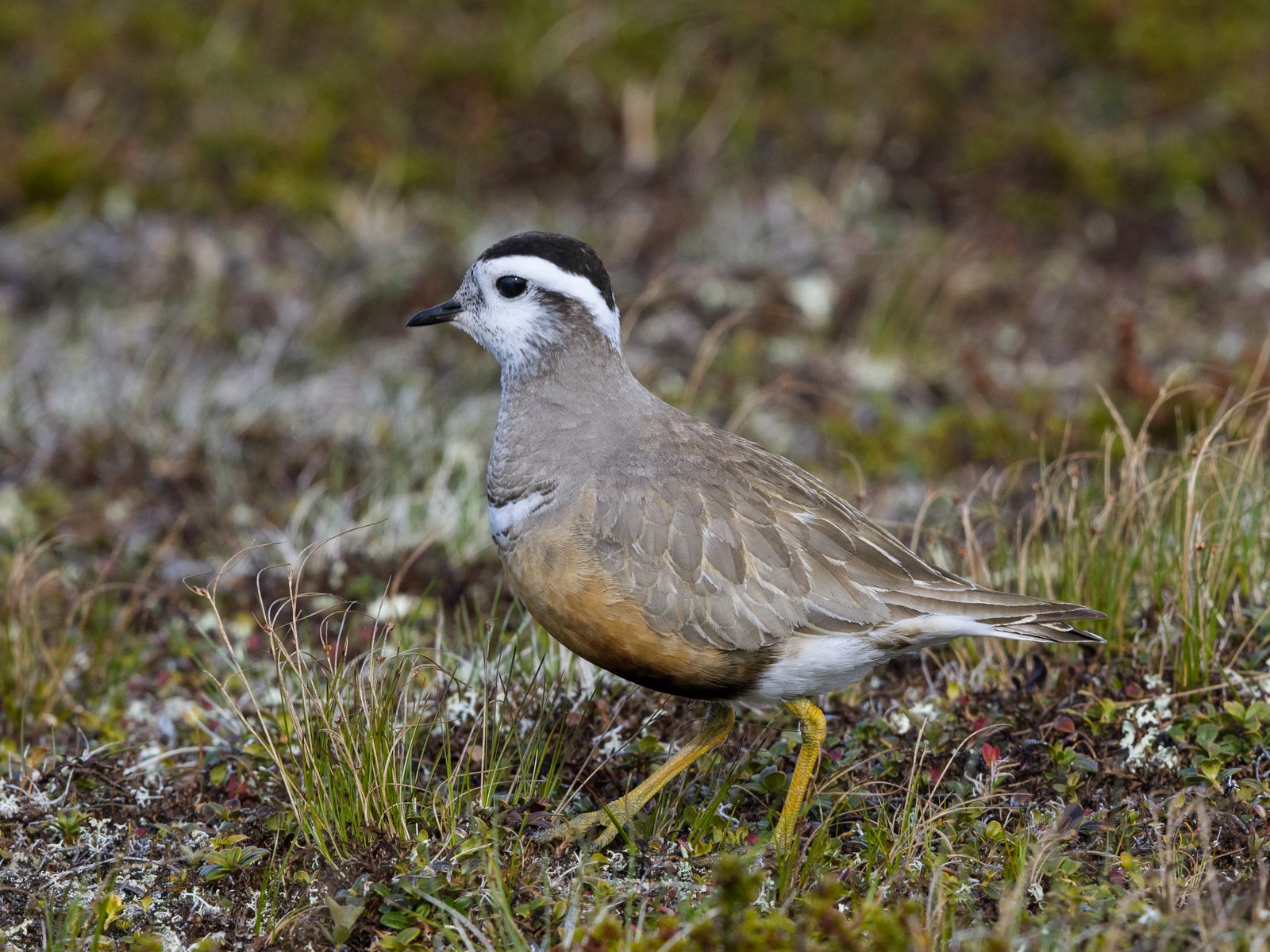
A tame, compact plover of the tundra and bare mountain tops that winters on the steppes and semi-deserts of North Africa and the Middle East. A large part of the world population spends the winter in the belt from Morocco to Iraq and Iran, in small, inconspicuous groups on bare plains.
Voice
In flight a soft, rolling pyurrr or kirrr; also a soft, whistled pweet. Winter flocks are often silent.
Recording: Hans van Loon — CC BY-NC-SA 4.0 · converted to mono · xeno-canto
Identification
Smaller and rounder than European Golden-Plover, with a short black bill and yellowish legs. The best feature in every plumage: broad pale supercilia meeting on the nape in a V, and a narrow pale band across the breast. Winter plumage: grey-brown to buff, with brown-scaled upperparts, a faint breast band and creamy supercilia. Breeding plumage (already visible on migrants in March and April; female brighter than male): grey breast, white breast band, chestnut flanks and a black belly patch. Rather plain in flight, without a wing bar; only the shaft of the outer primary is white.
Confusion species
European Golden-Plover (Pluvialis apricaria) is larger and gold-spangled, without the V-shaped supercilia and breast band. Caspian Plover (Anarhynchus asiaticus) is slimmer and longer-legged, with a brown breast lacking a pale band and a shorter supercilium; mainly a migrant in the east. Greater Sand-Plover (Anarhynchus leschenaultii) is greyer, with a heavier bill and white throat, and lives on coasts.
Habitat
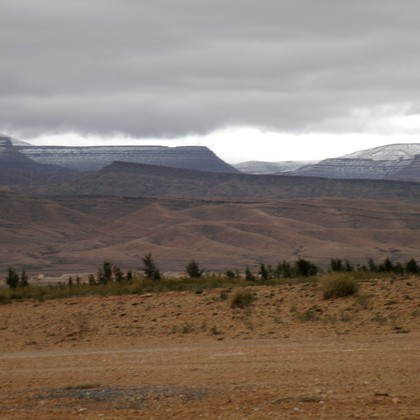
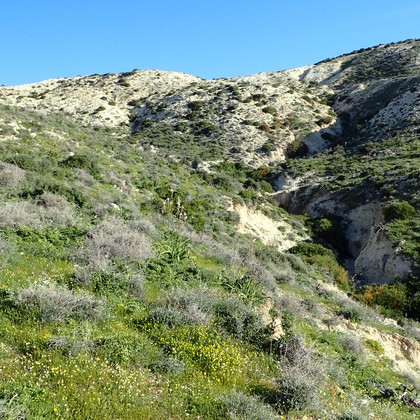
Bare steppe, semi-desert with low, open vegetation, stony plains, ploughed fields and fallow, bare high plateaus and the edges of dry chotts. Flocks rest pressed to the ground and are surprisingly well camouflaged; they often allow a close approach.
Where the bird is most at home, classified by the habitats of North Africa and the Middle East.

Range and movements
Winter visitor to the high plateaus and steppes of Morocco (mainly eastern Morocco, including around Missour and Boulemane, and the plains at the foot of the Atlas), Algeria (the high plateaus and northern Sahara), Tunisia (central and southern steppes) and scarce in northern Libya and northern Egypt. Commoner in the east: in Israel (northern Negev and the Golan), Jordan, Syria and northern Iraq; scarce in northern Saudi Arabia and Kuwait, rare in the Gulf states and Oman. On passage also in Lebanon and along the edge of the Sahara. Breeds in Scotland, Scandinavia, the Alps and other European mountains, and on the tundra from northern Russia to eastern Siberia.
- Winter visitor (c. Apr–Sep)
- Passage (Mar–Apr, Oct–Nov)
- dark = core range, pale = thinly spread
How and when to look
In the northern Negev, including Nizzana and the fields around Be'er Sheva, flocks of tens to hundreds winter; search bare, freshly ploughed fields and stony plains from November to February. In Morocco on the stony plateaus around Missour. Drive slowly and scan the ground: the birds crouch and flush late.
Conservation status
Not globally threatened; the European breeding population is declining, partly through climate change and changing land use in the mountains. In the region ploughing of steppe, overgrazing and hunting threaten the wintering areas.
Scientific name
Eudromias morinellus | (Linnaeus, 1758) (GBIF: Charadrius morinellus)
Linnaeus described the species in 1758 as Charadrius Morinellus; because it was later moved to another genus, the author and year stand in brackets. The genus Eudromias was introduced in 1830 by Brehm. Eudromias is Greek for 'good runner', from eu 'good' and dromas 'runner'. morinellus is a diminutive formed on Greek mōros 'foolish', after the bird's tameness. The specimen the first description was based on came from Sweden.