All species › Falcons › Falcons › Eurasian Hobby
Eurasian Hobby | Falco subbuteo
Boomvalk | Alcotán europeo
The Eurasian Hobby is a slender, fast falcon with long, scythe-shaped wings that catches dragonflies and swallows in full flight. In the north of the Maghreb and in the Levant it is a scarce summer visitor to woodland and orchards, and in spring and autumn it migrates across the whole region, from the Sahara to Arabia.

Voice
At the nest a clear, rapid kew-kew-kew-kew or kee-kee-kee, faster and more musical than Common Kestrel. Usually silent on passage.
Recording: Lars Edenius — CC BY-NC-SA 4.0 · converted to mono · xeno-canto
Identification
29–35 cm, wingspan 70–84 cm. Slim, with long, pointed, scythe-shaped wings and a fairly short tail; in flight it recalls a large swift. The adult is dark slate-grey above, with a black cap, a sharp, broad black moustache against a white throat and cheek, and white underparts heavily streaked black; the thighs and undertail coverts are rufous. The juvenile is browner above with pale fringes, with creamy, streaked underparts and no rufous thighs. Flight is fast and agile, with short bursts of stiff beats and glides; it catches insects with its feet and eats them on the wing.
Confusion species
Eleonora's Falcon (Falco eleonorae) is larger and longer-tailed, with rufous underparts and dark underwing coverts. Peregrine Falcon (Falco peregrinus) is bulkier, broader at the wing base and barred rather than streaked below. A young hobby resembles a young Red-footed Falcon (Falco vespertinus), but that has a paler crown and a smaller mask. Merlin (Falco columbarius) is smaller and shorter-winged and absent in summer.
Habitat
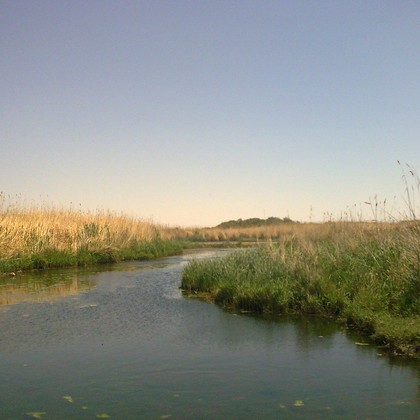
Breeds in open woodland, woodland edges, cork and holm oak forest, poplars and olive groves near open country, often near water. Lays in an old crow's or magpie's nest. Hunts over marshes, rivers, fields and villages for dragonflies and other large insects, and swallows, swifts and other small birds. On passage in any landscape, including over oases and desert.
Where the bird is most at home, classified by the habitats of North Africa and the Middle East.


Range and movements
Scarce summer visitor and breeder in northern Morocco (Rif, Middle and High Atlas, the cork oak forests of the Maâmora), in northern Algeria and northern Tunisia and possibly in the Jebel Akhdar of Libya. In the Levant a scarce breeder in northern Israel, Lebanon and Syria and possibly northern Iraq. Otherwise a common passage migrant throughout the region, from the Sahara and the Nile valley to the Levant, Iraq and all of Arabia, mainly in April–May and September–October. Beyond the region from Europe and north-west Africa across Asia to Kamchatka and Japan; winters in Africa south of the Sahara and in South Asia.
- Summer visitor (c. Oct–Mar)
- Passage (Mar–Apr, Oct–Nov)
- dark = core range, pale = thinly spread
How and when to look
In May and June at marshes and ponds in the Middle Atlas or in the Maâmora, where it hunts dragonflies over the water. On passage a good chance at Eilat, at Saharan oases and along the Nile in the early evening, when it hunts swallows and insects gathering over the water.
Conservation status
Not threatened, with a large, stable world population. In the region local loss of woodland and orchards, insecticides that reduce its prey, and shooting and trapping on migration play a role.
Scientific name
Falco subbuteo | Linnaeus, 1758
Linnaeus described the species in 1758 and placed it straight away in the genus where it still stands. He introduced the genus Falco in that same work. Falco is Late Latin for 'falcon', from falx, falcis 'sickle', after the sickle-shaped claws of the bird. subbuteo is Latin sub 'below, less than' and buteo 'buzzard'. The specimen the first description was based on came from Sweden.