All species › Birds of prey › Hawks, eagles and kites › Eurasian Sparrowhawk
Eurasian Sparrowhawk | Accipiter nisus
Sperwer | Gavilán común
The Eurasian Sparrowhawk is a small, agile hawk that flies low and unexpectedly along hedges, woodland edges and gardens to surprise small birds. In the forests of the Atlas and northern Maghreb the North African race punicus breeds; in winter birds from Europe and Asia reach the oases of Egypt and Arabia.

Voice
Around the nest a rapid, sharp chattering kek-kek-kek-kek, mainly in spring; also a plaintive peeee-oo from female and fledged young. Outside the breeding season and in winter usually silent.
Recording: Teet Sirotkin — CC BY-SA 4.0 · converted to mono · xeno-canto
Identification
28–38 cm, wingspan 56–78 cm. Short, broad, rounded wings with five or six fingers, a long tail with four to five dark bars and a square tip, a small head and long, thin yellow legs. Flies with quick beats alternating with short glides. The male is small, slate-grey above, with rufous-orange cheeks, orange barring on the underparts and an orange-red eye. The female is much larger, brown-grey above, with a white supercilium, grey-brown barring below and a yellow eye. The juvenile is brown above with rufous fringes and has coarse, irregular brown barring or spotting on the breast.
Confusion species
Northern Goshawk (Astur gentilis) is much bulkier, with a deep chest, a protruding head, a bulging trailing edge to the wing and a tail with rounded corners; a large female Eurasian Sparrowhawk and a small male Northern Goshawk overlap in size. Levant Sparrowhawk (Tachyspiza brevipes) has a more pointed hand with four fingers, a straight trailing edge, a dark eye and, in the male, a white underwing with a black tip. Shikra (Tachyspiza badia) is paler, without a supercilium, with unbarred central tail feathers. Common Cuckoo (Cuculus canorus) is deceptively similar in flight, but has pointed wings and never soars.
Habitat
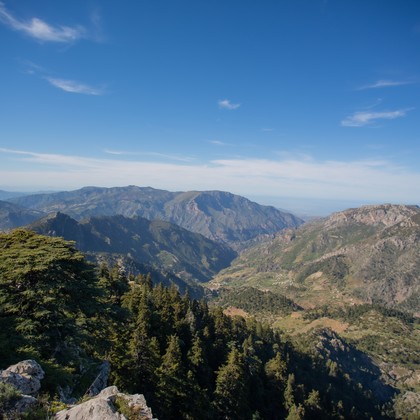
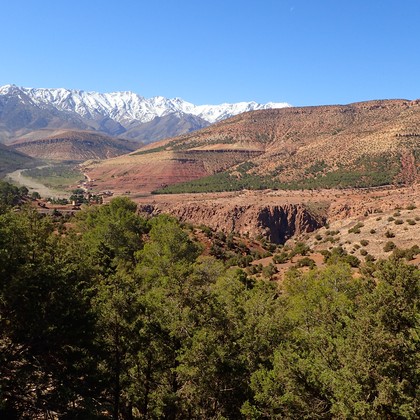
Breeds in forests of cedar, oak, cork oak, Aleppo pine and juniper in the mountains, also in planted woodland with dense conifers. In winter in all kinds of country with trees or bushes: olive groves, orchards, oases, date palm gardens, reedbeds, parks and gardens, also in towns. Hunts almost exclusively small birds, which it takes in a surprise attack from cover.
Where the bird is most at home, classified by the habitats of North Africa and the Middle East.

Range and movements
Breeds in northern Morocco (Rif, Middle and High Atlas, scarce in the Anti-Atlas), northern Algeria and Tunisia, and in small numbers in the Jebel Akhdar in northeast Libya. In the Middle East it breeds in the wooded mountains of Lebanon, Syria and northern Iraq. In winter and on passage widespread: fairly common in Israel, Jordan, the Nile valley and delta of Egypt and in Iraq, scarce in Libya and Arabia, with winter visitors in Kuwait, Saudi Arabia, the Emirates, Qatar, Bahrain and Oman south to northern Yemen. Beyond the region it breeds across almost all of Europe and in Asia to Japan; northern birds migrate south.
- Resident
- Summer visitor (c. Oct–Mar)
- Winter visitor (c. Apr–Sep)
- Passage (Mar–Apr, Oct–Nov)
- dark = core range, pale = thinly spread
How and when to look
In the Atlas the Eurasian Sparrowhawk often hunts along the edges of cedar forest; in winter look for it in Israel, Egypt and the oases of Arabia near bird-rich gardens and reedbeds. Watch for panic among small birds: often the hawk has gone before you see it well. When soaring over woodland it shows the square tail corners.
Conservation status
Not threatened. Little studied in North Africa; locally the population suffers from forest loss, but the species adapts well to plantations and gardens.
Scientific name
Accipiter nisus | (Linnaeus, 1758)
Linnaeus described the species in 1758 as Falco Nisus; because it was later moved to another genus, the author and year stand in brackets. The genus Accipiter was introduced in 1760 by Brisson. Accipiter is the Latin word for 'hawk', from accipere, 'to grasp'. nisus is the Latin name of the sparrowhawk and also that of Nisus, king of Megara, who in Greek myth was turned into a sparrowhawk after his daughter Scylla cut off his purple lock of hair. The specimen the first description was based on came from Sweden.