All species › Birds of prey › Hawks, eagles and kites › Northern Goshawk
Northern Goshawk | Astur gentilis
Havik | Azor común
The Northern Goshawk is a large, powerful forest raptor that takes pigeons, crows, partridges and rabbits from cover. In North Africa it is a rare and little-known breeder of the cork oak and cedar forests; in the Levant and Arabia it is a rare winter visitor.
Voice
At the nest a fast, piercing series gek-gek-gek-gek; the female begs with a drawn-out, plaintive heee-yaa. Most vocal from February to April around the nest site; otherwise very silent.
Recording: Lars Lachmann — CC BY-NC-SA 4.0 · converted to mono · xeno-canto
Identification
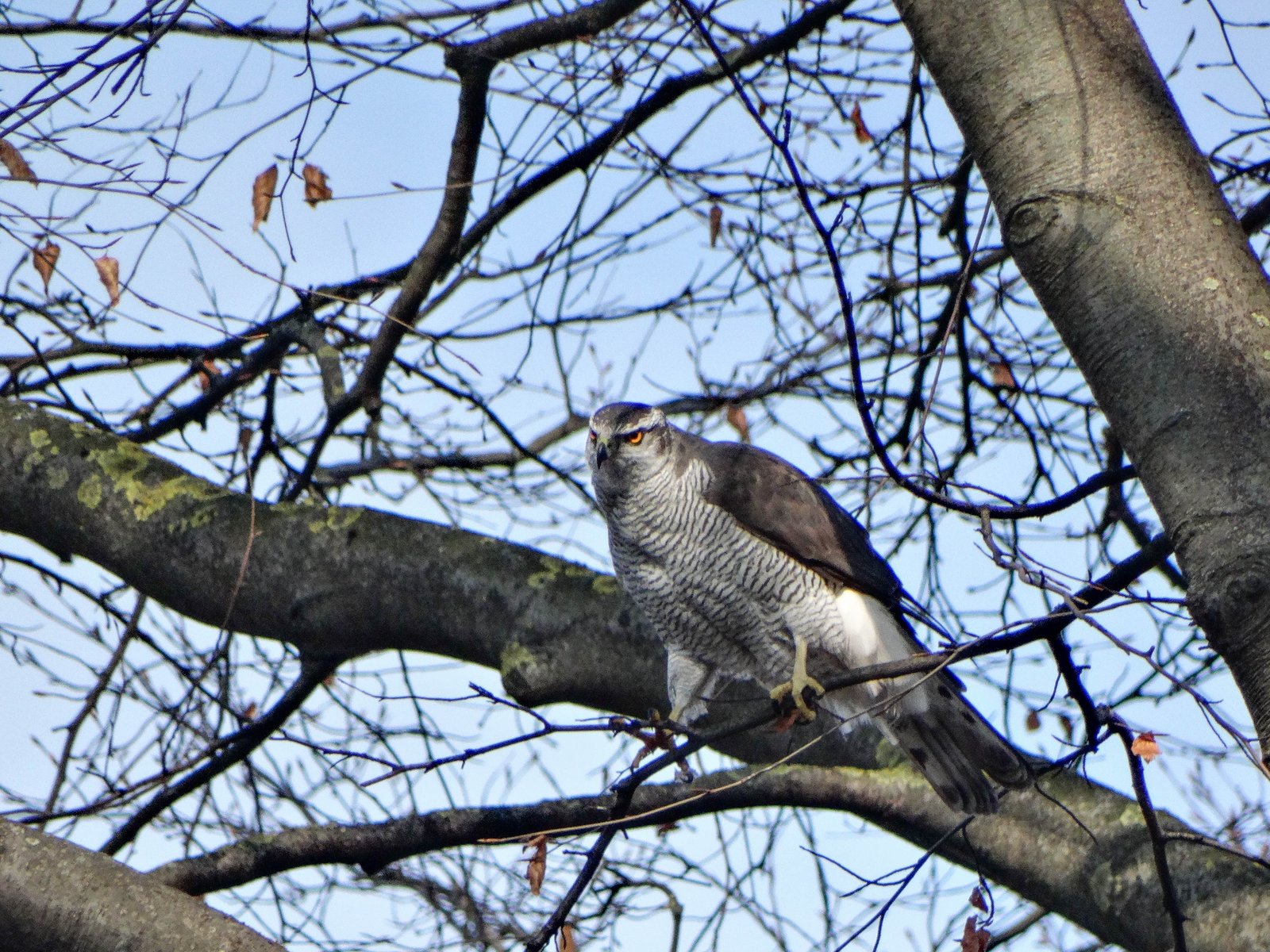
48–66 cm, wingspan 95–125 cm. Bulky and deep-chested, with a head that protrudes clearly in front of the wing, broad wings with a bulging trailing edge and a fairly long tail with rounded corners. Flies with a series of three to five strong, slow beats followed by a long glide. The adult male is slate-grey above, finely barred grey below, with a striking white supercilium above a dark ear patch and an orange-red eye. The female is clearly larger, browner grey above and more coarsely barred. The juvenile is warm brown above, with heavy dark streaks on the creamy underparts and a yellow eye. In display it fluffs out the white undertail coverts into a fluffy ball.
Confusion species
Eurasian Sparrowhawk (Accipiter nisus) is smaller and slimmer, with a small, barely protruding head, a narrower tail base with square corners and quicker, flickering beats; a large female Eurasian Sparrowhawk and a small male Northern Goshawk overlap in size. A young Northern Goshawk may resemble Common Buzzard (Buteo buteo), but that has broader wings and a short, fan-shaped tail. In flight a Northern Goshawk can also suggest Peregrine Falcon (Falco peregrinus), which however has pointed wings.
Habitat
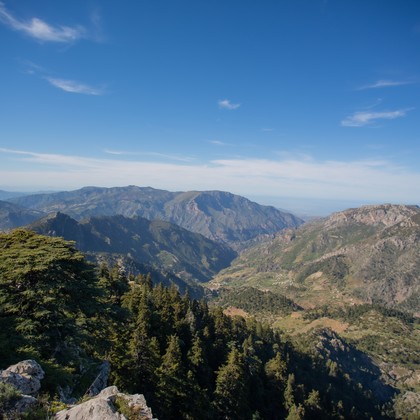
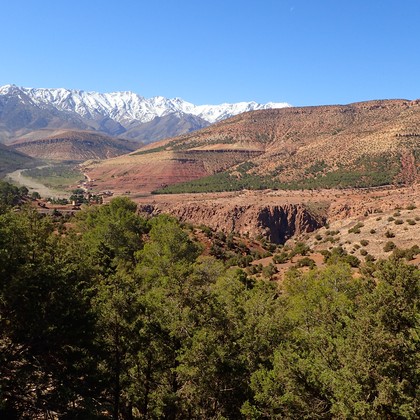
In Morocco in mature forest of cork oak, Portuguese oak, Aleppo pine, cedar and oak up to about 2,000 metres, with tall trees for the nest and clearings for hunting. The nest is high in a tree, in the Rif ten to twelve metres up in oaks. Winter visitors in the Levant and Arabia hunt in copses, orchards, oases and around fish farms and riverine woods.
Where the bird is most at home, classified by the habitats of North Africa and the Middle East.
Range and movements
In Morocco a rare and scattered breeder on the Tangier peninsula, in the Rif, the western Middle Atlas and the western High Atlas; in the 1970s about twenty pairs were estimated in the Tétouan–Chefchaouen area, in the late 1990s a few dozen pairs in all of Morocco. In 2016 a nest with three eggs was found near Tangier. A very rare breeder in the forests of northern Algeria and northwest Tunisia. In the Middle East a rare breeder in the wooded mountains of Lebanon, Syria and northern Iraq and a rare winter visitor to Israel and Jordan; a vagrant in Egypt and Arabia. Beyond the region in Europe, Turkey and Asia to Japan.
- Resident
- Summer visitor (c. Oct–Mar)
- Winter visitor (c. Apr–Sep)
- dark = core range, pale = thinly spread
How and when to look
The best chance in northern Morocco is a sunny morning from February to April, when the pair displays over the forests of the Rif or around Ifrane in the Middle Atlas with slow, deep wingbeats and fluffed-out white undertail coverts. Outside that period the Northern Goshawk is almost invisible in the forest.
Conservation status
Not threatened. Rare and poorly studied in North Africa; the population is threatened by the felling of old forest, disturbance and shooting.
Scientific name
Astur gentilis | (Linnaeus, 1758)
Linnaeus described the species in 1758 as Falco gentilis; because it was later moved to another genus, the author and year stand in brackets. The genus Astur was introduced in 1799 by De Lacépède. Astur is Late Latin for 'hawk'. gentilis is Latin for 'noble': in the Middle Ages only the nobility were permitted to fly goshawks. The specimen the first description was based on came from Dalarna, Sweden.