All species › Waterfowl › Ducks, geese and swans › Eurasian Teal
Eurasian Teal | Anas crecca
Wintertaling | Cerceta común
The smallest dabbling duck in the region, a fast, agile duck that swerves low over the reeds in tight flocks. In winter it is one of the most numerous ducks of the area, from the merjas of Morocco to the marshes of southern Iraq.
Voice
The male gives a clear, short, bell-like whistle, krik or prrit, which in flocks sounds like a tinkling bell and carries far. The female quacks high, thin and nasal. Often heard from birds hidden in the reeds.
Recording: Stanislas Wroza — CC BY-NC-SA 4.0 · converted to mono · xeno-canto
Identification
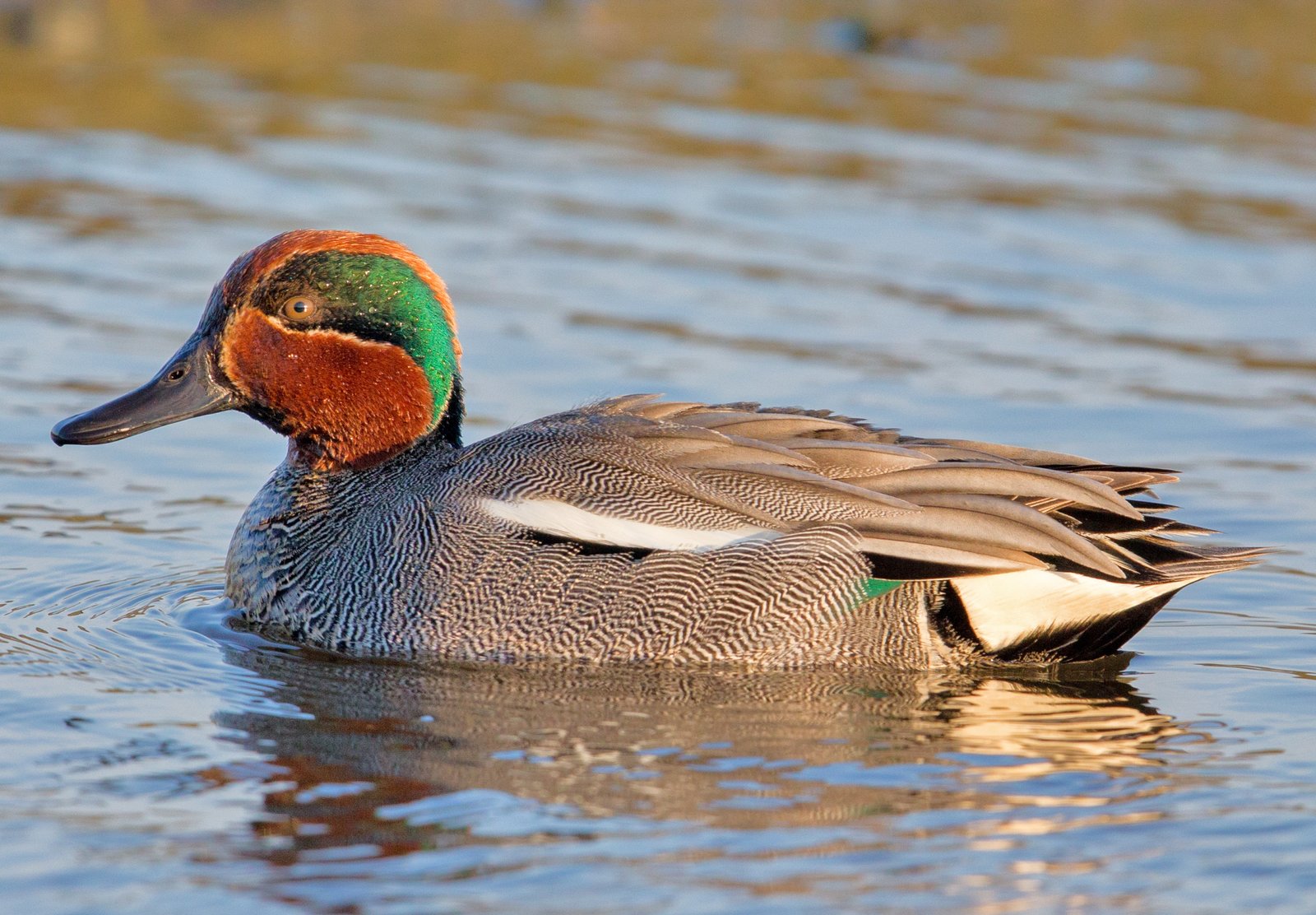
A very small, short-necked duck with a narrow dark bill. The male has a chestnut head with a broad green, yellow-bordered eye patch, finely grey-vermiculated flanks with a white horizontal stripe above the wing, and a yellow triangle beneath the black tail. The female is speckled brown with a dark eye-stripe and often a pale patch at the side of the tail base. Both sexes show a green speculum with a broad white leading edge and a narrow white trailing edge. It flies fast and twisting, and springs almost vertically from the water.
Confusion species
Female Garganey (Spatula querquedula) has a more strongly patterned head with a pale spot at the bill base and a pale supercilium, and in flight a blue-grey forewing; it passes mainly in March and September, when Eurasian Teal are scarce. Marbled Teal (Marmaronetta angustirostris) is larger, pale sandy and spotted, and has no speculum. Size and fast flight rule out the larger ducks.
Habitat
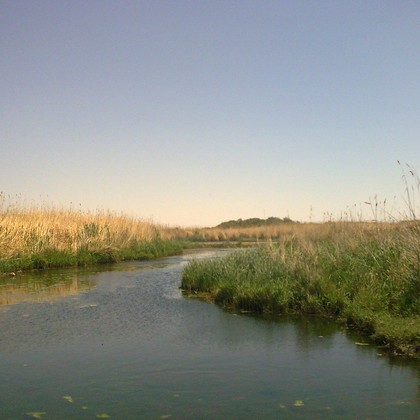
Shallow fresh and brackish water with vegetated margins: reed marshes, flooded meadows, the edges of reservoirs, fish ponds, rice fields, sewage ponds and coastal lagoons. It feeds by up-ending and dabbling in very shallow water and on mud, mainly on seeds.
Where the bird is most at home, classified by the habitats of North Africa and the Middle East.


Range and movements
Winter visitor throughout the region wherever there is water. In the west on the wetlands of Morocco (Merja Zerga, Sidi Bou Ghaba, the Moulouya, Souss-Massa), north-east Algeria (El Kala, Guerbes) and Tunisia (Ichkeul, Kelbia); further on the delta lakes and along the Nile in Egypt, and scarce in Libya. In the east very numerous on the marshes of southern Iraq, also in Syria, Lebanon, Israel and Jordan, and in smaller numbers in Kuwait, the Gulf states, Saudi Arabia, Oman and Yemen. On passage also at oases, wadi pools and reservoirs deep in the desert. Breeds from Iceland and Europe to eastern Siberia; also winters south to the Sahel, East Africa and South Asia.
- Resident
- Summer visitor (c. Oct–Mar)
- Winter visitor (c. Apr–Sep)
- Passage (Mar–Apr, Oct–Nov)
- dark = core range, pale = thinly spread
How and when to look
In winter scan the reed fringes and flooded edges of reservoirs and fish ponds quietly; flocks of teal often sit close under the bank and only show when they spring up. Listen for the tinkling whistles of the males: they give a flock away long before you see it.
Conservation status
Not threatened and widespread. In the region it is hunted on a large scale and caught in nets, above all in Egypt and Iraq, and it suffers from the drying out of wetlands; its dependence on shallow water makes it sensitive to dry years.
Scientific name
Anas crecca | Linnaeus, 1758
Linnaeus described the species in 1758 and placed it straight away in the genus where it still stands. He introduced the genus Anas in that same work. Anas is the Latin word for 'duck'. crecca comes from kricka, the Swedish name for the bird, an imitation of the male's call. The specimen the first description was based on came from Sweden.