All species › Waterfowl › Ducks, geese and swans › Northern Pintail
Northern Pintail | Anas acuta
Pijlstaart | Ánade rabudo
A slender, long-bodied dabbling duck with a long neck and pointed tail, passing through the region in large numbers on its way to and from the Sahel. Thousands winter on the lagoons of the Nile Delta and the wetlands of Tunisia and Morocco, while a large share flies straight across the Sahara to the floodplains of West Africa.

Voice
The male gives a soft, clear whistle, a short prruut, like the call of Eurasian Teal but fuller and lower. The female quacks low and hoarse, kwek-kwek, quieter than a Mallard. Usually silent in winter quarters, except in displaying groups from January.
Recording: Stanislas Wroza — CC BY-NC-SA 4.0 · converted to mono · xeno-canto
Identification
Long thin neck, small head and tapering rear end. The male has a chocolate-brown head with a white stripe running up the side of the neck, a white breast, a finely grey-vermiculated body, a creamy-yellow patch in front of the black undertail and two long, narrow central tail feathers. The female is plain coffee-brown and scaly with an unmarked face and an all-grey bill; the eclipse male resembles her but stays greyer. In flight: long pointed wings, a bronze-green speculum with a white trailing edge and the far-projecting neck.
Confusion species
The female is confused with female Mallard (Anas platyrhynchos) and Gadwall (Mareca strepera); both are more compact and shorter-necked and show orange on the bill. Marbled Teal (Marmaronetta angustirostris) is smaller, pale sandy with pale spots and a dark eye patch, without a speculum. Female Eurasian Wigeon (Mareca penelope) has a round head and a short blue-grey bill.
Habitat
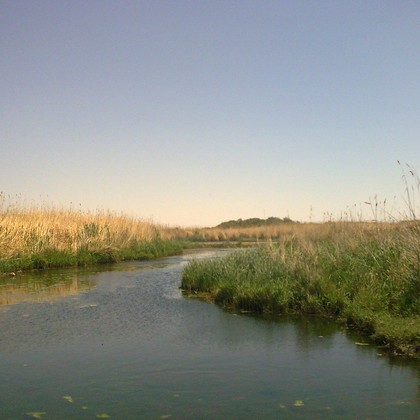
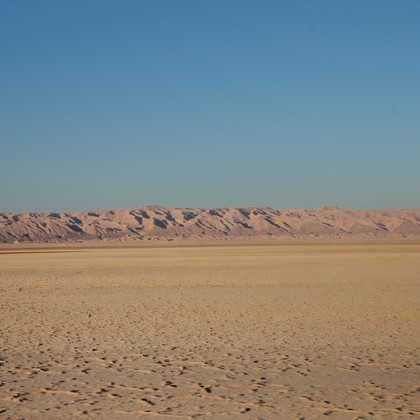
Brackish and fresh lagoons, shallow coastal lakes, flooded salt flats and chotts, rice fields and fish ponds. It feeds by up-ending with its long neck, reaching deeper than other dabbling ducks, often at night on flooded fields; by day it rests in flocks on open water.
Where the bird is most at home, classified by the habitats of North Africa and the Middle East.

Range and movements
Winter visitor across the north of the region. Egypt: large numbers on the delta lakes Manzala, Burullus and Idku and along the Nile. Tunisia: Ichkeul, Kelbia and the inland sebkhas; Algeria: the El Kala and Guerbes wetlands and the chotts; Morocco: Merja Zerga, Sidi Bou Ghaba, the Moulouya mouth and Souss-Massa. Libya: in small numbers on coastal lagoons. In the east on the marshes of southern Iraq, Lake Hula and the fish ponds of the Jordan Valley; scarce in Kuwait, the Gulf states, Oman and Saudi Arabia, and rare in Yemen. On passage across the whole Sahara and along the Red Sea, with resting flocks at oases and reservoirs. Breeds far to the north, from Iceland and north-west Europe to eastern Siberia and North America; also winters in the Sahel, from the Senegal delta to Lake Chad, and in South Asia.
- Resident
- Summer visitor (c. Oct–Mar)
- Winter visitor (c. Apr–Sep)
- Passage (Mar–Apr, Oct–Nov)
- dark = core range, pale = thinly spread
How and when to look
The highest numbers are in December and January on the Egyptian delta lakes and at Ichkeul in Tunisia, ideally in low light from a dyke or viewpoint. In February and March flocks pass through the Jordan Valley and Eilat. On passage in the desert, check reservoirs and sewage ponds: that is where flocks crossing the Sahara come down.
Conservation status
Not globally threatened, but the European and West African population has fallen sharply since the 1970s, partly through drought in the Sahel and the loss of floodplains. In the region it is heavily hunted and trapped on many wetlands, above all in the Nile Delta, and the lagoons suffer from drainage and pollution.
Scientific name
Anas acuta | Linnaeus, 1758
Linnaeus described the species in 1758 and placed it straight away in the genus where it still stands. He introduced the genus Anas in that same work. Anas is the Latin word for 'duck'. acuta is Latin for 'pointed', from acuere 'to sharpen', after the long pointed tail feathers of the male. The specimen the first description was based on came from Sweden.