All species › Woodpeckers and allies › Woodpeckers › Eurasian Wryneck
Eurasian Wryneck | Jynx torquilla
Draaihals | Torcecuello euroasiático
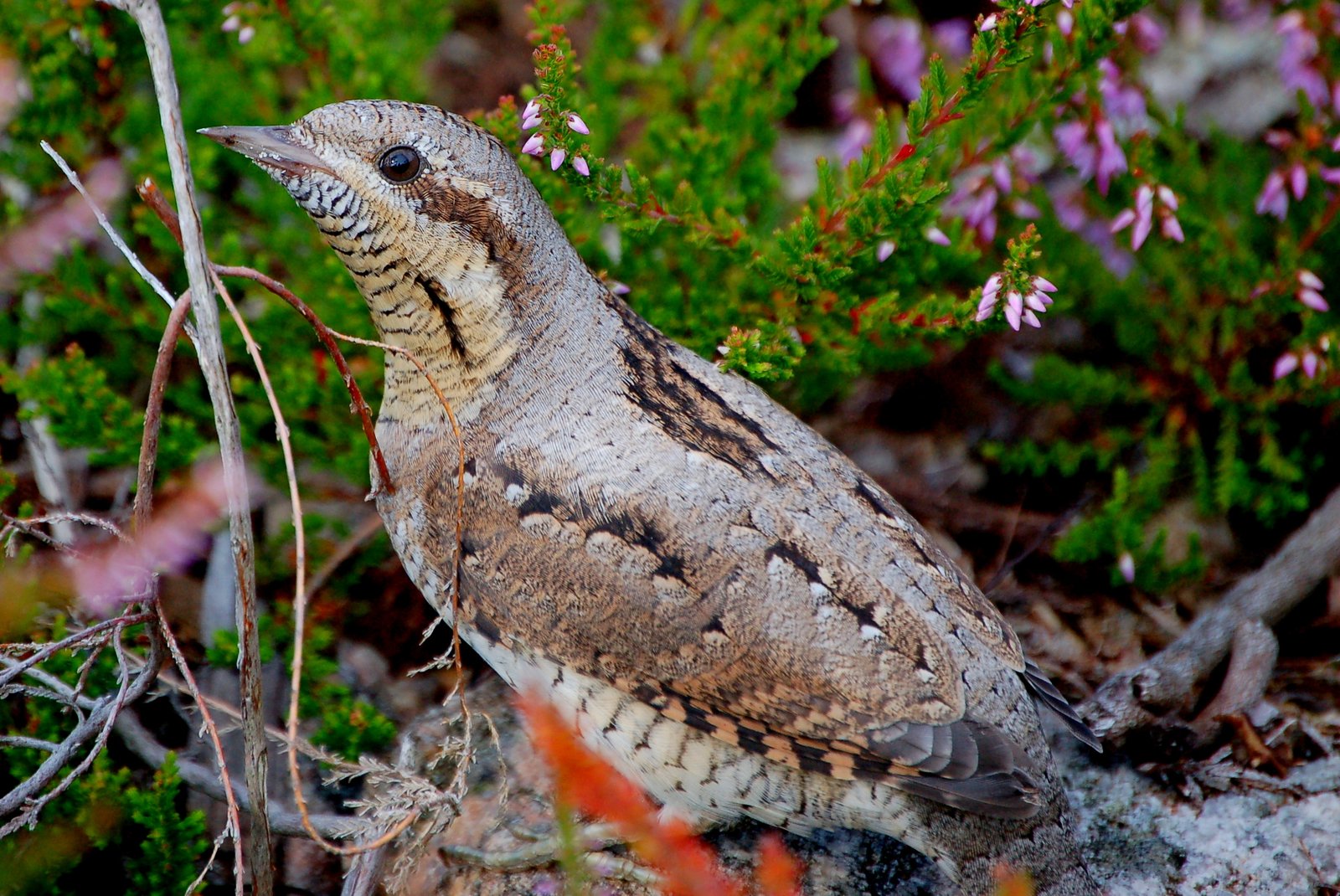
An aberrant, passerine-like woodpecker that neither chisels nor climbs trunks, but picks ants from the ground and from bark. Its cryptic grey, brown and rufous plumage recalls a nightjar more than a woodpecker. In the Maghreb the pale race mauretanica breeds as a resident; through the rest of the region birds from Europe and western Asia pass in spring and autumn to and from their winter quarters in the Sahel.
Voice
The song is a series of ten to fifteen plaintive, nasal notes, kee-kee-kee-kee or tyee-tyee-tyee, rather like a small falcon, heard in spring from orchards and woodland edges. Usually silent on passage; a soft hissing and ticking at the nest.
Recording: Gustav Haapalahti — CC BY-NC-SA 4.0 · shortened to the first 60 s, mono · xeno-canto
Identification
Slim, with a short, pointed bill and a long, rounded tail crossed by four or five narrow dark bars. Upperparts silvery grey, finely speckled, with a dark diamond-shaped band from crown down the back and brown, chequered wings; throat and breast buffish yellow with fine dark bars, belly paler with arrowhead marks. A dark eye-stripe runs to the nape. Sexes alike. The Maghreb race mauretanica is slightly smaller and paler, whiter below. When threatened it twists its head and neck in a snake-like way, which gives the bird its name.
Confusion species
In the field it looks more like a passerine than a woodpecker. Barred Warbler (Curruca nisoria) is also grey with barred underparts, but lacks the brown back band and the barred tail. Eurasian Nightjar (Caprimulgus europaeus) has a similar cryptic pattern, but is much larger with long wings and a broad, tiny bill; nightjars sit motionless by day on the ground or lengthwise on a branch. A female Red-backed Shrike (Lanius collurio) has a hooked bill and plain brown upperparts.
Habitat
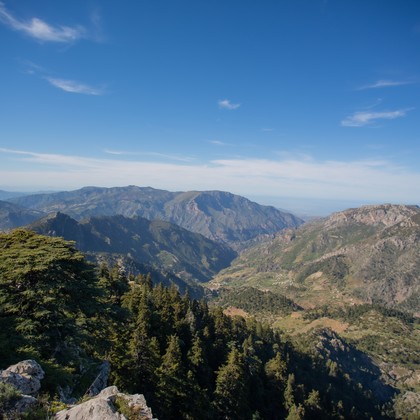
Semi-open country with old trees and bare or short-grazed ground with ants: orchards, olive and almond groves, open oak and cedar woodland, riverine woods and gardens. Nests in an existing cavity, also in nest boxes and walls. On passage almost anywhere with bushes: oases, wadis with acacias, parks and coastal scrub, even deep in the desert.
Where the bird is most at home, classified by the habitats of North Africa and the Middle East.


Range and movements
The race mauretanica breeds in northern Morocco, Algeria and Tunisia: in the Rif, Middle and High Atlas, the Tell and Kroumirie, mainly in olive groves and open woodland; largely resident, with some movement to lower ground in winter. Migrants of the nominate race cross the whole region on a broad front: through the Maghreb, Libya and the Saharan oases, along the Nile and through Sinai, the Levant (many in Israel, the Jordan Valley and Jordan) and the Arabian Peninsula to Yemen and Oman. A small number winter in the region, notably in the Nile Valley, the Levantine lowlands, south-west Arabia and Yemen. Beyond the region the species breeds from Europe to Japan and winters in the Sahel, East Africa and South Asia.
- Resident
- Summer visitor (c. Oct–Mar)
- Winter visitor (c. Apr–Sep)
- Passage (Mar–Apr, Oct–Nov)
- dark = core range, pale = thinly spread
How and when to look
In the Maghreb it is best heard in April–May in olive groves and open oak woodland in the Middle Atlas, for example around Ifrane and Azrou. On passage it is a regular find in March and September at Eilat and in Sinai; search the ground under low bushes and bare patches in parks, where it feeds on ants and flushes only at your feet.
Conservation status
Not globally threatened, but sharply declined across much of Europe through agricultural intensification and the loss of traditional orchards and ant-rich grassland. In the Maghreb the breeding population depends on traditional olive and fruit groves and open woodland; insecticide use and the felling of old trees with cavities threaten it locally.
Scientific name
Jynx torquilla | Linnaeus, 1758
Linnaeus described the species in 1758 and placed it straight away in the genus where it still stands. He introduced the genus Jynx in that same work. Jynx is the Ancient Greek name for this bird, iunx. torquilla is Medieval Latin from torquere 'to twist', for the bird's snake-like head and neck movements. The specimen the first description was based on came from Sweden.