All species › Kingfishers, bee-eaters and rollers › Kingfishers › Collared Kingfisher
Collared Kingfisher | Todiramphus chloris
Witkraagijsvogel | Martín cazador acollarado
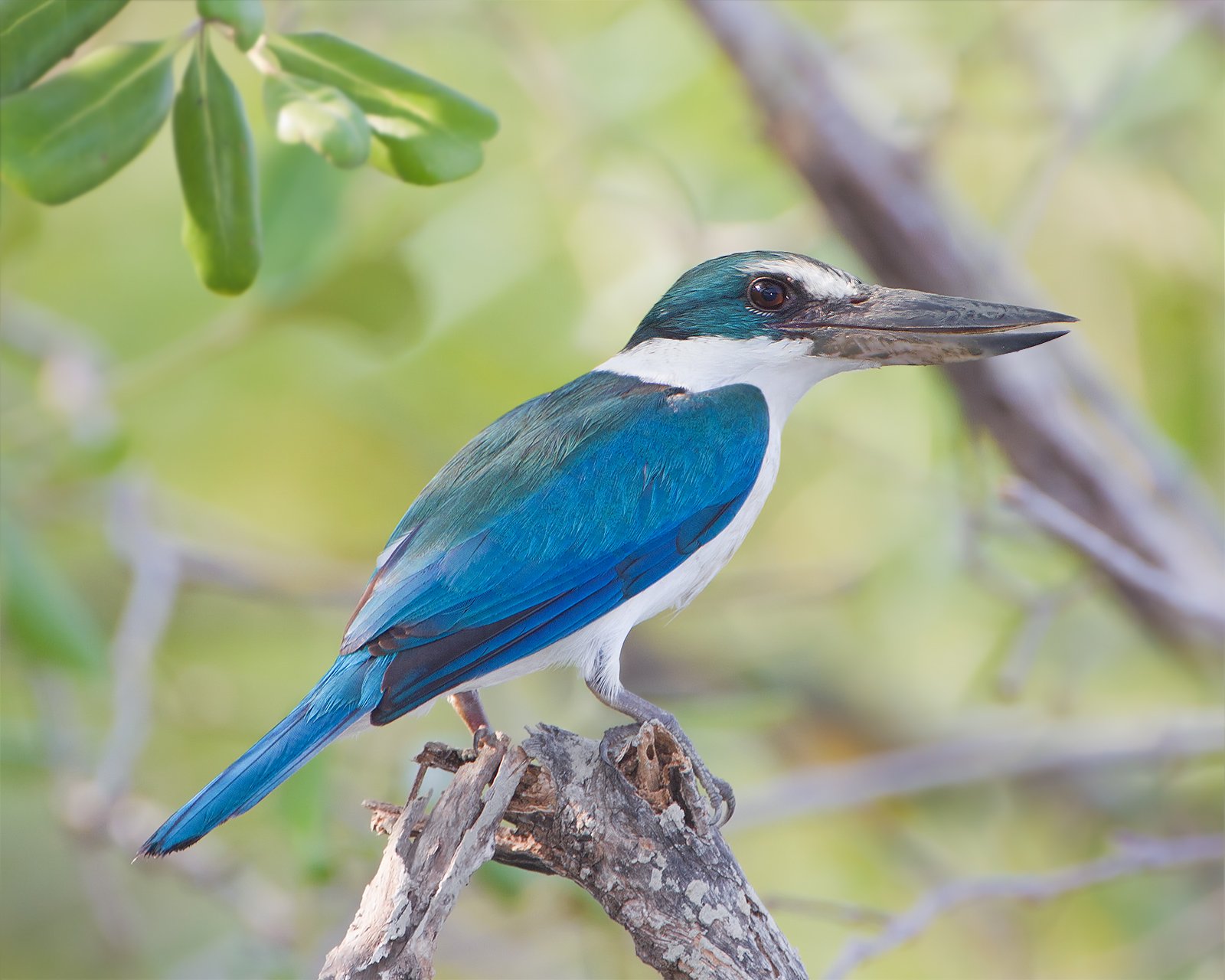
A blue-green and white kingfisher of mangroves, which in the region lives in two small, widely separated populations: on the Saudi Red Sea coast and on the Gulf of Oman, where the endemic subspecies kalbaensis occurs only in a handful of khors (mangrove creeks). It belongs to a group that reaches from East Africa to the Pacific.
Voice
Loud and harsh: a series of three to five strident notes, kee-kee-kee or kek-kek-kek, often from a high mangrove branch and in duets between neighbours; also a short, sharp kreek. Most vocal early in the morning and in spring.
Recording: Joan Theng — CC BY-NC-SA 4.0 · converted to mono · xeno-canto
Identification
Medium-sized and compact, with a big head and a heavy black dagger bill with a pale base to the lower mandible. Crown, back, wings and tail blue-green to turquoise, with a blackish eye-stripe continuing round the nape. A broad, pure white collar separates crown and back; throat and underparts are white. The female is slightly duller and greener. Juveniles have fine dark scaling on breast and collar and a buff wash on the flanks.
Confusion species
The combination of blue-green upperparts, white collar and all-white underparts in mangroves is hardly confusable. White-throated Kingfisher (Halcyon smyrnensis), which also turns up in the Emirates and Oman in winter, has a chestnut head and belly and a red bill. Grey-headed Kingfisher (Halcyon leucocephala) of inland south-west Arabia has a red bill and a chestnut belly. Common Kingfisher (Alcedo atthis), which also uses mangroves in winter, is much smaller and orange-brown below.
Habitat
Almost exclusively mangrove forest (Avicennia) in creeks, lagoons and tidal channels, with adjacent mudflats. Often sits for long periods on a branch 1–3 m above the mud and takes mainly crabs and other crustaceans, as well as small fish and insects. Nests in holes in old mangrove trunks.
Where the bird is most at home, classified by the habitats of North Africa and the Middle East.


Range and movements
Red Sea: the subspecies abyssinicus is resident in the mangroves of the Saudi coast, from Amaq north of Al Birk south to around Sabya and Jizan. In Yemen first recorded in 2008 in the Al Buhays mangroves, between Al Luhayyah and Midi; its status there is still unclear. Gulf of Oman: the subspecies kalbaensis lives only at Khor Kalba (Emirate of Sharjah) and at Khor Liwa and Khor Shinas in north-west Oman. Not recorded elsewhere in the region. Beyond it, from the African Red Sea coast (Sudan to north-west Somalia) through South and South-East Asia to Australia and the Pacific, in many subspecies.
- Resident
- Passage (Mar–Apr, Oct–Nov)
- dark = core range, pale = thinly spread
How and when to look
Khor Kalba on the east coast of the Emirates is the best-known site: paddle through the mangroves by kayak or walk the edge at low tide, early in the morning, and listen for the strident call series. On the Saudi Red Sea coast the mangroves south of Al Birk and near Al Qahma are good.
Conservation status
Not globally threatened, but both Arabian populations are small and wholly dependent on mangroves. The subspecies kalbaensis numbers at most a few dozen pairs and is vulnerable to coastal development, mangrove cutting and disturbance; Khor Kalba has therefore been designated a protected area. On the Saudi Red Sea coast too, mangroves are under pressure from camel grazing, cutting and building.
Scientific name
Todiramphus chloris | (Boddaert, 1783)
Boddaert described the species in 1783 as Alcedo Chloris; because it was later moved to another genus, the author and year stand in brackets. The genus Todiramphus was introduced in 1827 by Lesson. Todiramphus is formed from Todus, the tody genus, and Greek rhamphos 'bill'. chloris goes back to Greek khlōris, the name of a green-yellow bird, from khlōros 'green'. The specimen the first description was based on came from Buru, Indonesia.