All species › Kingfishers, bee-eaters and rollers › Kingfishers › White-Throated Kingfisher
White-Throated Kingfisher | Halcyon smyrnensis
Smyrna-ijsvogel | Alción de Esmirna
A big, colourful kingfisher that hardly needs water: it hunts grasshoppers, lizards and mice in orchards, fields and gardens just as readily. In Israel and Iraq it is one of the most conspicuous birds of farmland, with turquoise wings, a white bib and a loud, whinnying call. The western tip of its vast Asian range reaches the eastern Nile Delta.
Voice
A loud, descending, rather whinnying laugh, kee-kee-kee-kee-kee, that carries far over open country and in spring is given almost incessantly. The male also sings a drawn-out, trilling kirrrrr from a high perch; when disturbed a harsh rattle.
Recording: Kasper Wieck — CC BY-NC-SA 4.0 · converted to mono · xeno-canto
Identification
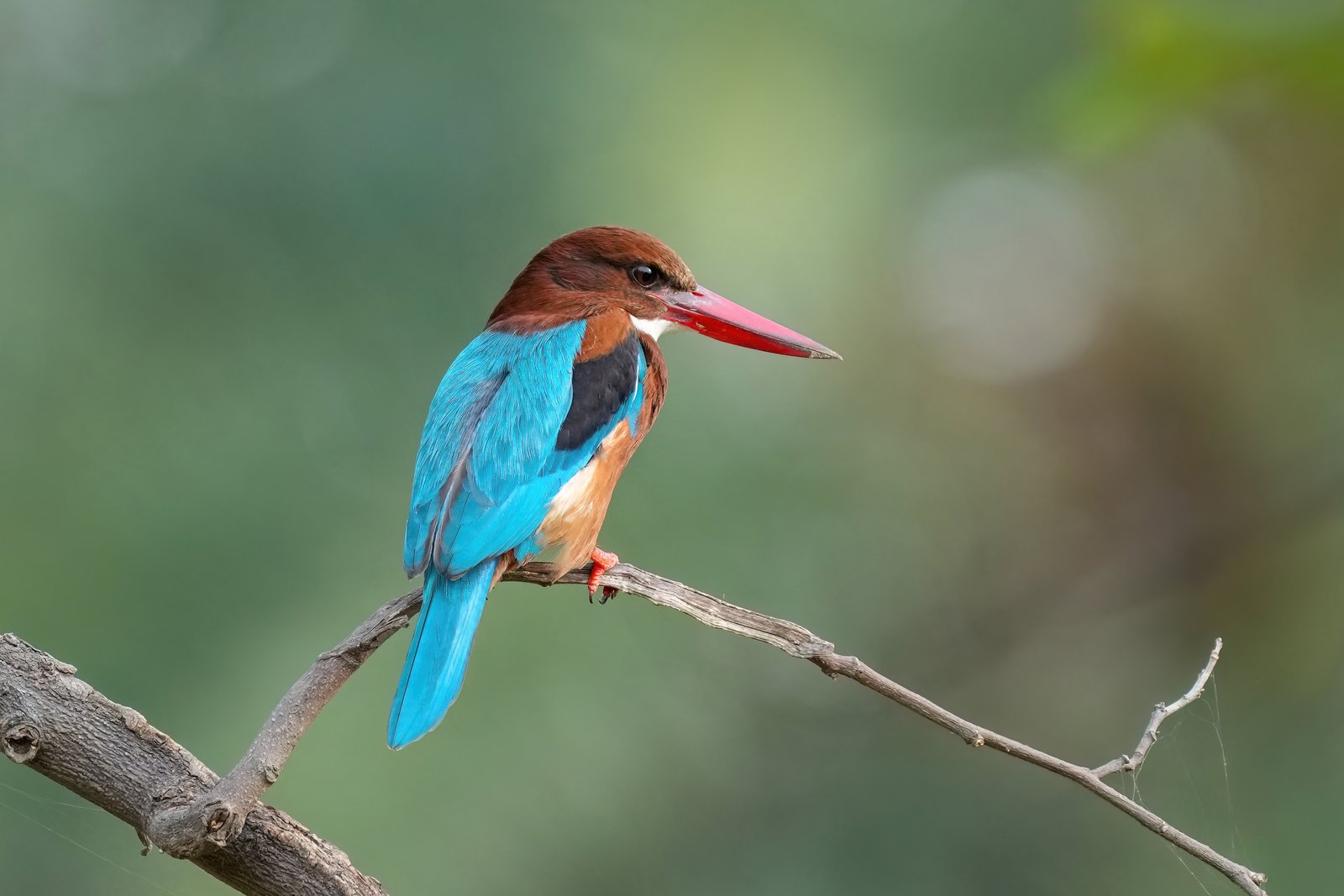
Large, with a heavy head, a thick coral-red dagger bill and red legs. Head, neck, flanks and belly deep chestnut, back, rump and tail bright turquoise blue, and a large, sharply defined white patch across throat and breast. The wing is turquoise with black coverts along the leading edge; in flight a large white window in the primaries stands out. The sexes are alike; juveniles are duller, with fine dark scaling on the white breast and a duller bill.
Confusion species
Common Kingfisher (Alcedo atthis) is barely half the size, cobalt blue and orange-brown, without a white bib or red bill. Grey-headed Kingfisher (Halcyon leucocephala) of south-west Arabia is smaller, with a grey head, a black mantle and only the belly chestnut. A blue bird on a roadside wire may also be a European Roller (Coracias garrulus) or Indian Roller (Coracias benghalensis); these are bulkier, with a black bill and no white bib.
Habitat
Open farmland with trees: orchards, date gardens, irrigated cultivation with ditches and canals, parks and gardens, river banks and fish ponds, also in villages and on the edge of towns. Hunts from wires, posts and dead branches for large insects, lizards, frogs, small rodents and small fish. Nests in a tunnel in a steep bank or ditch side, often far from open water.
Where the bird is most at home, classified by the habitats of North Africa and the Middle East.


Range and movements
Resident in Israel (mainly the coastal plain, the northern valleys and the Jordan Valley), Jordan (Jordan Valley, Azraq and Aqaba), Lebanon, western Syria and along the Euphrates, and throughout Iraq, most numerous in the south. Egypt: a small population in the north-east, in the eastern Nile Delta and along the Suez Canal. Kuwait: scarce breeder and winter visitor. Eastern Saudi Arabia: resident in the oases of Qatif and Al-Hasa, with a small population on Bahrain. Qatar, the Emirates and northern Oman: scarce winter visitor, increasing; elsewhere in Arabia and in Libya a vagrant. Beyond the region from southern Turkey and Iran through South Asia to southern China, the Philippines and Indonesia.
- Resident
- Summer visitor (c. Apr–Sep)
- Winter visitor (c. Oct–Mar)
- Passage (Mar–Apr, Oct–Nov)
- dark = core range, pale = thinly spread
How and when to look
In Israel you will see it almost anywhere water and trees meet; the fish ponds at Ma’agan Michael and in the Bet She’an Valley are reliable. In Iraq and Kuwait it likes power lines along irrigation canals. Listen for the laughing call and look for the white bib, which shows up from far away.
Conservation status
Not globally threatened and common across much of its range; in the Levant it has benefited from irrigation and fish ponds, and in eastern Arabia it seems to be spreading. It is, however, sometimes persecuted at fish ponds and locally suffers from pesticides.
Scientific name
Halcyon smyrnensis | (Linnaeus, 1758)
Linnaeus described the species in 1758 as Alcedo smyrnensis; because it was later moved to another genus, the author and year stand in brackets. The genus Halcyon was introduced in 1821 by Swainson. Halcyon goes back to Greek alkyon, the bird of legend that nested at sea and calmed the waves; the name later came to be used for kingfishers generally. smyrnensis means 'from Smyrna', the port on the west coast of Turkey now called İzmir. The specimen the first description was based on came from Izmir, Turkey.