All species › Kingfishers, bee-eaters and rollers › Kingfishers › Grey-Headed Kingfisher
Grey-Headed Kingfisher | Halcyon leucocephala
Grijskopijsvogel | Alción cabeciblanco
A small, colourful tree kingfisher that crosses the Red Sea as a summer visitor to breed in the wadis and acacia woodland of south-west Arabia. Despite its name it is no fisher: it hunts beetles and grasshoppers from a low branch. In Saudi Arabia, with an estimated 1,500 birds, it is the country’s most numerous kingfisher.

Voice
A high, weak, descending series, chi-chi-chi-chirrr, or a run of rapid whistled notes. In display the birds face each other with spread wings and call with open bills.
Recording: Mischa Keijmel — CC BY-NC-SA 4.0 · converted to mono · xeno-canto
Identification
About 20 cm, with a red dagger bill and red legs. Head, neck and breast pale grey to greyish-brown, mantle and scapulars black. Belly and undertail coverts deep chestnut. Flight feathers, rump and tail bright cobalt to turquoise blue, flashing brightly in flight. The sexes are alike; juveniles have a dark bill, a paler orange-brown belly and fine vermiculation on the breast.
Confusion species
White-throated Kingfisher (Halcyon smyrnensis) is larger, with a chestnut head and a white bib, and is largely absent from south-west Arabia. Collared Kingfisher (Todiramphus chloris) of the Red Sea mangroves is blue-green above and all white below, with a white collar and a black bill. In flight the blue may recall an Abyssinian Roller (Coracias abyssinicus), which is much larger and has long tail streamers.
Habitat
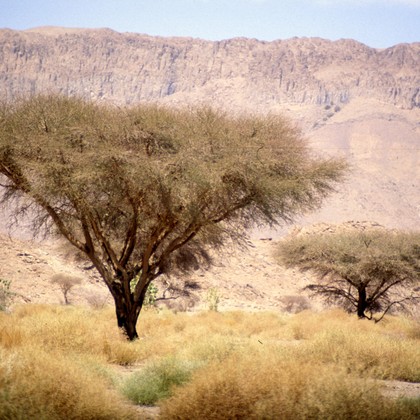
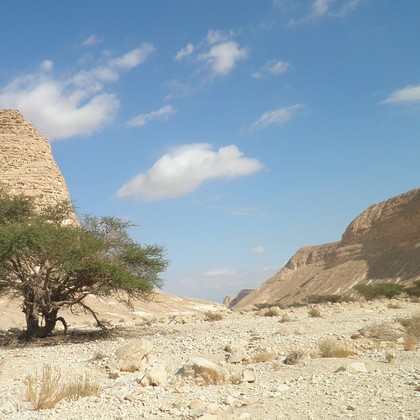
Acacia savanna and scrub in the foothills and lower mountain slopes, up to about 2,300 m, especially along wadis and streams with trees, and at the edges of fields and terraces. Sits still on a low branch and drops onto prey on the ground, mainly beetles, grasshoppers and locusts. Nests in a tunnel in a sand or loam bank along a wadi.
Where the bird is most at home, classified by the habitats of North Africa and the Middle East.

Range and movements
The subspecies semicaerulea breeds only in south-west Arabia: in Saudi Arabia in the Asir foothills and the wadis of the Tihama, from around Taif south to Jizan; in Yemen in the western mountains and their foothills, the Tihama and east into the southern mountains; and in Oman in Dhofar, where it breeds in the wooded wadis during the khareef. Winters in East Africa, probably mainly in Somalia. Elsewhere in the region at most a vagrant. Other subspecies live in sub-Saharan Africa, from Senegal to Ethiopia and south to South Africa, and on the Cape Verde Islands.
- Resident
- Summer visitor (c. Oct–Mar)
- Winter visitor (c. Apr–Sep)
- Passage (Mar–Apr, Oct–Nov)
- dark = core range, pale = thinly spread
How and when to look
Look for it from May to August in the wooded wadis of the Asir, such as Wadi Tarj, and along the roads descending from the Asir plateau to the Tihama; in Dhofar in the green wadis around Ayn Razat and Wadi Darbat at the end of the khareef. Check low, bare branches in acacia woodland: the bird sits still for long periods and only gives itself away by the blue in flight.
Conservation status
Not globally threatened. The Arabian population is small and depends on the acacia woodland and wadis of the south-west, which are under pressure from overgrazing, wood cutting, road building and agricultural expansion.
Scientific name
Halcyon leucocephala | (Müller, 1776)
Müller described the species in 1776 as Alcedo leucocephala; because it was later moved to another genus, the author and year stand in brackets. The genus Halcyon was introduced in 1821 by Swainson. Halcyon goes back to Greek alkyon, the bird of legend that nested at sea and calmed the waves; the name later came to be used for kingfishers generally. leucocephala is Greek, from leukos, 'white', and kephalē, 'head' — for the pale grey, almost white head. The specimen the first description was based on came from Senegal.