All species › Kingfishers, bee-eaters and rollers › Kingfishers › Pied Kingfisher
Pied Kingfisher | Ceryle rudis
Bonte ijsvogel | Martín pescador pío
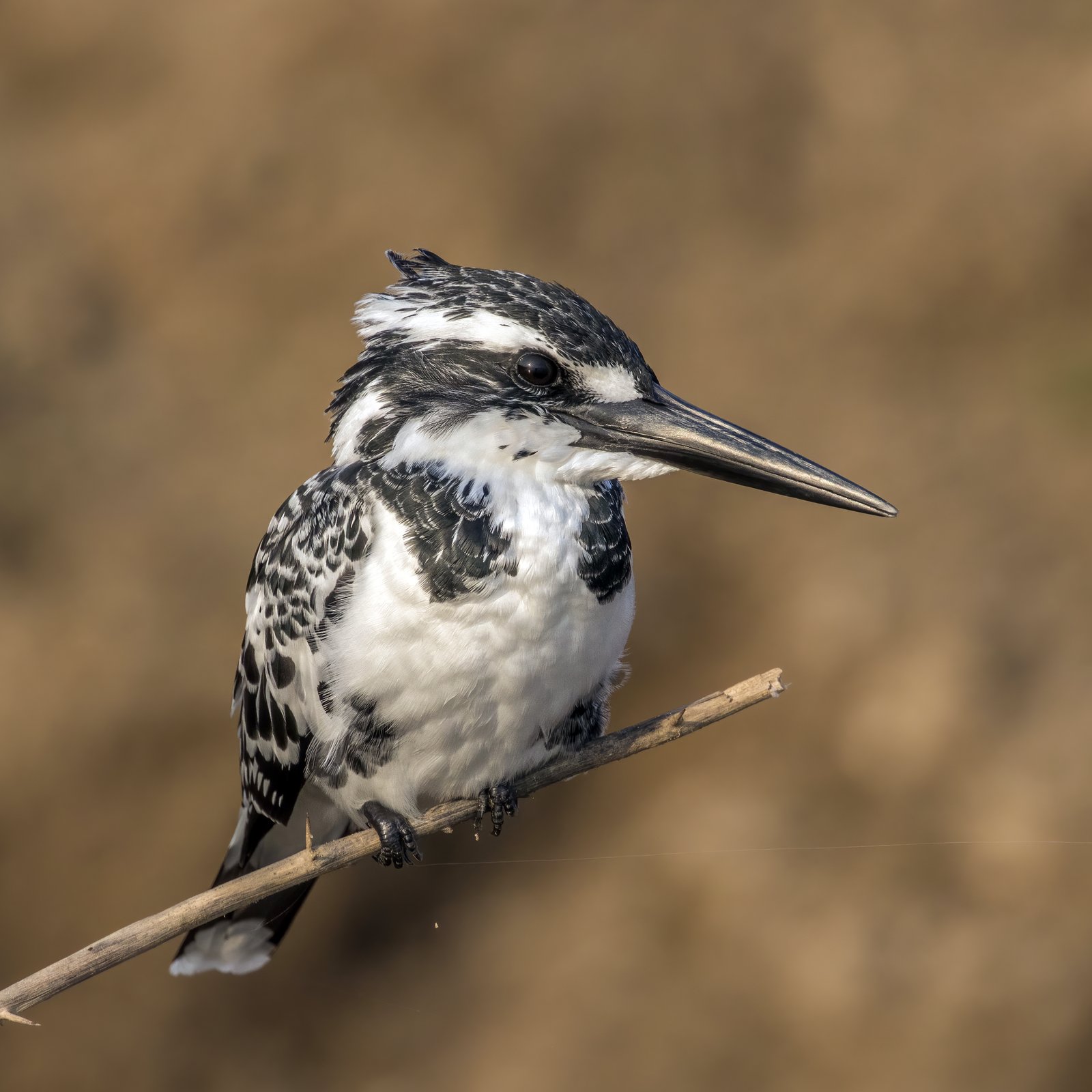
The black-and-white kingfisher that hangs hovering over the water before dropping head-first. Along the Nile it is one of the most familiar birds: every canal, fish pond and landing stage from Aswan to the Delta seems to have one. It is also a common resident in the Jordan Valley, around the Sea of Galilee and along the Euphrates and Tigris; on the Arabian Peninsula and in the Maghreb it is a rarity.
Voice
Noisy: a sharp, rattling kweek-kweek or chirrik, often in flight, and an excited high twittering when pairs or family groups sit together on a post or wire, often with wing-shaking.
Recording: Ray Tsu 诸仁 — CC BY-NC-SA 4.0 · converted to mono · xeno-canto
Identification
Large and heavily built, with a big head with a short, ragged crest, a long black dagger bill and dark legs. The whole plumage is black and white: black upperparts with plenty of white spots and fringes, a white supercilium above a black eye mask, and white underparts. The male has two black breast bands, a broad one with a narrow one below; the female has one, often broken in the middle. Juveniles have a greyish, scaly band. In flight it shows white wing patches and a white tail base with a black terminal band.
Confusion species
There is no other black-and-white kingfisher in the region. Common Kingfisher (Alcedo atthis) is much smaller and blue and orange. At a distance a hovering bird can recall a Common Tern (Sterna hirundo) or Little Tern (Sternula albifrons) over the same water, but these have narrow pointed wings, a forked tail and a light, buoyant flight, whereas Pied Kingfisher hangs heavily with the bill pointing straight down.
Habitat
Rivers, canals, fish ponds, lakes and reservoirs with clear water, and on the coast lagoons, estuaries and harbours. It hunts by hovering, even over open water far from the bank, so it does not depend on overhanging branches. Breeds in tunnels in steep banks, sometimes in small groups with helpers at the nest. Often perches on wires, posts and mooring poles.
Where the bird is most at home, classified by the habitats of North Africa and the Middle East.


Range and movements
Egypt: a common resident along the whole Nile, from Lake Nasser and Aswan to the Delta, in the Fayoum and along the Suez Canal. In the Levant it breeds in Israel (coastal plain, Hula, Sea of Galilee, Jordan Valley) and in the Jordanian Jordan Valley; scarce in Lebanon. Syria and Iraq: along the Euphrates and Tigris and in the marshes of southern Iraq. Kuwait: scarce winter visitor and passage migrant; elsewhere on the Arabian Peninsula, in Libya and in the Maghreb a rare wanderer. Beyond the region widespread in sub-Saharan Africa, in southern Turkey and Iran and through South Asia to southern China.
- Resident
- Summer visitor (c. Apr–Sep)
- Winter visitor (c. Oct–Mar)
- Passage (Mar–Apr, Oct–Nov)
- dark = core range, pale = thinly spread
How and when to look
Any boat trip or walk along the Nile at Luxor or Aswan will produce them, often hovering right next to the boat. In Israel the fish ponds of the Hula and the Sea of Galilee are reliable, especially in winter, when they gather around rich ponds.
Conservation status
Not globally threatened and common along the Nile. In the Levant and Iraq it is vulnerable to pollution and the drying-out of wetlands; in Israel it benefits from fish ponds but is also persecuted there as a fish thief.
Scientific name
Ceryle rudis | (Linnaeus, 1758)
Linnaeus described the species in 1758 as Alcedo rudis; because it was later moved to another genus, the author and year stand in brackets. The genus Ceryle was introduced in 1828 by Boie. Ceryle is from Greek kērulos, an unidentified and probably mythical bird mentioned by Aristotle and other authors. rudis is Latin for 'rough' or 'wild'. The specimen the first description was based on came from Egypt.