All species › Kingfishers, bee-eaters and rollers › Kingfishers › Common Kingfisher
Common Kingfisher | Alcedo atthis
IJsvogel | Martín pescador común
The small blue-and-orange kingfisher familiar to Europeans, here often in surprising surroundings: on a concrete pumping station in the Nile Delta, among the mangroves of the Gulf or by a fish pond in a desert oasis. It breeds in small numbers in the Maghreb and the Levant, but over most of the region it is a winter visitor from the north that can turn up by almost any water from September to April, salt water on the coast included.
Voice
A sharp, high, penetrating tseet or tee-tee, almost always given in fast, low flight over the water. It calls less in winter quarters, but is still often heard before it is seen. In spring a soft, trilling song accompanies chases.
Recording: Magnus Hellström — CC BY-NC-SA 4.0 · converted to mono · xeno-canto
Identification
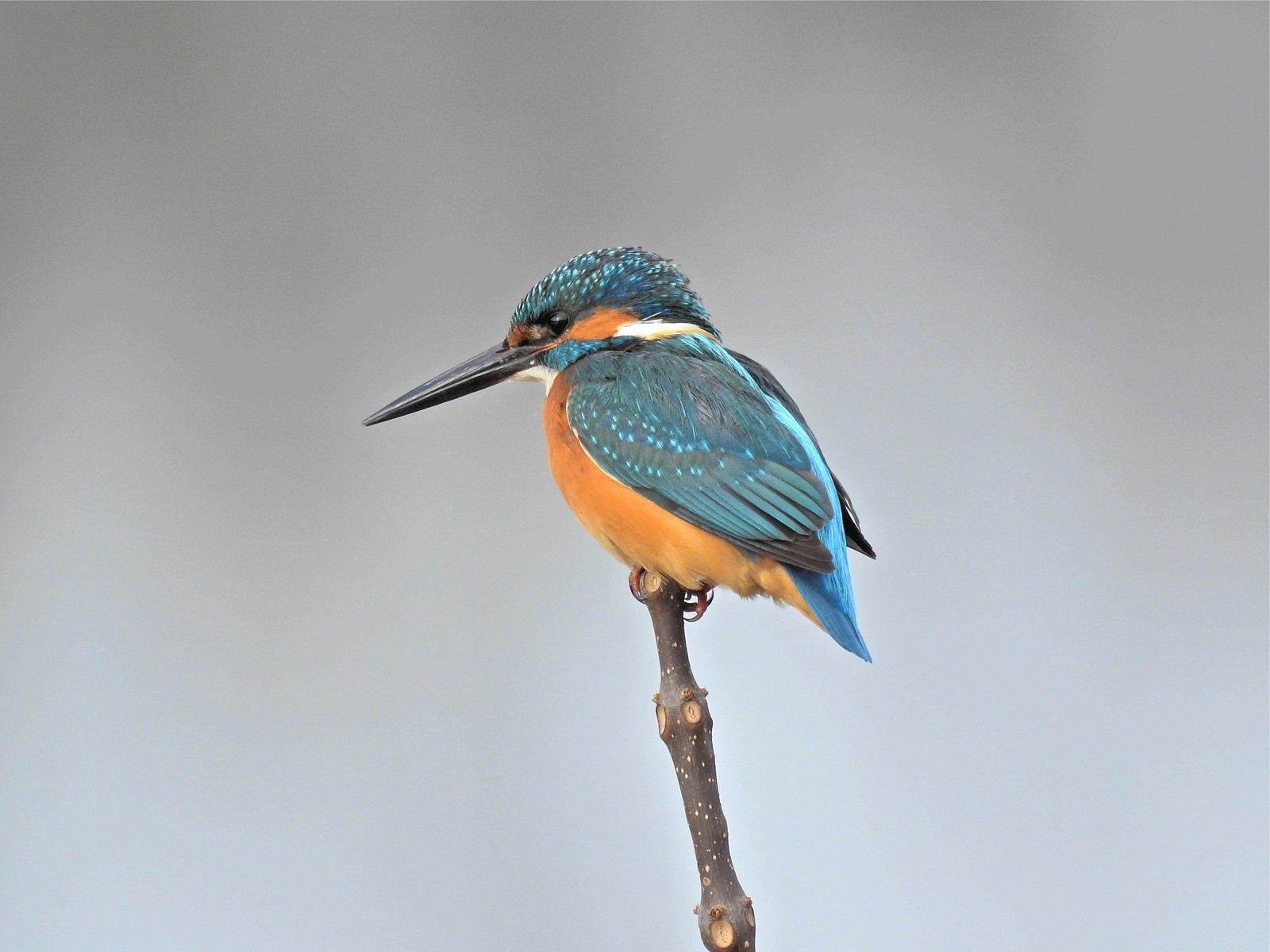
Compact, short-tailed and big-headed, with a long dagger-shaped bill and small red feet. Upperparts cobalt blue with a glossy turquoise back stripe that flashes in flight, underparts and cheek patch orange-brown, with a white throat and a white neck patch. The female has an orange-red base to the lower mandible, the male an all-black bill. Juveniles are duller and greener, with a dusky wash on the breast and dark feet.
Confusion species
Malachite Kingfisher (Corythornis cristatus), a rare visitor to Dhofar, is smaller, with a bright red bill, a barred turquoise crest and all-orange cheeks without a white ear patch. The other blue kingfishers of the region, White-throated Kingfisher (Halcyon smyrnensis) and Collared Kingfisher (Todiramphus chloris), are much larger with a white throat or collar; the former also has a red bill and a chestnut head. A blue flash along the bank sometimes turns out to be a Bluethroat (Luscinia svecica).
Habitat
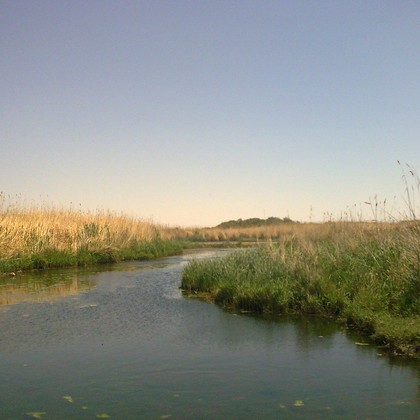
Clear, calm water with fish and perches: rivers, irrigation canals, fish ponds, reed-fringed banks and reservoirs, and in winter also brackish lagoons, harbours, rocky shores and mangroves. Nests in a self-dug tunnel in a steep sandy or loamy bank. Sits on a branch, post or rock low over the water and plunges vertically for small fish; occasionally hovers briefly.
Where the bird is most at home, classified by the habitats of North Africa and the Middle East.


Range and movements
Breeds sparsely in northern Morocco, northern Algeria and Tunisia, along rivers such as the Sebou and Medjerda; in winter it spreads to the oases on the northern edge of the Sahara. In Libya mainly a winter visitor on the coast. In Egypt a common winter visitor along the Nile, in the Delta, the Fayoum and along the Suez Canal. In the Levant (Israel, Lebanon, Syria) and in Iraq it breeds locally and is more numerous in winter, with many birds in the marshes of southern Iraq. On the Arabian Peninsula a winter visitor and passage migrant: regular along the Gulf coast of Kuwait, Saudi Arabia, Bahrain, Qatar and the Emirates, in Oman south to Dhofar, and scarce in western Saudi Arabia and Yemen. Beyond the region it breeds from Europe and north-west Africa through Central Asia to Japan, South and South-East Asia and New Guinea.
- Resident
- Summer visitor (c. Apr–Sep)
- Winter visitor (c. Oct–Mar)
- Passage (Mar–Apr, Oct–Nov)
- dark = core range, pale = thinly spread
How and when to look
In winter a quiet fish pond or irrigation canal in the Nile Delta or the Jordan Valley is a good bet; on the Gulf coast they sit remarkably often on stone jetties and breakwaters. Listen for the high whistle and then scan low along the bank: the bird often flies off before you have seen it perched.
Conservation status
Not globally threatened. The small breeding populations in North Africa and the Levant suffer from canalisation, pollution and rivers drying out through water abstraction; hard winters in Europe can make the number of winter visitors fluctuate sharply.
Scientific name
Alcedo atthis | (Linnaeus, 1758)
Linnaeus described the species in 1758 as Gracula Atthis; because it was later moved to another genus, the author and year stand in brackets. The genus Alcedo was introduced in 1758 by Linnaeus. Alcedo is the Latin word for 'kingfisher'. atthis refers to Atthis, a young woman of Lesbos and a favourite of the poet Sappho. The specimen the first description was based on came from Egypt.