All species › Waterfowl › Ducks, geese and swans › Falcated Duck
Falcated Duck | Mareca falcata
Bronskopeend | Cerceta de alfanjes
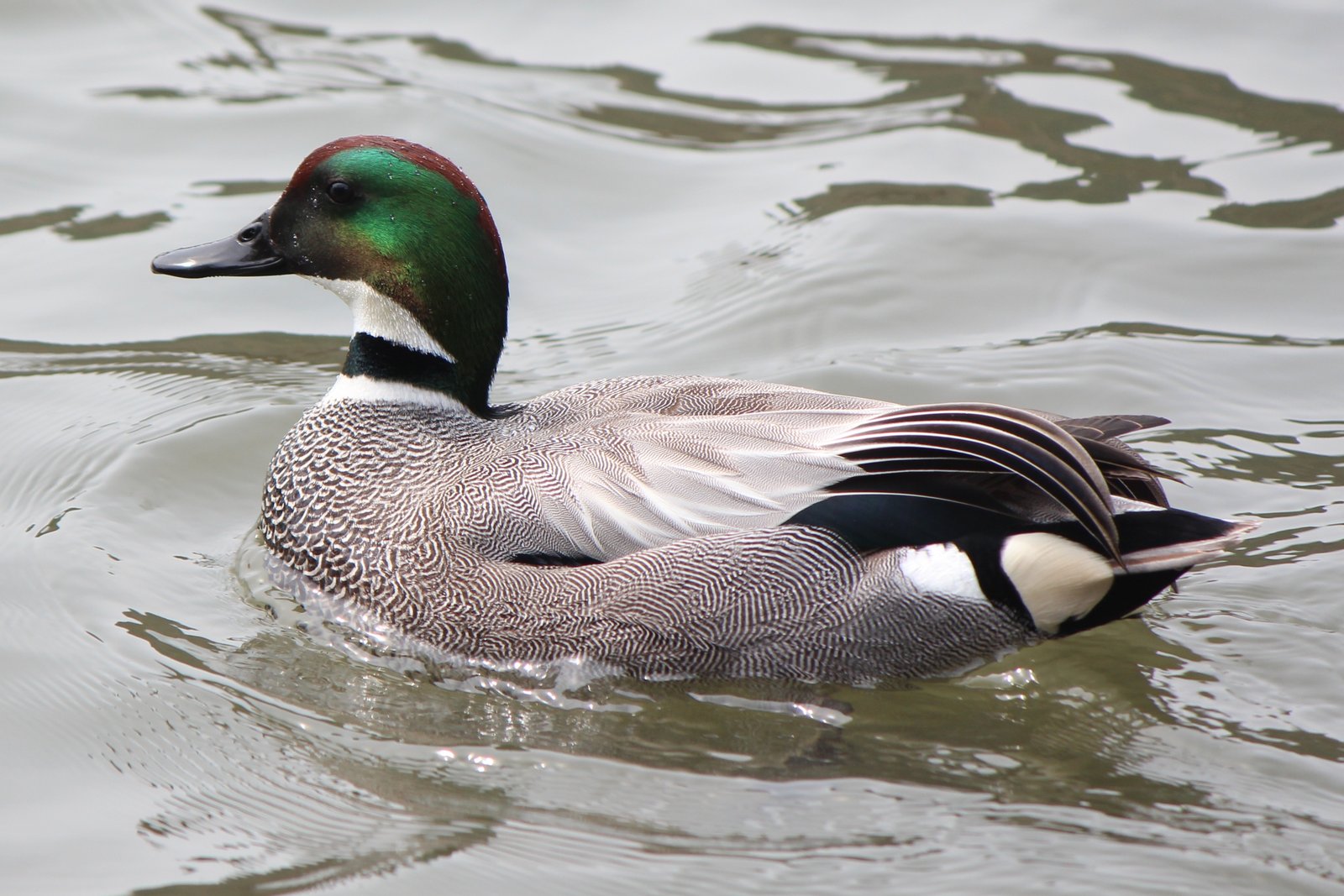
An East Asian relative of Gadwall and wigeon with a glossy bronze and green head and long sickle-shaped tertials that hang over the tail like a train. In the region it is an exceptional winter visitor, with only a handful of records known in the east.
Voice
Seldom heard. The male gives a low whistle followed by a trilling uit-trr; the female a hoarse quack rather like a female Gadwall.
Recording: Albert Lastukhin — CC BY-NC-SA 4.0 · converted to mono · xeno-canto
Identification
Slightly larger than a Eurasian Wigeon, with a dark, narrow bill. The male has a head with a long drooping nape crest, glossy copper-bronze on the crown and metallic green on the sides, a white throat with a narrow black collar, finely scaled grey breast and flanks, and black-and-grey sickle-shaped tertials curling over the rear. There is a yellow triangle in front of the black tail. The female is dark rufous-brown and scaled, with a greyer rounded head, a dark bill and a dark grey-green speculum with a narrow white leading edge.
Confusion species
The female resembles Gadwall (Mareca strepera), which has an orange bill edge and a white speculum, and Eurasian Wigeon (Mareca penelope), which has a short blue-grey bill and a white belly in warmer-coloured underparts. With an oddly coloured male, hybrids and escapes from captivity must be considered.
Habitat
Freshwater lakes, marshes, rivers and fishponds; vagrants usually join flocks of Eurasian Wigeon or Gadwall.
Where the bird is most at home, classified by the habitats of North Africa and the Middle East.


Range and movements
In the region only a handful of accepted records in the east, including Israel and the Gulf states; not established with certainty in North Africa. Breeds in eastern Siberia, Mongolia, north-east China and northern Japan and winters mainly in China, Japan and Korea, in small numbers west to northern India and Iran.
How and when to look
In winter check flocks of wigeon and Gadwall in the Jordan and Hula valleys and on the large lagoons of the Gulf states. A male stands out by the green head with its drooping crest and the curved tertials. With any find, check for rings, worn feathers or other signs of captivity: the species is widely kept in waterfowl collections.
Conservation status
Not threatened, although it was long listed as Near Threatened because of hunting and the loss of wetlands in East Asia. In the region a vagrant that does not originate there; for any record, escape from captivity remains a possibility.
Scientific name
Mareca falcata | (Georgi, 1775)
Georgi described the species in 1775 as Anas falcata; because it was later moved to another genus, the author and year stand in brackets. The genus Mareca was introduced in 1824 by Stephens. Mareca comes from the Portuguese marreco, a word for a small duck. falcata is Latin for 'sickle-shaped', after the long curved plumes that hang over the male's tail. The specimen the first description was based on came from Lake Baikal.