All species › Waterfowl › Ducks, geese and swans › Blue-Winged Teal
Blue-Winged Teal | Spatula discors
Blauwvleugeltaling | Cerceta aliazul
An American sister species of Garganey that crosses the Atlantic as a vagrant. In the region it turns up almost only in Morocco, where more than thirty records have now been made, sometimes of two or more birds together.
Voice
Mostly silent in the region. The male gives a high thin whistle, tsiew; the female a short hoarse quack.
Recording: Stanislas Wroza — CC BY-NC-SA 4.0 · converted to mono · xeno-canto
Identification
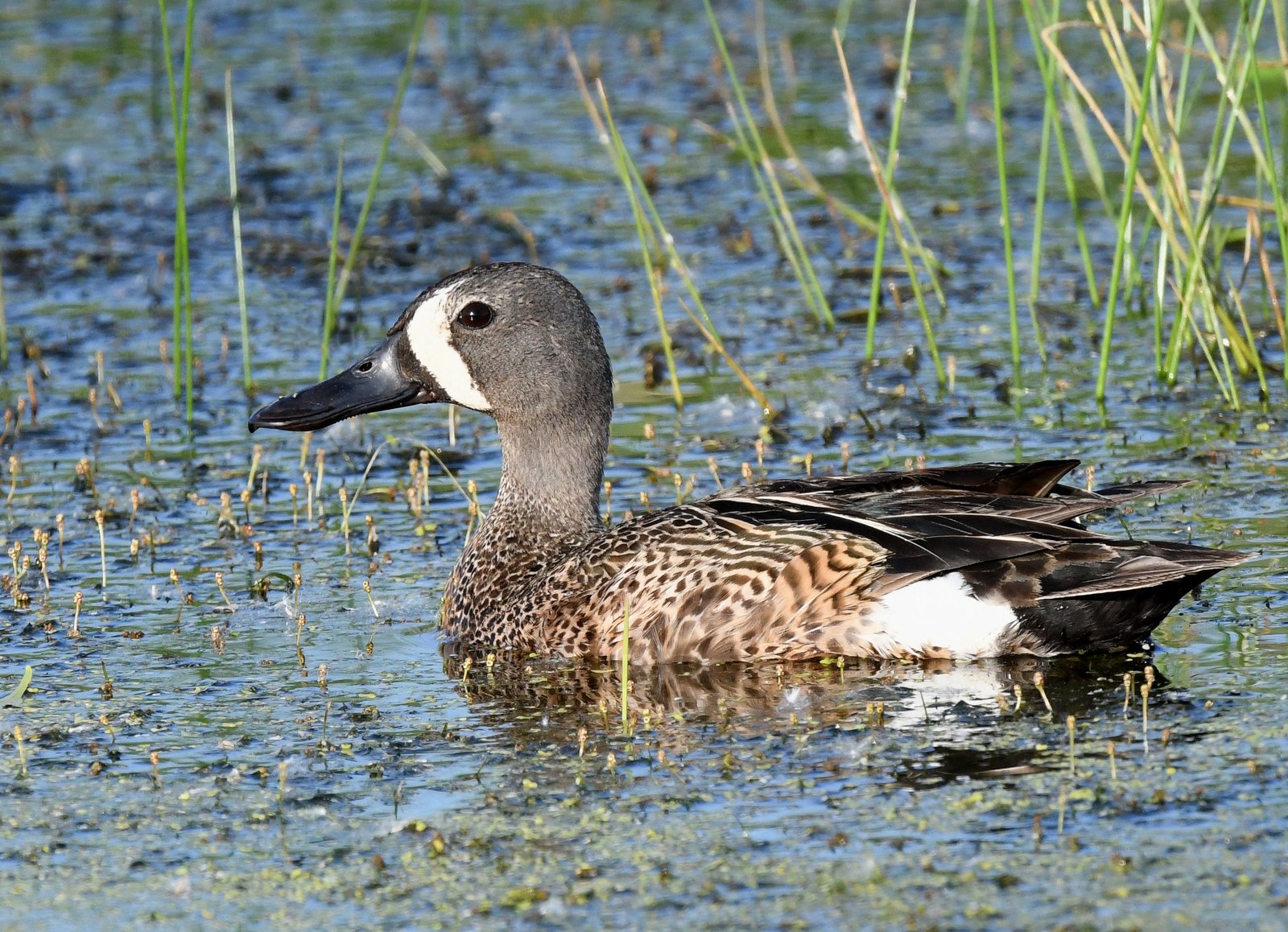
Small, with a fairly long dark bill. The male has a slate-grey head with a striking white crescent in front of the eye, pinkish-brown underparts spotted black, and a white patch on the rear flank before the black tail. In flight both sexes show a bright pale blue forewing with a white bar behind it and a green speculum. The female is warm greyish-brown, with a dark eye-stripe, a broken white eye-ring, a pale spot at the bill base and yellowish to orange-yellow legs.
Confusion species
Females and eclipse males closely resemble Garganey (Spatula querquedula), which has a more strongly striped face with a dark cheek bar, grey legs and a dull grey rather than bright blue forewing. Eurasian Teal (Anas crecca) is smaller and shorter-billed, with no blue in the wing. Females of Cinnamon Teal (Spatula cyanoptera), an American relative that may appear as an escape, are warmer brown and longer-billed with a plainer face.
Habitat
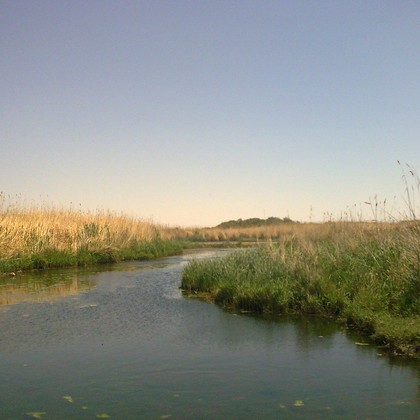
Shallow freshwater pools, river and wadi margins, flooded meadows, saltpans and treated-water pools; in Morocco also the lakes and temporary pools on the Saharan side of the Atlas. Often keeps company with Garganey and Eurasian Teal.
Where the bird is most at home, classified by the habitats of North Africa and the Middle East.

Range and movements
More than thirty records in Morocco, mainly along the Atlantic coast (including near Rabat, at Merja Zerga and at the Oued Massa mouth) and surprisingly often inland too, as at Merzouga. Exceptional elsewhere in the region. Breeds in North America from Alaska to Texas and winters from the southern United States to northern South America; wanders regularly to western Europe.
How and when to look
In Morocco between October and April, check every flock of small ducks at Merja Zerga, the Oued Massa and the pools around Merzouga. In flight the bright blue forewing gives it away, but Northern Shoveler shows that too: note the much smaller build.
Conservation status
Not threatened and one of the most numerous ducks in North America. In the region a vagrant that does not originate there; the strikingly high number of Moroccan records fits the country's Atlantic position.
Scientific name
Spatula discors | (Linnaeus, 1766)
Linnaeus described the species in 1766 as Anas discors; because it was later moved to another genus, the author and year stand in brackets. The genus Spatula was introduced in 1822 by Boie. Spatula is Latin for 'spoon' or 'spatula', after the broad, spoon-shaped bill of the shoveler. discors is Latin for 'discordant, differing', literally 'not of one heart'. The specimen the first description was based on came from Virginia or Carolina.