All species › Gamebirds › Guineafowl › Helmeted Guineafowl
Helmeted Guineafowl | Numida meleagris
Helmparelhoen | Pintada común
A large, grey and white-spotted gamebird with a bare blue head and a bony casque, running in groups through the scrub. In the region it is a marginal species: a small, declining population in the wadis and lowlands of south-west Saudi Arabia and western Yemen. The Moroccan subspecies N. m. sabyi is regarded as extinct.

Voice
Very noisy. The hen gives a grating, two-syllable ka-braak, ka-braak, repeated endlessly; when alarmed the flock bursts into a staccato kek-kek-kek-kerrr. Most vocal at first light and just before the group goes to roost in trees.
Recording: Walter Wallner — CC BY-NC-SA 4.0 · converted to mono · xeno-canto
Identification
A rotund body carried forward on dark grey legs, with a short drooping tail and short rounded wings. The plumage is dark slate-grey dotted all over with white spots. The head is bare, blue and red, with wattles at either side of the bill and a buff to reddish horny casque on the crown. Arabian birds are smaller and darker than African ones and have thick pale bristles at the base of the upper mandible, a striking red and yellow casque and blue wattles. The sexes are alike; the male has a slightly larger casque.
Confusion species
In south-west Arabia no real confusion is possible: no other gamebird is grey with white spots and a bare blue head. Arabian Partridge (Alectoris melanocephala), in the same foothills, is sandy with a black head stripe and a red bill. Domestic guineafowl from farmyards, often pied or white, may roam free; they are not part of the wild population.
Habitat
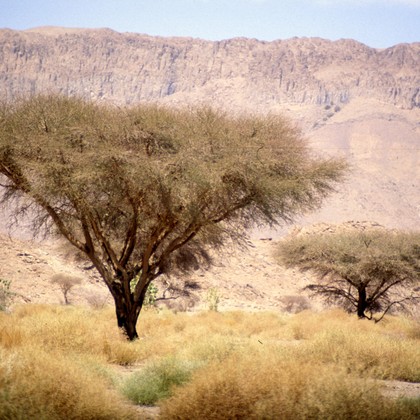
In Arabia dense acacia scrub and riverine woodland along wadis and reservoirs in the Tihama lowlands and the foot of the mountains, with adjoining fields and plantations where the birds feed. It roosts in tall trees near water. In Morocco the species lived in cork-oak and scrub woodland with clearings.
Where the bird is most at home, classified by the habitats of North Africa and the Middle East.


Range and movements
Saudi Arabia: very local in Jizan province, chiefly around Malaki Dam lake, Wadi Juwwah and Wadi Jizan, and at Abu Arish. Yemen: scattered in the western lowlands and foothills. Whether the Arabian birds are native or were introduced from Africa long ago is unclear; they have been known since the late eighteenth century and differ from the African forms. Morocco: the subspecies sabyi lived in the north-west; the last certain records in the wild date from the 1950s. Beyond the region widespread in sub-Saharan Africa, and introduced on many islands.
- Resident
- Summer visitor (c. Oct–Mar)
- Winter visitor (c. Apr–Sep)
- Passage (Mar–Apr, Oct–Nov)
- dark = core range, pale = thinly spread
How and when to look
In Jizan come to the shores of Malaki Dam lake or Wadi Jizan at first light and listen for the grating calls from the roost trees. During the day groups run through the scrub and sometimes cross a track; they only fly when cornered.
Conservation status
Not globally threatened and common in Africa. In Arabia the population is small and has declined sharply through hunting, clearance of scrub and drought; the Arabian Breeding Bird Atlas (2010) considered extinction within a few decades possible. The Moroccan form is probably extinct.
Scientific name
Numida meleagris | (Linnaeus, 1758)
Linnaeus described the species in 1758 as Phasianus Meleagris; because it was later moved to another genus, the author and year stand in brackets. The genus Numida was introduced in 1764 by Linnaeus. Numida is Latin for 'Numidian', an inhabitant of North Africa. meleagris is the Greek word for guineafowl. The specimen the first description was based on came from Nubia on the upper Nile.