All species › Pelicans, herons and ibises › Herons and bitterns › Goliath Heron
Goliath Heron | Ardea goliath
Goliathreiger | Garza goliat
The largest heron in the world, a giant of nearly one and a half metres that in the region lives mainly in the mangroves and on the islets of the southern Red Sea. It is scarce everywhere, but a resident along the coast of south-west Saudi Arabia and Yemen, and for many birders one of the highlights of the Red Sea coast.
Voice
A deep, loud, barking kowoork, audible at great distance, usually on take-off or when disturbed; otherwise fairly silent.
Recording: Jonathan Onongo — CC BY-NC-SA 4.0 · converted to mono · xeno-canto
Identification
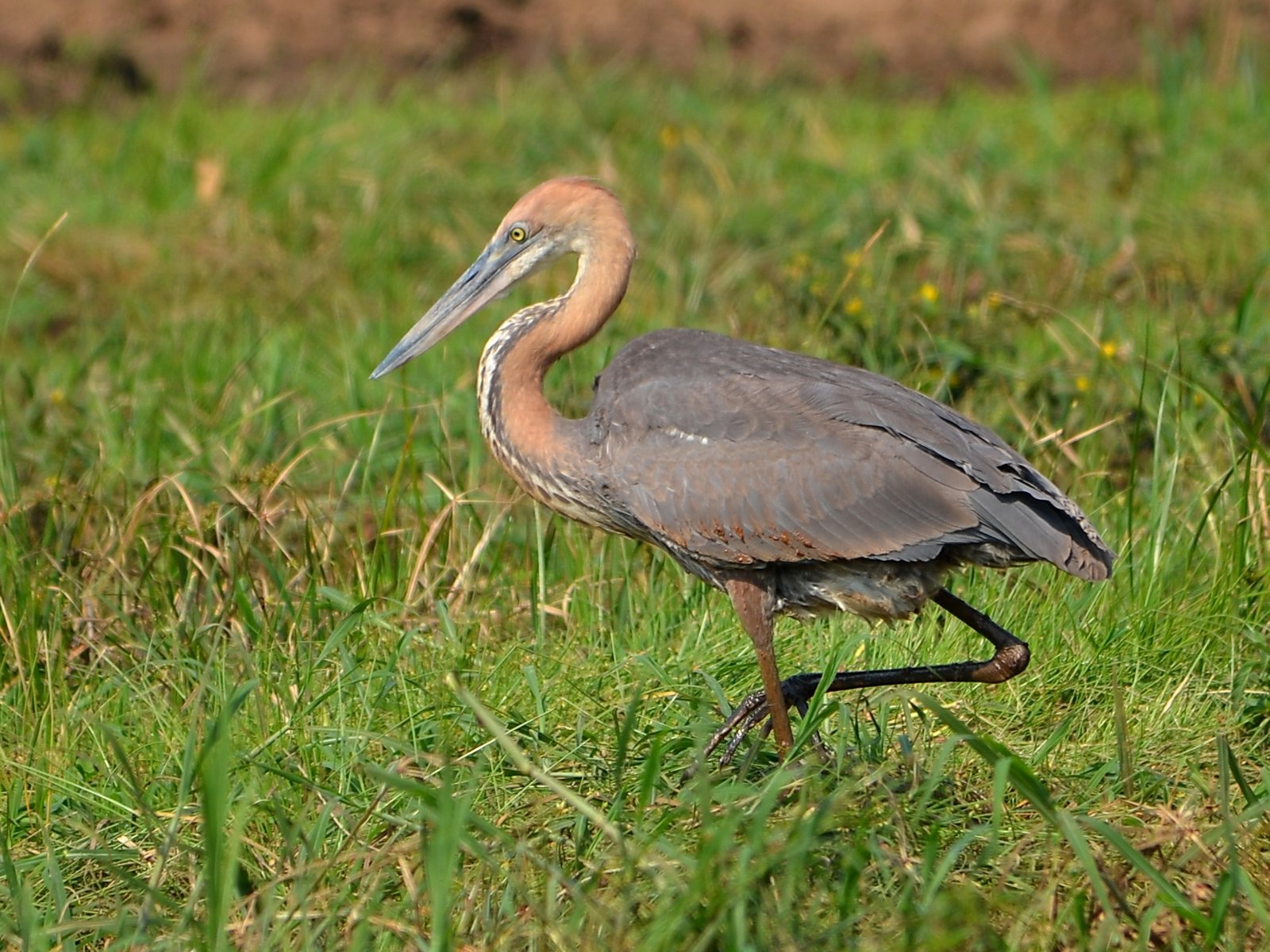
Huge, with a long, thick neck, a massive, dagger-shaped dark grey bill and long black legs. The head, hindneck and underparts are deep rufous to chestnut, the throat and foreneck white with black streaks, and the back and wings slate-grey. There is no black crown. Juveniles are paler and duller rufous. Flight slow and heavy, with very broad wings, the neck retracted and the long legs well beyond the tail; the underwing is grey with rufous coverts.
Confusion species
Purple Heron (Ardea purpurea) has a similar colour pattern but is much smaller and slimmer, with a black crown and black neck stripes and yellow legs. Grey Heron (Ardea cinerea) is smaller and grey and white. At a distance a resting Goliath Heron may recall Common Crane (Grus grus) or a stork, but the shape of the bill and neck soon gives it away.
Habitat
In the region almost exclusively coastal: mangroves, creeks, shallow lagoons, reef flats and tidal flats, and the small islands of the Red Sea, where it also breeds. It hunts alone, with endless patience in shallow water, for large fish. Rarely inland, then at reservoirs or sewage ponds.
Where the bird is most at home, classified by the habitats of North Africa and the Middle East.


Range and movements
A small resident population lives along the Red Sea coast of south-west Saudi Arabia, from the mangroves at Al Lith and Amaq to Jizan and the Farasan Islands, and in Yemen (the Tihama coast and offshore islands); it breeds mainly on the islets. In Egypt rare on the southern Red Sea coast, where breeding has been recorded, and a scarce visitor to the Gulf of Aqaba and Sinai. In Israel and Jordan (Eilat, Aqaba) a rare vagrant; in southern Iraq it formerly bred in the marshes, but there are no recent breeding records. Otherwise a rare visitor to Oman and the Emirates. Inland in Saudi Arabia only a single record (Tabuk). Beyond the region in sub-Saharan Africa, from Senegal to Ethiopia and South Africa, with a small, declining population in Iran and scattered records in South Asia.
- Resident
- Summer visitor (c. Apr–Sep)
- Winter visitor (c. Oct–Mar)
- Passage (Mar–Apr, Oct–Nov)
- dark = core range, pale = thinly spread
How and when to look
Drive or take a boat along the mangroves of south-west Saudi Arabia, at Al Lith, Amaq and Jizan, or visit the Farasan Islands: Goliath Herons often stand motionless at the edge of the mangrove there. A telescope is essential, as they are shy and keep their distance.
Conservation status
Not globally threatened. On the Arabian side of the Red Sea the population seems stable or slightly increasing, but it is small and depends on undisturbed mangroves and islands, threatened by coastal development, shrimp farms and disturbance. In Iraq it has virtually disappeared as a breeding bird.
Scientific name
Ardea goliath | Cretzschmar, 1829
Cretzschmar described the species in 1829 and placed it straight away in the genus where it still stands. The genus Ardea was introduced in 1758 by Linnaeus. Ardea is the Latin word for 'heron'. goliath refers to Goliath, the biblical giant — for the size of the world's largest heron. The specimen the first description was based on came from White Nile, Sudan.