All species › Waders, gulls and terns › Gulls and terns › Great Black-Backed Gull
Great Black-Backed Gull | Larus marinus
Grote mantelmeeuw | Gavión atlántico
The largest gull in the world, a northern species of the North Atlantic coasts. Surprisingly, a small isolated group breeds far to the south in the Khnifiss lagoon in southern Morocco, the only place in the world where it occurs together with Kelp Gull; otherwise it is a scarce winter visitor to the region.
Voice
A deep, hoarse, short owk-owk-owk and a low, barking laughing call, clearly lower than other large gulls.
Recording: Corentin Rivière — CC BY-NC-SA 4.0 · converted to mono · xeno-canto
Identification
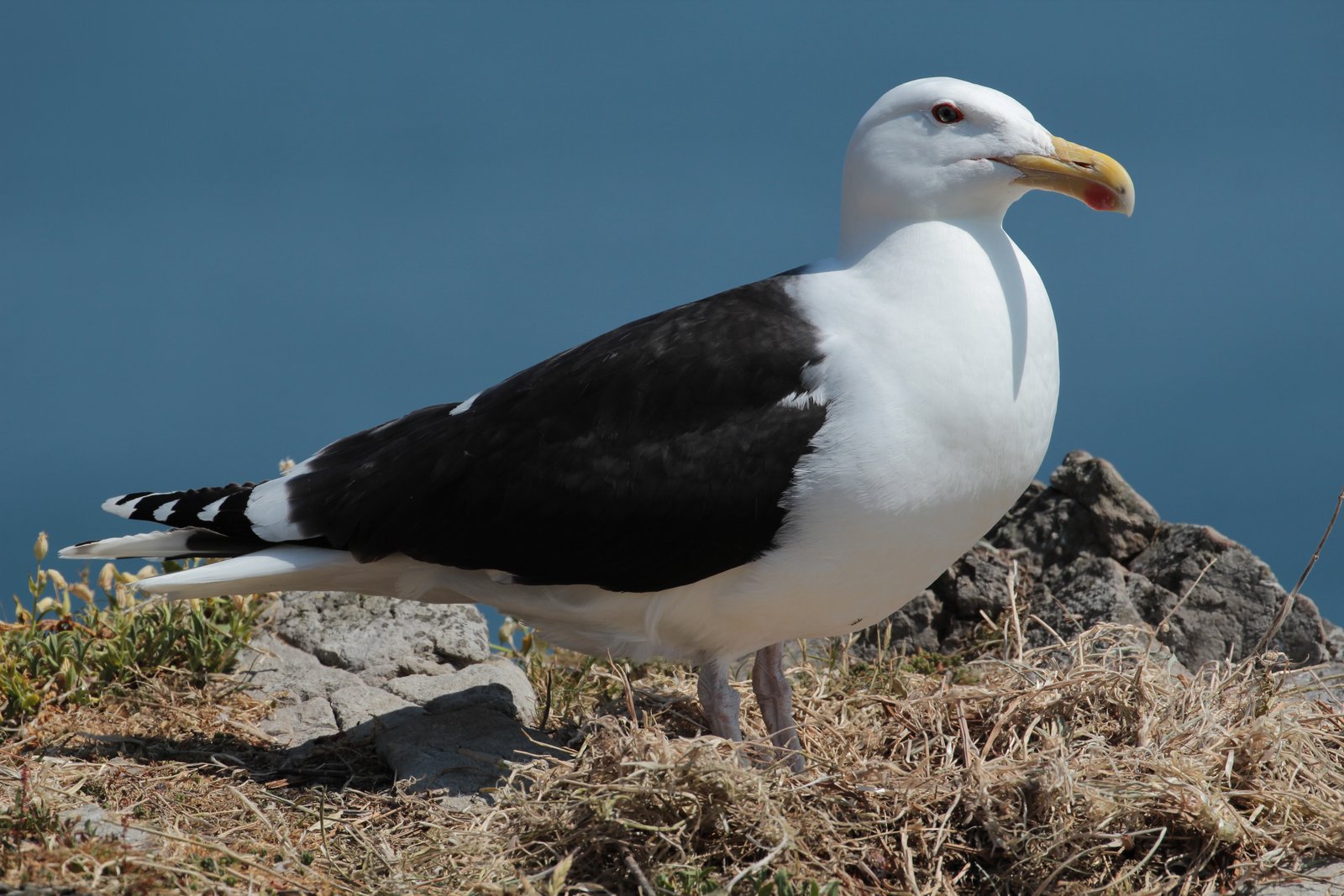
Very large and heavy, with a broad chest, a big head and a massive yellow bill with a red gonys spot. The mantle and wings are blackish slate, the legs flesh-pink, the eye pale. The wingtip shows much white: a large white mirror on p10 that often merges with the white tip, and a mirror on p9. In flight it looks heavy, with broad wings and slow beats. First-years are coarsely chequered black and white above, with a pale, whitish head and underparts, a black bill and a narrow, broken tail band; they are adult only after four years.
Confusion species
Kelp Gull (Larus dominicanus) is smaller, with olive-green legs, a dark eye and only one small mirror in the wingtip. Lesser Black-backed Gull (Larus fuscus) is much smaller and slimmer, with yellow legs, a slimmer bill, longer wingtips and little white in them. Young birds can resemble young Yellow-Legged Gulls (Larus michahellis), but are larger, with a paler head, a heavier bill and more contrastingly chequered upperparts.
Habitat
Rocky coasts, lagoons, sandy beaches, estuaries and fishing harbours. At Khnifiss it breeds on islets and sandbanks in the lagoon.
Where the bird is most at home, classified by the habitats of North Africa and the Middle East.

Range and movements
A small breeding population of a few pairs is established in the Khnifiss lagoon in southern Morocco; in that area and elsewhere along the southern Atlantic coast (Akhfenir, Tarfaya, Dakhla) it can be seen year-round in small numbers. Elsewhere in Morocco a scarce winter visitor, with a few birds each year along the Atlantic coast from Salé to Agadir and on the Mediterranean coast at Martil and Ceuta. Very rare in Algeria and Tunisia, and only exceptionally recorded in the east of the region. Beyond the region it breeds along the coasts of the North Atlantic, from north-west France and the British Isles through Scandinavia and Iceland to Greenland and eastern Canada, and winters mainly in those areas, south to Spain.
- Resident
- Winter visitor (c. Apr–Sep)
- Passage (Mar–Apr, Oct–Nov)
- dark = core range, pale = thinly spread
How and when to look
The Khnifiss lagoon, reached from Akhfenir, is the only place in the region where you can be sure of seeing the species, often among Lesser Black-Backed Gulls and sometimes next to a Kelp Gull: a unique chance for comparison.
Conservation status
Not globally threatened, but declining in parts of north-west Europe. The tiny Moroccan breeding population is vulnerable to disturbance in the Khnifiss lagoon, which is protected as a national park.
Scientific name
Larus marinus | Linnaeus, 1758
Linnaeus described the species in 1758 and placed it straight away in the genus where it still stands. He introduced the genus Larus in that same work. Larus is Latin, from Ancient Greek laros, and appears to have referred to a gull or another large seabird. marinus is Latin for 'marine', the whole name meaning 'sea gull'. The specimen the first description was based on came from Gotland, Sweden.