All species › Cuckoos › Cuckoos › Great Spotted Cuckoo
Great Spotted Cuckoo | Clamator glandarius
Kuifkoekoek | Críalo europeo
A large, slender cuckoo with a silver-grey crest, white-spotted back and long tail, which as one of the earliest summer visitors returns to North Africa and the Levant as early as January and February. It is a brood parasite of magpies and crows and chases through olive groves and open woodland in noisy pursuits.

Voice
A loud, far-carrying rattle, kitte-kitte-kitte-keh, like a hurried magpie, plus a harsh, rising kreeah. Displaying pairs and small groups call all morning, also from posts and wires, especially in the first weeks after arrival.
Recording: Walter Wallner — CC BY-NC-SA 4.0 · converted to mono · xeno-canto
Identification
Large and slender, with a long, graduated tail and a grey crest often half raised. The upperparts are dark grey-brown with dense white drop-shaped spots; throat and breast cream to yellowish, belly white. The tail feathers have white tips; around the eye is a red to orange eye-ring. Juveniles have a black crown without a crest and bright rufous primaries, a vivid signal in flight. Flies straight and fast with deep beats, almost like a small falcon or a magpie.
Confusion species
Common Cuckoo (Cuculus canorus) is smaller, plain slate-grey without a crest or white spots, with barred underparts. Jacobin Cuckoo (Clamator jacobinus) is black and white, with a black crest, a white wing patch and an unspotted back; it occurs mainly in south-west Arabia. At a distance a flying Great Spotted Cuckoo can look like a Eurasian Magpie (Pica pica) or Maghreb Magpie (Pica mauritanica), but the pale, unstreaked underside gives it away.
Habitat
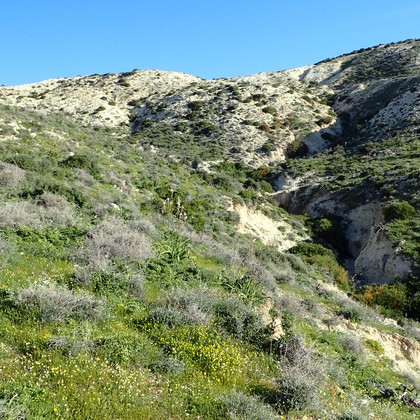
Open country with scattered trees: olive, almond and citrus groves, open oak and pine woodland, garrigue with shrubs, wooded field edges and parks, always where magpies or crows breed. On passage also in oases, palm groves and wadis with acacias. Feeds mainly on hairy caterpillars, which other birds avoid.
Where the bird is most at home, classified by the habitats of North Africa and the Middle East.


Range and movements
Breeds in Morocco (mainly the Atlantic plains, the Rif and the Middle Atlas), northern Algeria and Tunisia, north-east Libya (Cyrenaica), the Nile Delta in Egypt, Israel, the West Bank (Samaria and Judea), Jordan, Lebanon, Syria and Iraq. In Egypt and the Levant it mainly parasitises Hooded Crow (Corvus cornix), in the Maghreb the Maghreb Magpie. Scarce on passage across the Sahara, in Saudi Arabia, Kuwait and the Gulf states; a rare migrant in Yemen and Oman. Beyond the region it breeds in south-west Europe and Turkey and in parts of sub-Saharan Africa; winters mainly in the Sahel and East Africa.
- Resident
- Summer visitor (c. Apr–Sep)
- Winter visitor (c. Oct–Mar)
- Passage (Mar–Apr, Oct–Nov)
- dark = core range, pale = thinly spread
How and when to look
In February and March the displaying groups are easiest: look in the Jordan Valley, around Beit She'an and in the olive groves of Galilee, or in Morocco in the cork-oak forests around Rabat and the Maamora. Follow rattling birds and quarrelling magpies or crows: where the hosts are alarming, the cuckoo is often close by.
Conservation status
Not globally threatened and common in large parts of the region. It is sensitive to insecticide use in orchards, which removes caterpillars, and to hunting and trapping on passage; at the same time it follows its hosts, and is increasing in some parts of the Levant and Egypt.
Scientific name
Clamator glandarius | (Linnaeus, 1758)
Linnaeus described the species in 1758 as Cuculus glandarius; because it was later moved to another genus, the author and year stand in brackets. The genus Clamator was introduced in 1829 by Kaup. Clamator is Latin for 'shouter', from clamare 'to shout'. glandarius is Latin for 'of acorns', the same epithet borne by the jay. The specimen the first description was based on came from Gibraltar.