All species › Cuckoos › Cuckoos › White-Browed Coucal
White-Browed Coucal | Centropus superciliosus
Wenkbrauwspoorkoekoek | Cucal cejiblanco
A large coucal with a white supercilium and chestnut wings, which in the region occurs only in south-west Arabia. In the green wadis and field edges of Yemen and the far south-west of Saudi Arabia, its gurgling call is one of the typical sounds of early morning.
Voice
A long, bubbling series of hollow notes, hoo-hoo-hoo-hoo-hoo-hoo, first falling and accelerating, then rising and slowing again, like water poured from a bottle; often in duet, especially at sunrise, at dusk and after rain. When alarmed a harsh, hissing chek.
Recording: Jonathan Onongo — CC BY-NC-SA 4.0 · converted to mono · xeno-canto
Identification
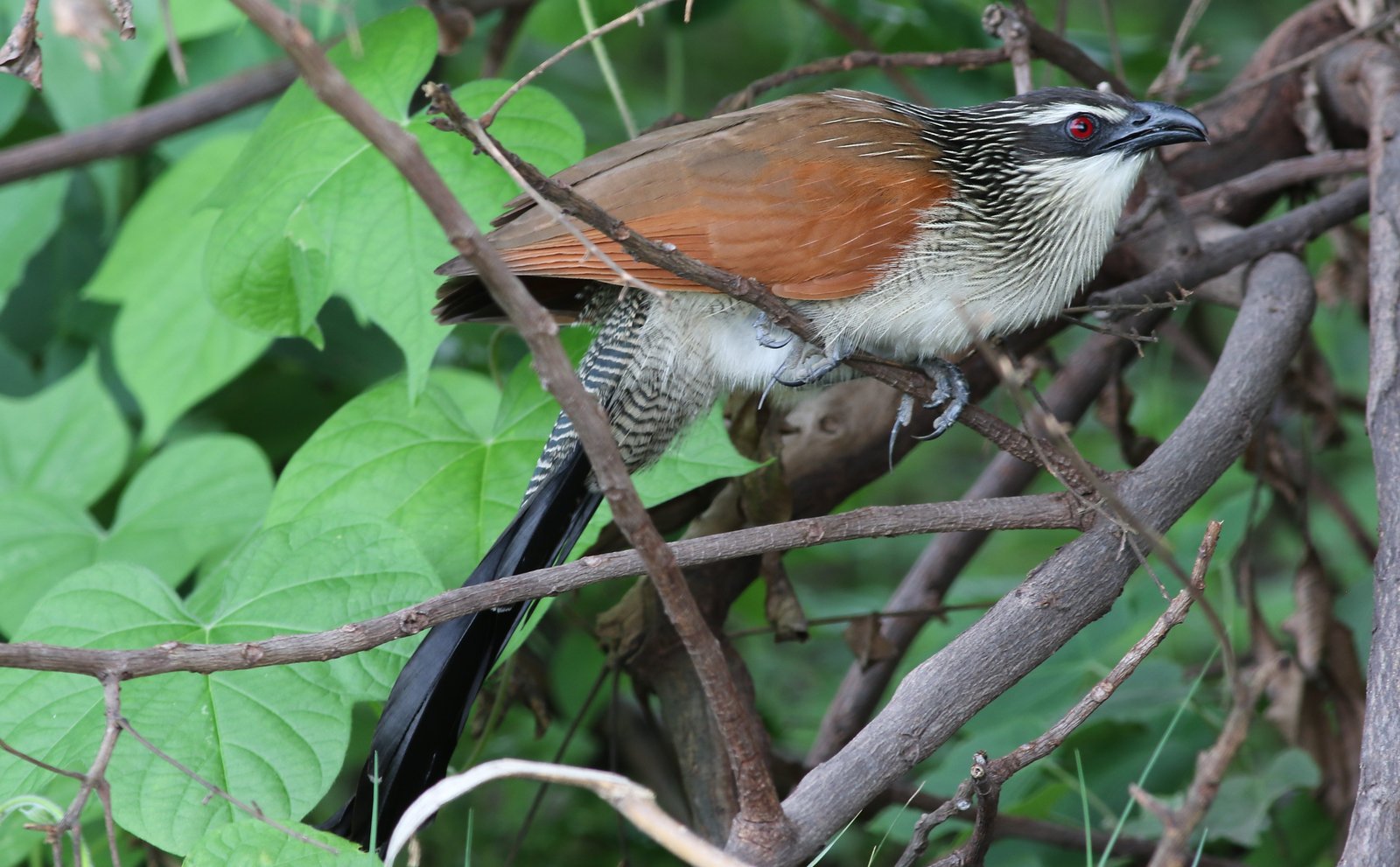
Dark brown to blackish crown, a broad white supercilium and a finely white-streaked hindneck, sides of head and mantle. Back rufous-brown, wings chestnut, underparts cream to white, the breast sometimes with fine pale shaft streaks. Rump and uppertail coverts finely barred black and cream; the long, broad tail is black with a greenish gloss. Red eye, heavy black bill. Juveniles have a barred back, a fainter supercilium and a dark eye. Flight short and heavy, with the tail broadly fanned.
Confusion species
In the region it cannot be confused with any other coucal: Senegal Coucal (Centropus senegalensis) occurs only in the Nile country of Egypt and lacks the white supercilium and the barred rump. In quick flight between bushes it may recall a large babbler or an Asian Koel (Eudynamys scolopaceus), but the chestnut wings are always distinctive.
Habitat
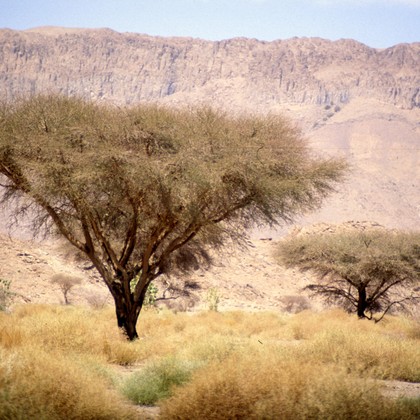
Dense scrub and rank growth along wadis with permanent or seasonal water, riverine woodland with tamarisk and figs, reedbeds, irrigated fields with hedges, banana and mango plantations and dense gardens. In Yemen from the Tihama coastal plain up to at least 2000 m in the mountains. It takes mainly large insects, lizards and small vertebrates, on the ground and low in bushes.
Where the bird is most at home, classified by the habitats of North Africa and the Middle East.


Range and movements
In the region in Yemen, in the Tihama and the western and southern mountain wadis into the interior of Hadramaut, and in south-west Saudi Arabia, in the Tihama and the foothills of the Asir mountains around Jizan and Abha. Not on Socotra. Beyond the region from Eritrea and Ethiopia through East Africa to southern Africa; Arabian birds belong to the nominate form superciliosus.
- Resident
- Summer visitor (c. Oct–Mar)
- Winter visitor (c. Apr–Sep)
- Passage (Mar–Apr, Oct–Nov)
- dark = core range, pale = thinly spread
How and when to look
It shows best in the first hours after sunrise, when it sits warming itself with spread wings in a treetop or on a hedge. Walk along vegetated wadis in the Tihama or the mountains west of Taiz and Ibb and listen for the gurgling duet; it is often followed by a short flight low over the bushes.
Conservation status
Not globally threatened and fairly common in suitable parts of Yemen and south-west Saudi Arabia. It is sensitive to the clearing of riverine vegetation and the drying out of wadis through excessive groundwater extraction, but locally benefits from irrigated agriculture with hedges.
Scientific name
Centropus superciliosus | Hemprich & Ehrenberg, 1829
Hemprich & Ehrenberg described the species in 1829 and placed it straight away in the genus where it still stands. The genus Centropus was introduced in 1811 by Illiger. Centropus comes from the Greek kentron, 'spur, goad', and pous, 'foot' — for the long, straight hind claw, a feature of all coucals. superciliosus is Latin for 'eyebrowed' — for the broad white supercilium. The specimen the first description was based on came from Arabia and Ethiopia.