All species › Waders, gulls and terns › Painted-snipes › Greater Painted-Snipe
Greater Painted-Snipe | Rostratula benghalensis
Goudsnip | Aguatero bengalí
A secretive, snipe-like wader with reversed sex roles: the female is larger and more brightly marked and does the displaying, while the male incubates and raises the young. In the region it is a bird of the Nile: in the Delta, the valley and the Faiyum it is a resident but rarely seen inhabitant; beyond that it breeds locally in Israel and recently in south-western Saudi Arabia.
Voice
Usually silent. The displaying female gives a series of deep, hollow notes, mainly at dusk and at night, like blowing across a bottle: ook… ook… ook, slowly and long repeated. Flushed birds sometimes give a short, harsh kek.
Recording: Greg Irving — CC BY-NC-SA 4.0 · converted to mono · xeno-canto
Identification
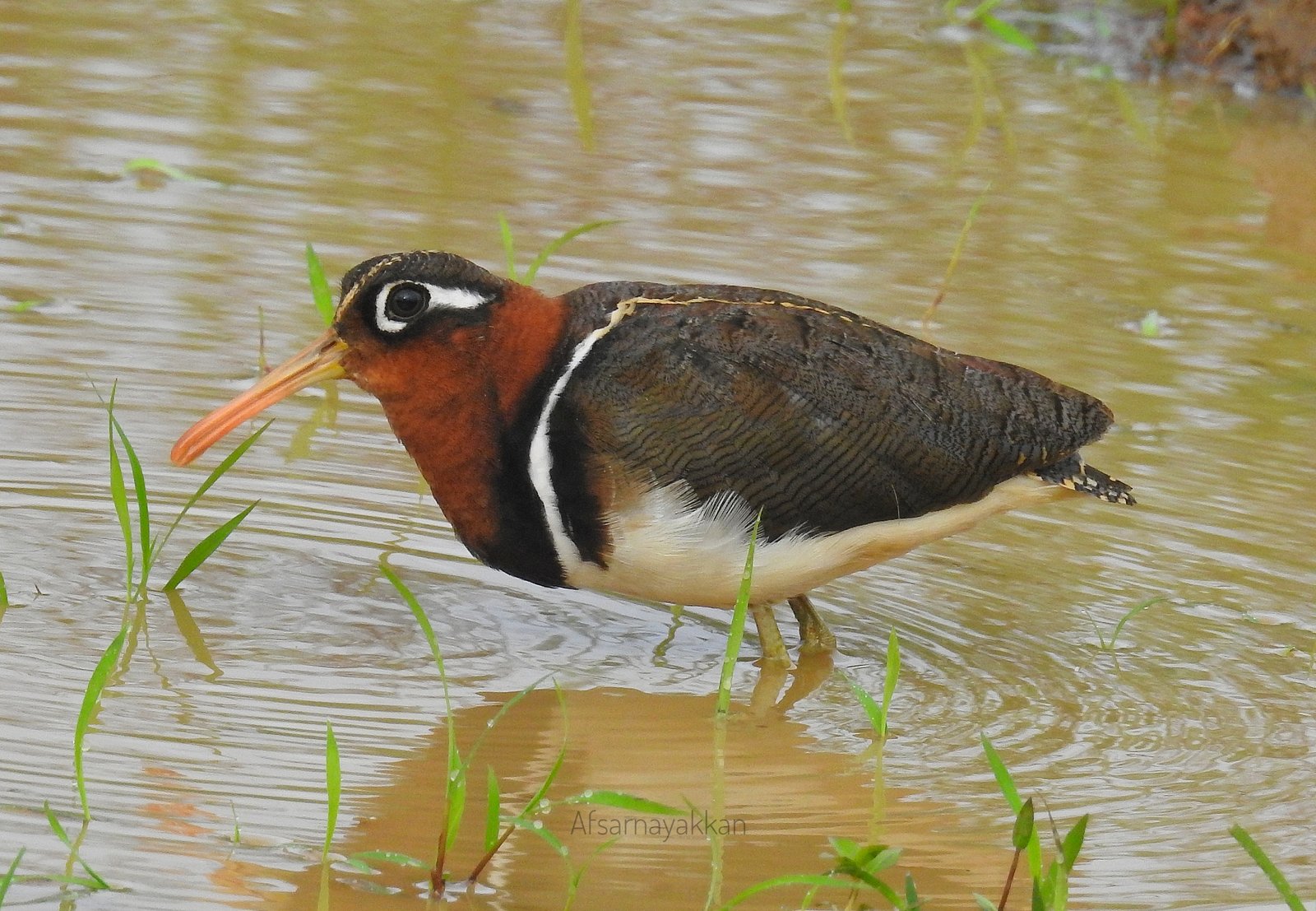
Stocky, with a long bill that droops slightly and broadens at the tip, fairly short greenish legs and broad, rounded wings. Both sexes show a pale crown stripe, a striking pale patch around the eye that extends back into a point, and a pale band running obliquely from the shoulder down the breast side. The female has a warm chestnut head and neck, a blackish breast band, dark bronze-green upperparts and a pure white eye patch. The male is smaller and duller, grey-brown with golden-buff spots on the wing coverts and a pale buff eye patch. Flushes weakly and floppily with dangling legs, like a rail.
Confusion species
Common Snipe (Gallinago gallinago) and other snipes are boldly striped, have a much longer, straight bill and pointed wings, and fly off fast and zigzagging. Greater Painted-Snipe has the pale eye patch, the oblique shoulder band and rounded wings with buff spots. When flushed it can recall a Water Rail (Rallus aquaticus) or Spotted Crake (Porzana porzana), but those lack the long, slightly drooping bill and the bold head pattern.
Habitat
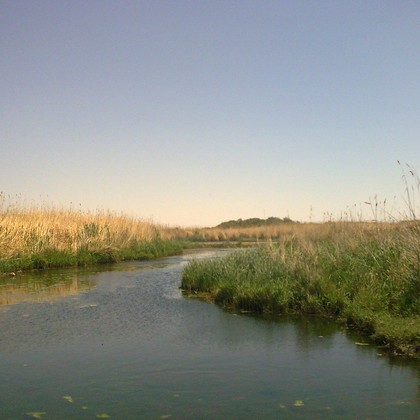
Shallow, muddy freshwater margins with dense cover: small marshes and reed fringes, overgrown irrigation canals and ditches, rice fields, wet fields, fish ponds and sewage settling ponds. It needs soft mud to probe and vegetation to hide in, and is most active at dusk.
Where the bird is most at home, classified by the habitats of North Africa and the Middle East.


Range and movements
In Egypt resident in the Nile Delta, the Nile Valley and the Faiyum, locally into Upper Egypt. In Israel a breeder since the 1990s at fish ponds and small marshes on the coastal plain and in the Hefer Valley (including En Hahoresh and the Hama'apil ponds), now recorded almost annually; also an irregular visitor inland. In south-western Saudi Arabia first seen in 2010 near Sabya, where it has been recorded in most years since and has bred a few times since 2013. Elsewhere a rare visitor: a few records from Oman (Al Ansab, Raysut, Khawr Rawri), the Emirates and Qatar. Beyond the region widespread in sub-Saharan Africa, Madagascar and from Pakistan and India to South-East Asia.
- Resident
- Summer visitor (c. Apr–Sep)
- Winter visitor (c. Oct–Mar)
- Passage (Mar–Apr, Oct–Nov)
- dark = core range, pale = thinly spread
How and when to look
In Egypt the canal and rice-field margins around the Faiyum and in the Delta give the best chance: drive slowly along overgrown canals early in the morning or at dusk and scan the muddy edges. In Israel the fish ponds of the Hefer Valley and Hama'apil are the place; listen at dusk for the hollow calls of the female.
Conservation status
Not globally threatened. In Egypt under pressure from the concreting of irrigation canals, clearance of bank vegetation and drainage of marshes; in Israel dependent on fish ponds, which are increasingly filled in or intensified. The colonisation of Saudi Arabia depends on a few settling ponds and wet fields near Sabya.
Scientific name
Rostratula benghalensis | (Linnaeus, 1758)
Linnaeus described the species in 1758 as Rallus benghalensis; because it was later moved to another genus, the author and year stand in brackets. The genus Rostratula was introduced in 1816 by Vieillot. Rostratula is Latin, a diminutive of rostratus 'beaked', from rostrum 'bill', after the long bill of these snipe-like birds. benghalensis means 'from Bengal', after the region in the north-east of the Indian subcontinent. The specimen the first description was based on came from Asia.