All species › Passerines › Buntings › Grey-Necked Bunting
Grey-Necked Bunting | Emberiza buchanani
Steppegors | Escribano cabecigrís
Grey-necked Bunting is an ortolan-like bunting of dry, rocky mountain slopes in Iran and Central Asia, wintering in the Indian subcontinent. The region lies west of its migration route; there are only a few records, mainly in eastern Arabia, and every find calls for careful comparison with the much commoner Ortolan Bunting.
Voice
The call is a short, soft tchep or tsip, a little softer than Ortolan Bunting's, and a thin tsee. The song, a short phrase of a few equal notes with a lower ending, resembles Ortolan's but is almost never heard in the region.
Recording: Richard E. Webster — CC BY-NC-SA 4.0 · shortened to the first 60 s, mono · xeno-canto
Identification
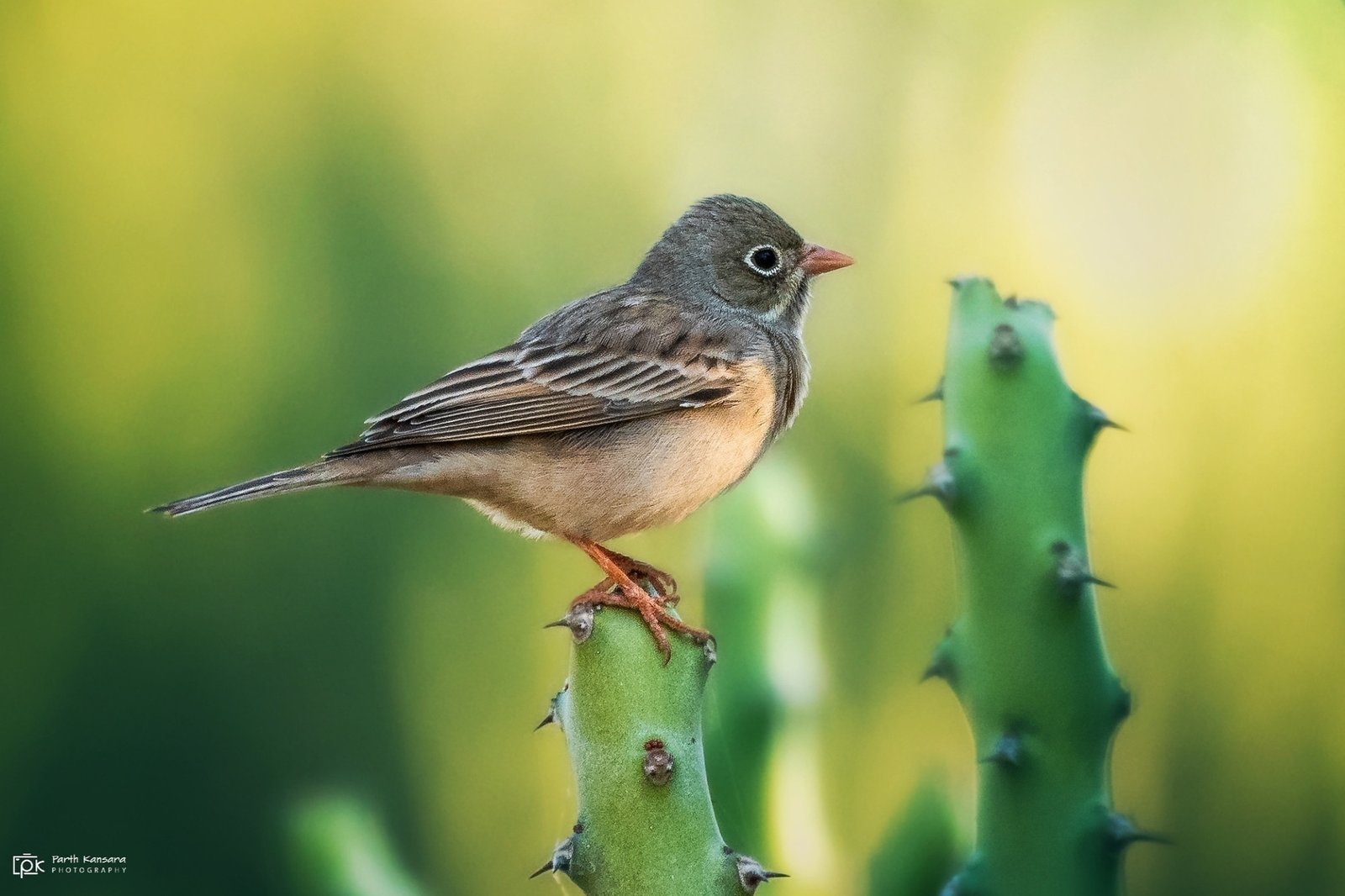
15–16 cm. Slim bunting with a long tail with white outer feathers and a pink bill. Head and neck are plain blue-grey with a striking white eye-ring and a pale, creamy throat and moustachial stripe, lacking the yellow or orange-brown tones of the ortolans. The upperparts are grey-brown with a rusty tinge to the scapulars, the underparts pinkish cinnamon, paler towards the belly. The female is duller, with a finely streaked crown and some streaks on the breast; juveniles are browner and streaked but keep the white eye-ring and the pale, almost unstreaked belly.
Confusion species
Ortolan Bunting (Emberiza hortulana) is the main pitfall: it has a grey-green head, a yellow throat and moustachial stripe, a yellow eye-ring and a clearly streaked back. Cretzschmar's Bunting (Emberiza caesia) has an orange-brown throat and a darker rufous belly. Grey-necked looks paler and greyer, with an unstreaked, sandy-grey back with rusty scapulars and a whitish throat. Juveniles of all three are difficult; check the back pattern, the colour of the eye-ring and the call.
Habitat
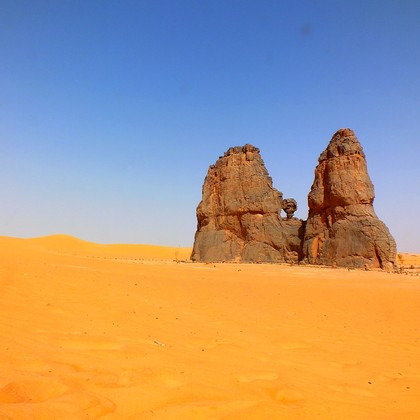
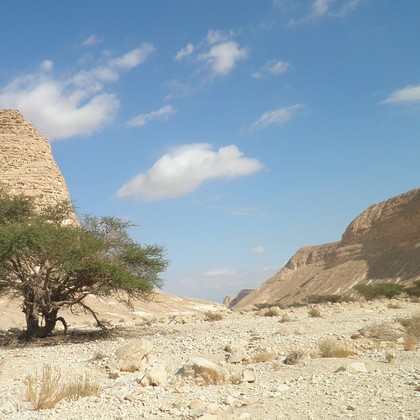
On passage and in winter on dry, stony slopes with sparse vegetation, in wadis and on bare plains at the foot of mountains, also at field edges. On the breeding grounds on bare, rocky mountain slopes up to above 2,000 m.
Where the bird is most at home, classified by the habitats of North Africa and the Middle East.
Range and movements
A vagrant in the region. Kuwait has three records, each a single bird on passage, the latest in September 2011. Oman and the United Arab Emirates have a small number of records in winter and on passage, mainly in the stony foothills of the Hajar Mountains; one or a few records are also known from Israel. Elsewhere, in Iraq, Saudi Arabia and the rest of the Gulf, it has as far as known hardly been recorded, although it is easily overlooked among Ortolan Buntings. Beyond the region it breeds from eastern Turkey and Armenia through Iran and Afghanistan to the Altai and Mongolia, and winters in western and central India.
How and when to look
Check every pale Ortolan Bunting in autumn and winter in Oman and the Emirates: a white eye-ring, a whitish throat and an unstreaked grey back with rusty scapulars are the clues. Photograph back and head and record the call; an undocumented report is rarely accepted.
Conservation status
Not globally threatened (IUCN: Least Concern). In the region a rare vagrant with no regular route, with at most a handful of records per country.
Scientific name
Emberiza buchanani | Blyth, 1845
Blyth described the species in 1845 and placed it straight away in the genus where it still stands. The genus Emberiza was introduced in 1758 by Linnaeus. Emberiza comes from Old German Embritz, a name for a bunting. buchanani honours Francis Buchanan-Hamilton (1762-1829), Scottish surgeon and naturalist in India. The specimen the first description was based on came from the Indian peninsula.