All species › Passerines › Buntings › Striolated Bunting
Striolated Bunting | Emberiza striolata
Gestreepte gors | Escribano estriado
The Striolated Bunting is a small, warm-brown bunting of rocky desert mountains, gorges and wadis, from Sinai and the Negev to Oman. It is the eastern counterpart of the House Bunting and is usually treated as a separate species; unlike that species it lives mainly outside villages.

Voice
The song is short and dry: a handful of fast, somewhat twanging notes with a falling ending, witch-witch-weechee-choo, repeated in short series from a boulder or ledge, most often in the early morning and late afternoon. The call is a nasal, slightly rising tchweep that carries far between rock walls.
Recording: David Darrell-Lambert — CC BY-NC-SA 4.0 · converted to mono · xeno-canto
Identification
14 cm, small and short-tailed, without white in the tail. The head is grey with sharp dark and white stripes: a pale crown stripe between dark bands, a white supercilium, a dark eye-stripe and a white stripe below the cheek. Throat and breast are grey with fine dark streaks. The back is grey-brown with clear dark streaks, the wings rufous, the belly warm cinnamon. The upper mandible is dark, the lower orange-yellow. The female is slightly duller, with less contrast on the head.
Confusion species
House Bunting (Emberiza sahari) in North Africa has a less sharply marked head, an almost unstreaked grey throat and an unstreaked back. Cinnamon-breasted Bunting (Emberiza tahapisi) in south-western Arabia has, in the male, a black head and throat with bright white stripes and deep cinnamon underparts. Female Cretzschmar’s Bunting (Emberiza caesia) and Ortolan Bunting (Emberiza hortulana) have a pale eye-ring, white in the tail and a pink bill.
Habitat
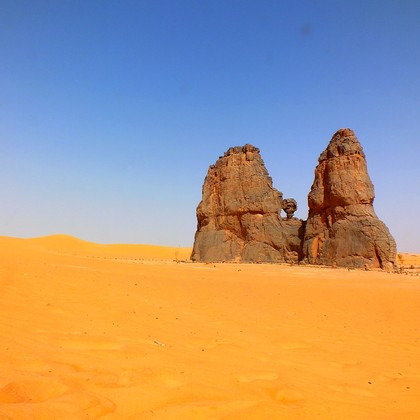
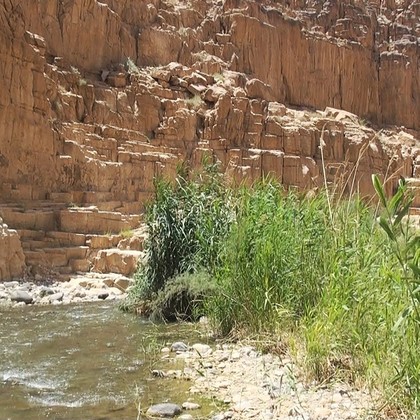
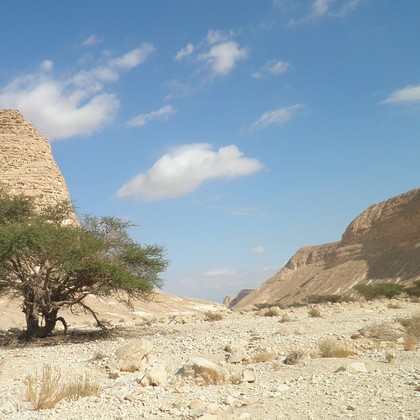
Bare and sparsely vegetated rocky mountains, gorges and canyons, wadis with some shrubs and acacias, scree slopes and the edges of oases, from sea level at the Dead Sea to high in the mountains. It comes to drink at springs, troughs and leaking pipes, and in Arabia also lives in villages and around farms. It feeds on the ground on seeds and small insects.
Where the bird is most at home, classified by the habitats of North Africa and the Middle East.
Range and movements
In Egypt in the mountains of Sinai, the Eastern Desert along the Red Sea and Gebel Elba; in Israel and Jordan in the Negev, the Dead Sea area, the Arava and the southern desert mountains; in Saudi Arabia widespread in rocky terrain, from the Hejaz and Asir to the central plateau; further in Yemen, in Oman (Hajar Mountains and Dhofar) and in the east of the United Arab Emirates (Hajar Mountains, Jebel Hafeet). Rare or a vagrant in Kuwait, Iraq and Syria. Beyond the region from Sudan and the eastern Sahel through Iran and Afghanistan to Pakistan and north-western India.
- Resident
- Summer visitor (c. Oct–Mar)
- Winter visitor (c. Apr–Sep)
- Passage (Mar–Apr, Oct–Nov)
- dark = core range, pale = thinly spread
How and when to look
Easy to see in the gorges around Eilat, at Ein Gedi, in Wadi Rum and at Petra, and in the mountains of the Emirates and Oman at Jebel Hafeet. A dripping pipe or a spring in a dry gorge draws birds from far and wide; sit quietly nearby in the morning.
Conservation status
Not globally threatened and widespread. Locally common in the region in suitable rocky terrain. Drought can depress numbers temporarily, while artificial water at villages and tourist sites offers it new opportunities.
Scientific name
Emberiza striolata | (Lichtenstein, 1823)
Lichtenstein described the species in 1823 as Fringilla striolata; because it was later moved to another genus, the author and year stand in brackets. The genus Emberiza was introduced in 1758 by Linnaeus. Emberiza comes from Old German Embritz, a name for a bunting. striolata is Latin for 'finely streaked', a diminutive of stria, 'streak', after the markings on head and back. The specimen the first description was based on came from Ambukol, Sudan.