All species › Passerines › Buntings › Socotra Bunting
Socotra Bunting | Emberiza socotrana
Socotragors | Escribano de Socotora
The Socotra Bunting is a small, rare bunting found only on the island of Socotra, off the coast of Yemen. It lives on the higher limestone plateaus and mountain slopes and is the least often seen of the island’s endemic birds.

Voice
The song is a short, simple series of clear notes, chee-chee-chooo, repeated from a boulder or bush top, mostly in the early morning. The call is a soft, short tsip, easily lost in the wind on the plateaus.
Recording: Mischa Keijmel — CC BY-NC-SA 4.0 · converted to mono · xeno-canto
Identification
13 cm, a small, compact bunting with a fairly short tail. The head is sharply striped black and white: a narrow white crown stripe between black lateral crown stripes, a broad white supercilium, a black eye-stripe and a white stripe below the cheek, set off by a dark malar stripe. The throat is whitish. Mantle and back are warm rufous-brown with dark streaks; the wings show a rufous panel on the coverts and two narrow pale wingbars. The underparts are pale grey-buff to off-white, slightly warmer on the breast. The bill is dark with a paler lower mandible, the legs flesh-coloured. The female is duller, with browner rather than black head stripes.
Confusion species
Cinnamon-breasted Bunting (Emberiza tahapisi) also occurs on Socotra, as the island form insularis; it has a black throat, deep cinnamon underparts and no white wingbars, and lives mainly lower down on rocky slopes. Socotra Sparrow (Passer insularis) is heavier, with an unstreaked grey crown and, in the male, a black bib. The species does not occur on the mainland, so confusion with Striolated Bunting (Emberiza striolata) does not arise.
Habitat
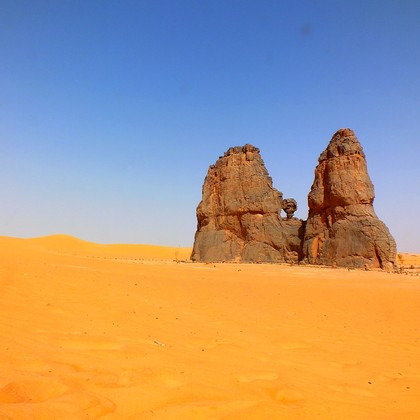
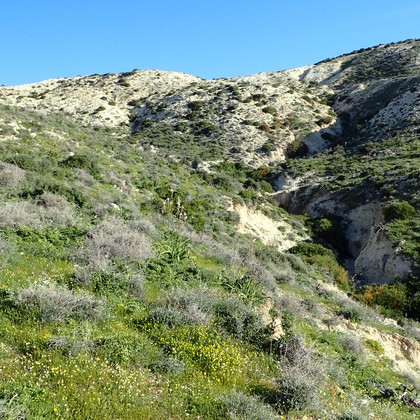
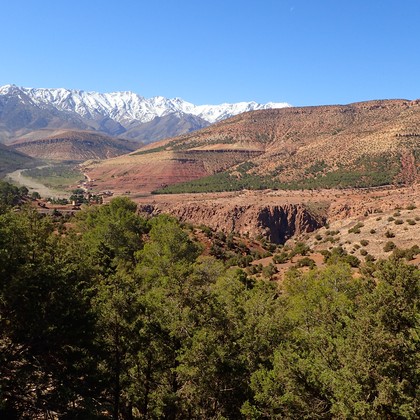
Open limestone plateaus with short grass, scattered shrubs, boulders and bare limestone pavement, and rocky slopes in and around the Hagghier Mountains, mostly at some altitude. It forages unobtrusively on the ground among grass and stones, on seeds and in the breeding season on insects. Locally it reaches the edges of scrub and open woodland with dragon’s blood trees.
Where the bird is most at home, classified by the habitats of North Africa and the Middle East.
Range and movements
Endemic to the Socotra archipelago (Yemen), and known almost only from the main island of Socotra: on the plateaus of Diksam, Homhil, Ma’alah and Siko and on the slopes of the Hagghier Mountains. Its distribution is local and thin; it is absent from many places with apparently suitable terrain. It occurs nowhere else.
- Winter visitor (c. Apr–Sep)
- Passage (Mar–Apr, Oct–Nov)
- dark = core range, pale = thinly spread
How and when to look
The Diksam plateau and the Homhil area are the best-known sites. Search in the cool morning hours along the edges of grassland with loose stones and shrubs and listen for the short song; the bird is often only seen when it flies up and perches on a boulder. Be patient: experienced visitors regularly miss it.
Conservation status
Near Threatened. A small population with a restricted range on a single island. Overgrazing by goats and changes in land use on the plateaus are the main threats; because of the insecure situation in Yemen there is little recent research on numbers and trend.
Scientific name
Emberiza socotrana | (Ogilvie-Grant & Forbes, 1899)
Ogilvie-Grant & Forbes described the species in 1899 as Fringillaria socotrana; because it was later moved to another genus, the author and year stand in brackets. The genus Emberiza was introduced in 1758 by Linnaeus. Emberiza comes from Old German Embritz, a name for a bunting. socotrana refers to Socotra, the island where the species occurs. The specimen the first description was based on came from Adho Dimellus, Socotra, Yemen.