All species › Birds of prey › Hawks, eagles and kites › Griffon Vulture
Griffon Vulture | Gyps fulvus
Vale gier | Buitre leonado
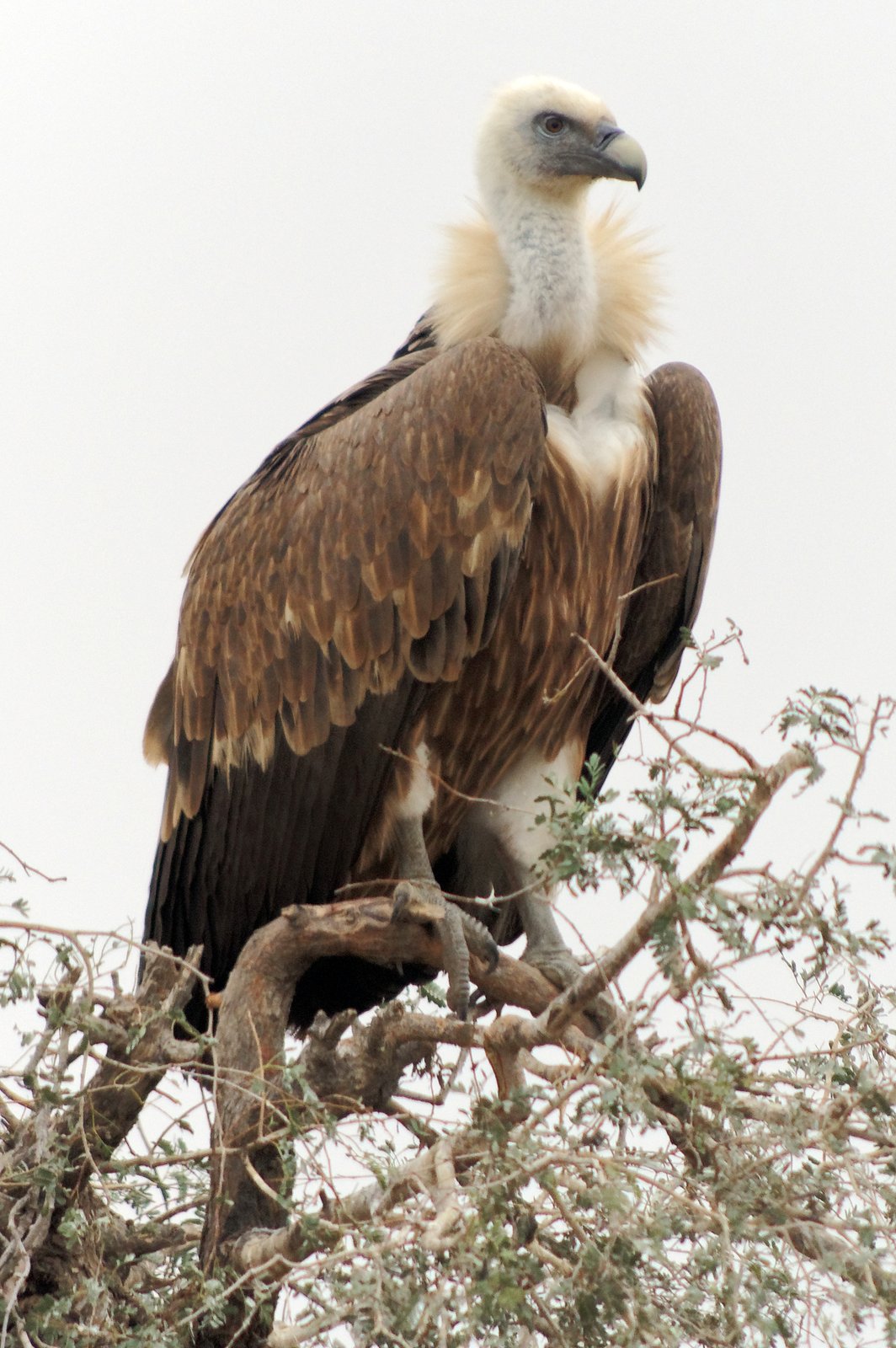
The Griffon Vulture is a huge, sandy-brown vulture with a long neck covered in white down, which soars in groups for hours on thermals over open country in search of carcasses. In the region it has declined steeply as a breeder; every autumn, however, thousands of mainly young Iberian birds cross the Strait of Gibraltar into Morocco.
Voice
Almost silent away from the colony and the carcass. At food and on the nest ledge a hoarse hissing, grunting and harsh cackling screech, ggrrr-kakakak.
Recording: Pere Josa — CC BY-NC-SA 4.0 · converted to mono · xeno-canto
Identification
95–110 cm, wingspan 230–265 cm. The adult is warm sandy brown on the body and wing coverts, with contrasting blackish-brown flight feathers and tail, a whitish downy head and neck, a pale downy ruff and a horn-coloured bill. The juvenile is plainer and more rufous, with pale shaft streaks, a ruff of long brown lanceolate feathers and a dark bill; adult plumage is reached only after five or six years. In flight very long, broad wings with seven deeply fingered primaries, a short, slightly rounded tail and a retracted head; soars with the wings in a shallow V. On the underwing a paler band across the coverts contrasts with the dark flight feathers.
Confusion species
Rueppell's Griffon (Gyps rueppelli) is somewhat smaller and darker; the adult looks scaly through pale feather edges and shows narrow white bands across the underwing, but young birds are very similar. Cinereous Vulture (Aegypius monachus) is uniformly blackish-brown and soars on flat wings; Lappet-faced Vulture (Torgos tracheliotos) is dark with white thighs and a bare red head. Bearded Vulture (Gypaetus barbatus) has narrow wings and a long wedge tail. At great range eagles such as Steppe Eagle (Aquila nipalensis) may cause confusion, but they have a clearly protruding head and a longer tail.
Habitat
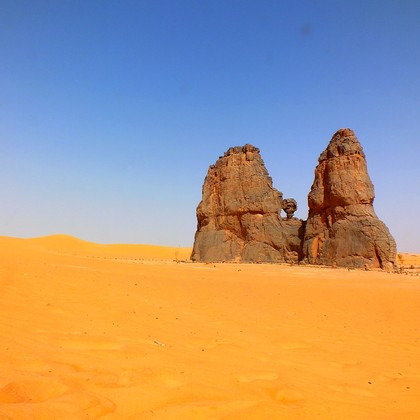
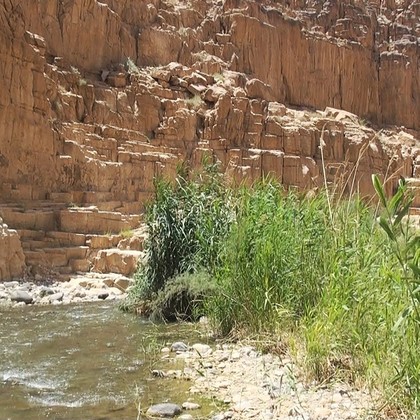
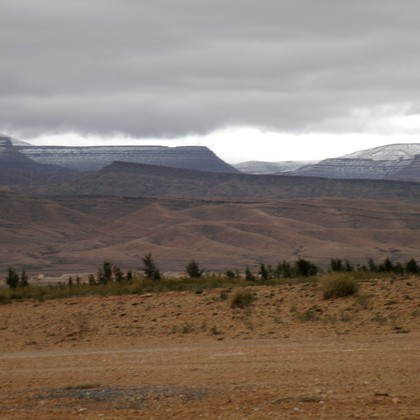
Breeds in colonies on ledges in tall cliffs and gorges in hilly and mountainous country, from sea level to high in the mountains. Forages over open landscapes with livestock or wild ungulates: steppe, high plateaus, semi-desert and grazed uplands. Migrants and wintering birds also visit rubbish dumps and slaughterhouse waste.
Where the bird is most at home, classified by the habitats of North Africa and the Middle East.
Range and movements
In Algeria colonies remain in the mountains of the north, where the species is holding up well at some sites. In Morocco virtually or entirely extinct as a breeder, and in Tunisia extinct apart from at most a few pairs in the north-west; gone from Libya. Every autumn, though, thousands of birds from Spain pass via Jbel Moussa into Morocco; some winter there, others move on to the Sahel. In Israel a small population supported by releases on the Golan (Gamla), on Mount Carmel and in the Negev. In Jordan, Lebanon, Syria and the Kurdish north of Iraq scarce and scattered. In Saudi Arabia a breeder in the Hejaz and Asir mountains, but much reduced: at Tanomah the number of nests fell from 45 in 1999 to 3 in 2016. Small numbers in the highlands of Yemen. In Egypt (mainly Sinai), the Gulf states and Oman a scarce passage migrant or winter visitor. Beyond the region from Iberia and southern Europe via Turkey and the Caucasus to Central Asia and the Himalayas.
- Resident
- Summer visitor (c. Apr–Sep)
- Winter visitor (c. Oct–Mar)
- Passage (Mar–Apr, Oct–Nov)
- dark = core range, pale = thinly spread
How and when to look
Visit Jbel Moussa near Tangier in September and October: on days with easterly winds groups of hundreds of Griffon Vultures come in low across the Strait. In Israel Gamla on the Golan is the best place to watch the birds gliding along the gorge walls; in Saudi Arabia the escarpments around Taif and Tanomah.
Conservation status
Not globally threatened and increasing in Europe, but seriously declined in North Africa and the Middle East. The main causes are poisoned bait and insecticides (locust control, pest control at dumps), disturbance of colonies, electrocution on power-line pylons and a shortage of carcasses. In Israel the population is kept going with captive breeding and feeding stations.
Scientific name
Gyps fulvus | (Hablizl, 1783)
Hablizl described the species in 1783 as Vultur fulvus; because it was later moved to another genus, the author and year stand in brackets. The genus Gyps was introduced in 1809 by De Savigny. Gyps is Greek gups 'vulture'. fulvus is Latin for 'tawny', after the colour of the back and wing coverts. The specimen the first description was based on came from Gilan, Iran.