All species › Birds of prey › Hawks, eagles and kites › Rueppell's Griffon
Rueppell's Griffon | Gyps rueppelli
Rüppells gier | Buitre moteado
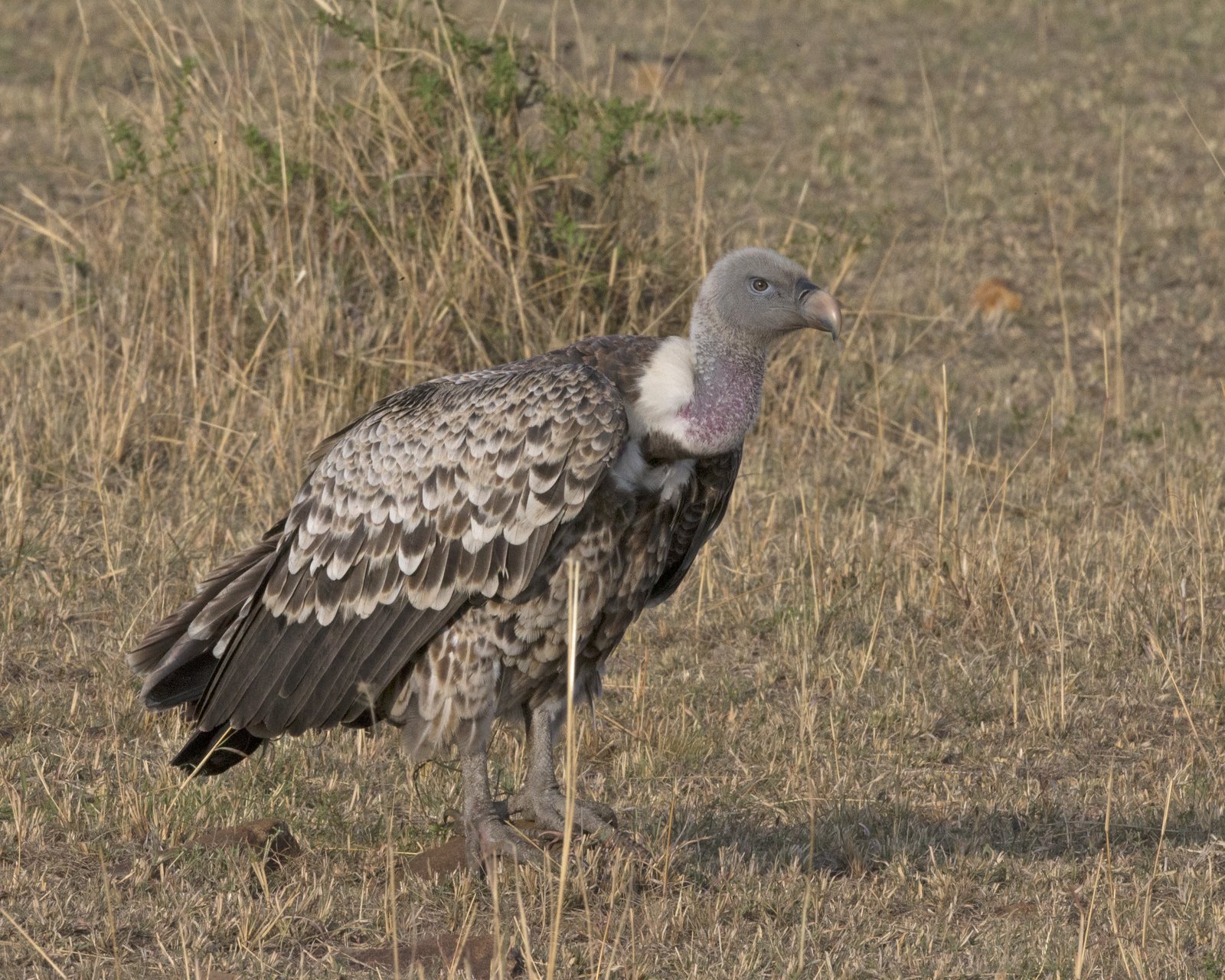
Rueppell's Griffon is a large vulture of the Sahel and the savannas of East Africa that has turned up more and more often in northern Morocco since the late 1990s. The birds, mainly immatures, travel with Griffon Vultures returning from West Africa to the Strait of Gibraltar; elsewhere in the region the species is a great rarity.
Voice
Silent in the region. At carcasses and in colonies a harsh hissing, screeching and cackling, similar to that of Griffon Vulture.
Recording: Alain Malengreau — CC BY-NC-SA 4.0 · converted to mono · xeno-canto
Identification
85–97 cm, wingspan 220–250 cm. Slightly smaller and slimmer than Griffon Vulture. The adult is dark chocolate brown, densely scaled on the body and wing coverts by broad creamy-white feather edges; the head and neck are covered in greyish-white down, the ruff is white, the bill yellowish horn and the eye pale. In flight two or three narrow white bands across the coverts stand out on the dark underwing. The juvenile is plainer dark brown with fine pale streaking, a brown ruff and a dark bill, and then closely resembles a young Griffon Vulture; immatures gradually acquire the scaly plumage.
Confusion species
Griffon Vulture (Gyps fulvus) is larger and warmer sandy brown, without a scaly pattern; young birds of the two species can be separated only with good photographs, noting the darker, colder tone, the narrower white lines on the underwing and the finer streaking. White-backed Vulture (Gyps africanus) is smaller, with a shorter tail and, in adults, a white back and plain pale underwing. Cinereous Vulture (Aegypius monachus) is blackish-brown without pale feather edges.
Habitat
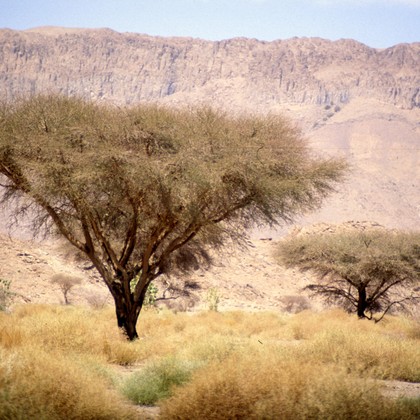
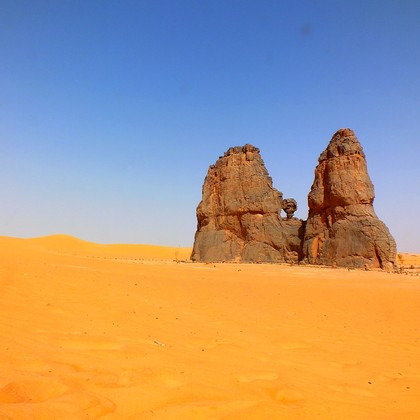
In the breeding range dry savanna and semi-desert with rocky hills, where it nests in colonies on steep cliffs. In Morocco seen on migration over the ridges by the Strait of Gibraltar and at carcasses and feeding stations among Griffon Vultures.
Where the bird is most at home, classified by the habitats of North Africa and the Middle East.
Range and movements
In Morocco the first records were in the late 1990s, including a young bird at Jbel Moussa in June 2002; since counts began in 2014 the species has been seen there annually, in groups of up to five birds, mainly from May to September, and numbers are increasing. In Algeria one bird, caught in April 2006 near Khenchela. A few, mostly older reports from southern Egypt. In Israel one probable third-calendar-year bird in the Lakhish Hills on 5 May 2014; in Saudi Arabia the first fully documented record on 12 October 2018 at Tanomah in the Asir mountains, an adult of the form erlangeri with features that could point to a hybrid with Griffon Vulture. Breeds in the Sahel from Senegal and southern Mauritania to Ethiopia, and in East Africa south to Tanzania; via Morocco it also strays to Spain.
- Resident
- Winter visitor (c. Oct–Mar)
- Passage (Mar–Apr, Oct–Nov)
- dark = core range, pale = thinly spread
How and when to look
In May and June scan every group of Griffon Vultures at Jbel Moussa and elsewhere along the north coast of Morocco for a darker, scaly bird; look at the underwing in particular for white lines. Take photographs: immatures are hard to separate from young Griffon Vultures in the field.
Conservation status
Critically Endangered. Across Africa it has declined very steeply within a few decades through poisoning, the trade in body parts for traditional medicine, electrocution and the loss of wild ungulates and livestock. The increasing records in Morocco and Spain are linked to young birds travelling with Griffon Vultures that winter in the Sahel.
Scientific name
Gyps rueppelli | (Brehm, 1852) (GBIF: Gyps rueppellii)
Brehm described the species in 1852 as Vultur Ruppellii; because it was later moved to another genus, the author and year stand in brackets. The genus Gyps was introduced in 1809 by De Savigny. Gyps is Greek gups 'vulture'. rueppelli honours the German naturalist and African explorer Eduard Rüppell (1794–1884). The specimen the first description was based on came from Khartoum, Sudan.