All species › Birds of prey › Hawks, eagles and kites › White-Backed Vulture
White-Backed Vulture | Gyps africanus
Witruggier | Buitre dorsiblanco africano
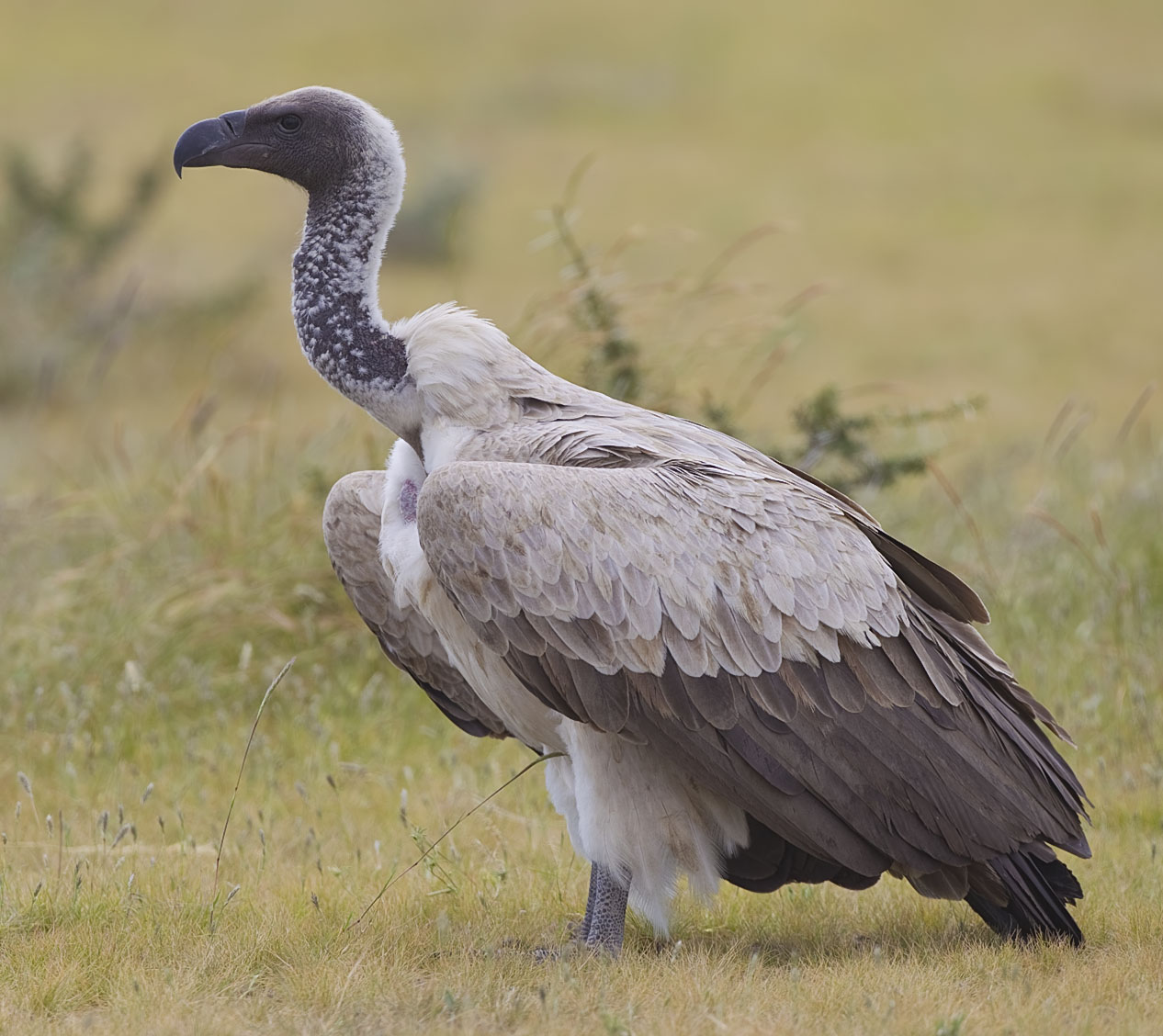
The White-backed Vulture is a vulture of the African savannas south of the Sahara that occurs in the region as a rare visitor. Since the first record in 2014 birds have been seen more and more often in northern Morocco, where they travel with Rueppell's Griffons and Griffon Vultures from the Sahel to the Strait of Gibraltar and sometimes on into Spain.
Voice
Silent; at carcasses rasping, hissing and cackling screeches.
Recording: Ehren Eksteen — CC BY-NC-SA 4.0 · converted to mono · xeno-canto
Identification
80–98 cm, wingspan 196–225 cm. A medium-sized Gyps vulture, smaller and more compact than Griffon Vulture, with a long, bare, greyish-black neck and a black bill. The adult is plain pale greyish-brown with a white lower back that shows from above in flight, and white underwing coverts contrasting sharply with the black flight feathers. The juvenile, the plumage most often seen in North Africa, is dark brown with narrow pale streaks on the underparts and underwing, and lacks the white back.
Confusion species
Griffon Vulture (Gyps fulvus) is larger and warm sandy brown, with a pale ruff and, in adults, a pale bill. Rueppell's Griffon (Gyps rueppelli) is about the same size, but the adult looks scaly through pale feather edges, has a yellowish bill and in flight shows narrow white bands across the underwing. Young birds of all three species are tricky; in White-backed Vulture note the smaller build, the shorter tail and the fine pale streaking, and photograph the bird where possible.
Habitat
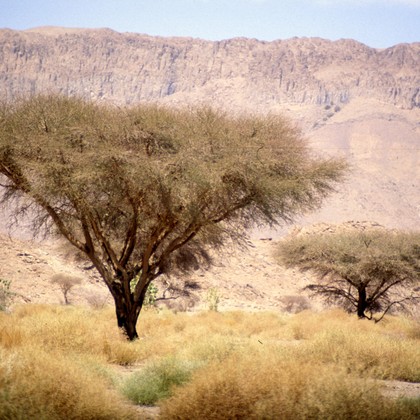
In its African range open acacia savanna and wooded grassland with large ungulates; nests in tall trees. In northern Morocco seen over hills and ridges along the Strait of Gibraltar, at feeding stations and in flocks of Griffon Vultures.
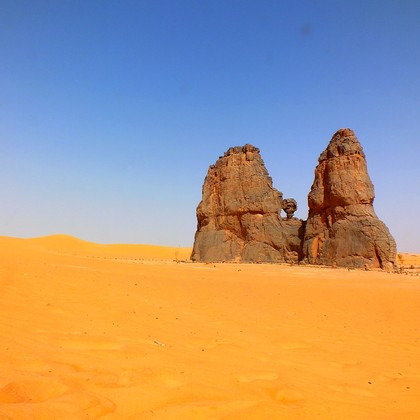
Where the bird is most at home, classified by the habitats of North Africa and the Middle East.
Range and movements
In the region a rare passage migrant in northern Morocco, a vagrant elsewhere. In Morocco the first record was in May 2014 near Tétouan, followed by several at Jbel Moussa and elsewhere in the north, and also in the Tafilalt; in May 2024 at least four birds were fitted with transmitters at Jbel Moussa. In Israel one bird in May 2021 in the Beit She'an valley and the Hula area. From Egypt only old museum specimens from the Nile valley. Breeds in the Sahel and the savannas of West, East and southern Africa.
- Resident
- Winter visitor (c. Apr–Sep)
- Passage (Mar–Apr, Oct–Nov)
- dark = core range, pale = thinly spread
How and when to look
In May – June and in September search at Jbel Moussa among the flocks of Griffon Vultures and Rueppell's Griffons waiting to cross to Spain. Photograph the underwing and the back: only then can a young bird be identified reliably.
Conservation status
Critically Endangered. Across Africa it has declined by more than 90 % in a few decades through poisoning, the trade in body parts for traditional medicine, electrocution and habitat loss. The North African records are part of the northward dispersal of vultures from the Sahel; weakened birds are cared for at the vulture rehabilitation centre near Jbel Moussa.
Scientific name
Gyps africanus | Salvadori, 1865
Salvadori described the species in 1865 and placed it straight away in the genus where it still stands. The genus Gyps was introduced in 1809 by De Savigny. Gyps is Greek gups 'vulture'. africanus is Latin for 'African'. The specimen the first description was based on came from Sennar, Sudan.