All species › Pigeons and doves › Pigeons and doves › Laughing Dove
Laughing Dove | Spilopelia senegalensis
Palmtortel | Tórtola senegalesa
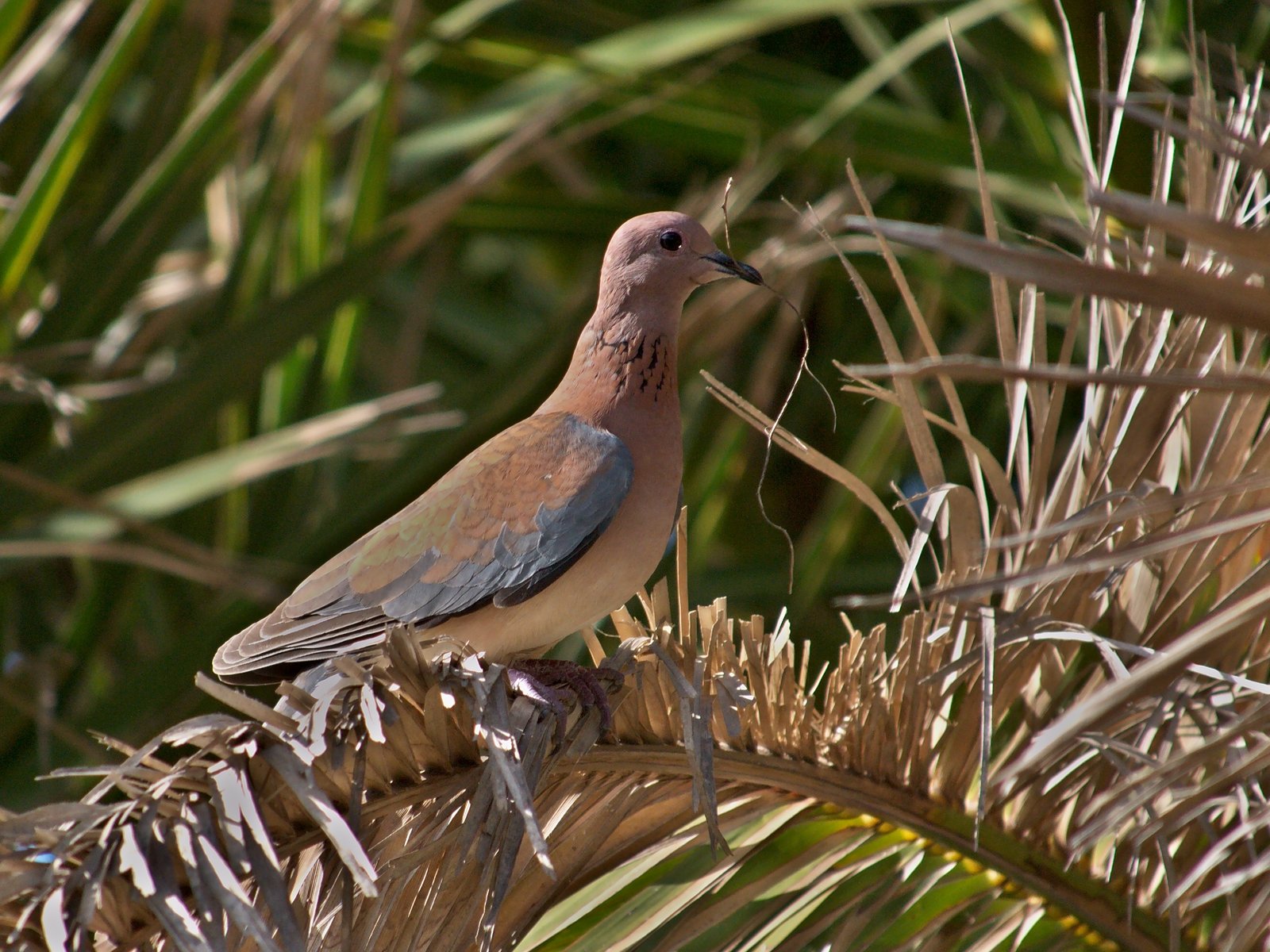
The dove of village squares, oases and hotel palms: across much of the region the commonest and tamest dove. Small, warmly coloured and without a collar, and thanks to its soft, laughing coo often heard before it is seen.
Voice
A soft, cheerful, rapid coo of five to seven notes that first rise and then fall away, oo-oo-ROO-roo-oo, sounding like a stifled laugh. It claps its wings loudly on take-off.
Recording: African Bioacoustics Community — CC BY-NC-SA 4.0 · shortened to the first 60 s, mono · xeno-canto
Identification
Small, long-tailed dove with a wine-pink head and breast and a rufous-brown back. On the foreneck a characteristic breast shield of black spots on a coppery ground; no black neck band. The wing shows a blue-grey panel between the brown back and the dark primaries. The long tail has white corners that stand out on take-off. Juveniles are duller and lack the spotted breast shield.
Confusion species
Eurasian Collared-Dove (Streptopelia decaocto) and African Collared Dove (Streptopelia roseogrisea) are paler, sandier and have a black neck band. European Turtle Dove (Streptopelia turtur) has black-and-white striped neck patches and strongly scaled, orange-brown wing coverts. Namaqua Dove (Oena capensis) is smaller, with a very long, pointed tail and rufous primaries in flight.
Habitat
Villages, towns, gardens, palm groves and oases, irrigated farmland and acacia wadis, anywhere water and seeds are within reach. Deep in the desert only at settlements and watering places. Feeds on the ground, often among people and livestock.
Where the bird is most at home, classified by the habitats of North Africa and the Middle East.


Range and movements
Common resident in the Nile Valley, the Nile Delta and the Egyptian oases, throughout Israel, Samaria and Judea, Jordan, Lebanon, Syria and Iraq, and across the Arabian Peninsula, from Kuwait and the Gulf states to Oman and Yemen. In the Maghreb it has spread strongly: in Morocco mainly in towns and oases of the south and interior, in Algeria and Tunisia in the northern towns and the Saharan oases, in Libya along the coast and in the Fezzan. Beyond the region across almost all of Africa south of the Sahara, and through Turkey and Central Asia to India.
- Resident
- Summer visitor (c. Apr–Sep)
- Winter visitor (c. Oct–Mar)
- Passage (Mar–Apr, Oct–Nov)
- dark = core range, pale = thinly spread
How and when to look
To see a Laughing Dove at close range, simply sit down in an oasis garden or on a terrace. In a mixed group look for the spotted breast shield: it separates it at a glance from the pale collared doves.
Conservation status
Not globally threatened, and in the region numerous and still spreading, especially in the Maghreb, where it follows the growth of towns and irrigated farming. It is trapped locally, but without noticeable effect on numbers.
Scientific name
Spilopelia senegalensis | (Linnaeus, 1766)
Linnaeus described the species in 1766 as Columba senegalensis; because it was later moved to another genus, the author and year stand in brackets. The genus Spilopelia was introduced in 1873 by Sundevall. Spilopelia is Greek, from spilos 'spot' and peleia 'dove', after the speckled neck patch. senegalensis means 'from Senegal', the country the first described specimen came from. The specimen the first description was based on came from Senegal.