All species › Falcons › Falcons › Lesser Kestrel
Lesser Kestrel | Falco naumanni
Kleine torenvalk | Cernícalo primilla
The Lesser Kestrel is a small, sociable falcon that nests in colonies in old buildings, kasbahs, ruins and cliffs and hunts almost only large insects. In the Maghreb and the Levant it is a characteristic summer visitor to steppe and farmland, and in spring large numbers cross the deserts of North Africa and Arabia heading north.

Voice
Much noisier than Common Kestrel. At the colony a hoarse, rasping trisyllabic chay-chay-chay or kyeh-kyeh-kyeh, lower and less shrill than the kee-kee-kee of Common Kestrel, often from many birds at once.
Recording: Pere Josa — CC BY-NC-SA 4.0 · converted to mono · xeno-canto
Identification
29–33 cm, wingspan 58–72 cm. Slightly smaller and slimmer than a Common Kestrel, with shorter, more pointed wings and a wedge-shaped tail because the central feathers project slightly. The male has a blue-grey head without a clear moustache, plain rufous back without black spots, a blue-grey panel across the greater coverts and buff, sparsely spotted underparts; the underwing is whiter and less marked than in Common Kestrel. At close range the claws are white. Female and juvenile are brown barred black and closely resemble a female Common Kestrel, with a fainter moustache and a paler face. It hunts more lightly than Common Kestrel, with short bouts of hovering and much gliding, often in small groups.
Confusion species
Common Kestrel (Falco tinnunculus) is in practice the only confusion species: larger and longer-tailed, with a rounded tail, a distinct moustache and black claws; the male has a black-spotted back and lacks the blue-grey wing panel. Females are difficult: look for the shorter wedge tail, paler face, paler underwing and social behaviour. The female Red-footed Falcon (Falco vespertinus) has an orange crown and underparts and a dark eye mask.
Habitat
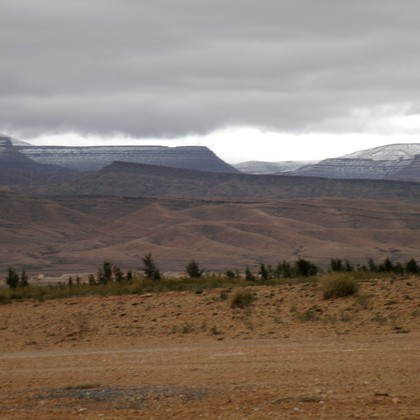
Open steppe, alfa-grass plains, dry grassland, cereal fields and extensively grazed land, on passage also desert edges, oases and irrigated farmland. Breeds colonially in cavities of old buildings, kasbahs, mosques, ruins, bridges and cliffs, sometimes in the middle of a town. Hunts grasshoppers, beetles and crickets, occasionally small lizards and rodents, and outside the breeding season roosts communally in trees.
Where the bird is most at home, classified by the habitats of North Africa and the Middle East.


Range and movements
Summer visitor and breeder in the Maghreb: scattered across Morocco, mainly on the plains and plateaus of the north and centre and in the Middle Atlas, in northern Algeria and Tunisia and locally in north-west Libya. In the Levant a small, much reduced population breeds in Israel, among other places around Jerusalem, the Gilboa and the Golan, and further in Jordan, Syria, Lebanon and northern Iraq. In Egypt and almost all of Arabia a passage migrant, commoner in spring (February–April) than in autumn; locally an odd bird winters. Beyond the region from Iberia through southern Europe and Turkey to Central Asia and Mongolia; winters mainly in the Sahel and southern Africa.
- Resident
- Summer visitor (c. Oct–Mar)
- Winter visitor (c. Apr–Sep)
- Passage (Mar–Apr, Oct–Nov)
- dark = core range, pale = thinly spread
How and when to look
In Morocco find a village or kasbah with old mud walls on the plateaus near Midelt or around Fès and Meknès, and in April and May watch the roofs: the birds fly to and fro and call incessantly. In Israel the nest boxes and roofs around Jerusalem and the Gilboa give a good chance in spring. In males the unspotted rufous back and blue-grey wing panel are decisive.
Conservation status
Not threatened, after a collapse in the second half of the twentieth century that long kept the species listed as Vulnerable. In the region the loss of nest sites through renovation and demolition of old buildings, agricultural intensification and insecticides all play a role; in Israel and Jordan numbers have fallen sharply and are supported with nest boxes. Shooting and trapping also occur on migration.
Scientific name
Falco naumanni | Fleischer, 1818
Fleischer described the species in 1818 and placed it straight away in the genus where it still stands. The genus Falco was introduced in 1758 by Linnaeus. Falco is Late Latin for 'falcon', from falx, falcis 'sickle', after the sickle-shaped claws of the bird. naumanni honours the German naturalist Johann Friedrich Naumann. The specimen the first description was based on came from southern Germany.