All species › Waders, gulls and terns › Gulls and terns › Lesser Noddy
Lesser Noddy | Anous tenuirostris
Kleine noddy | Tiñosa picofina
A small, slender noddy of the tropical Indian Ocean, which in the region turns up only as a rare visitor off the coasts of Oman and the UAE east coast. In 2024 a flock of more than twenty birds stayed there for the first time.
Voice
A dry, rattling tchrrr; usually silent away from the breeding colonies.
Recording: Ross Gallardy — CC BY-NC-SA 4.0 · converted to mono · xeno-canto
Identification
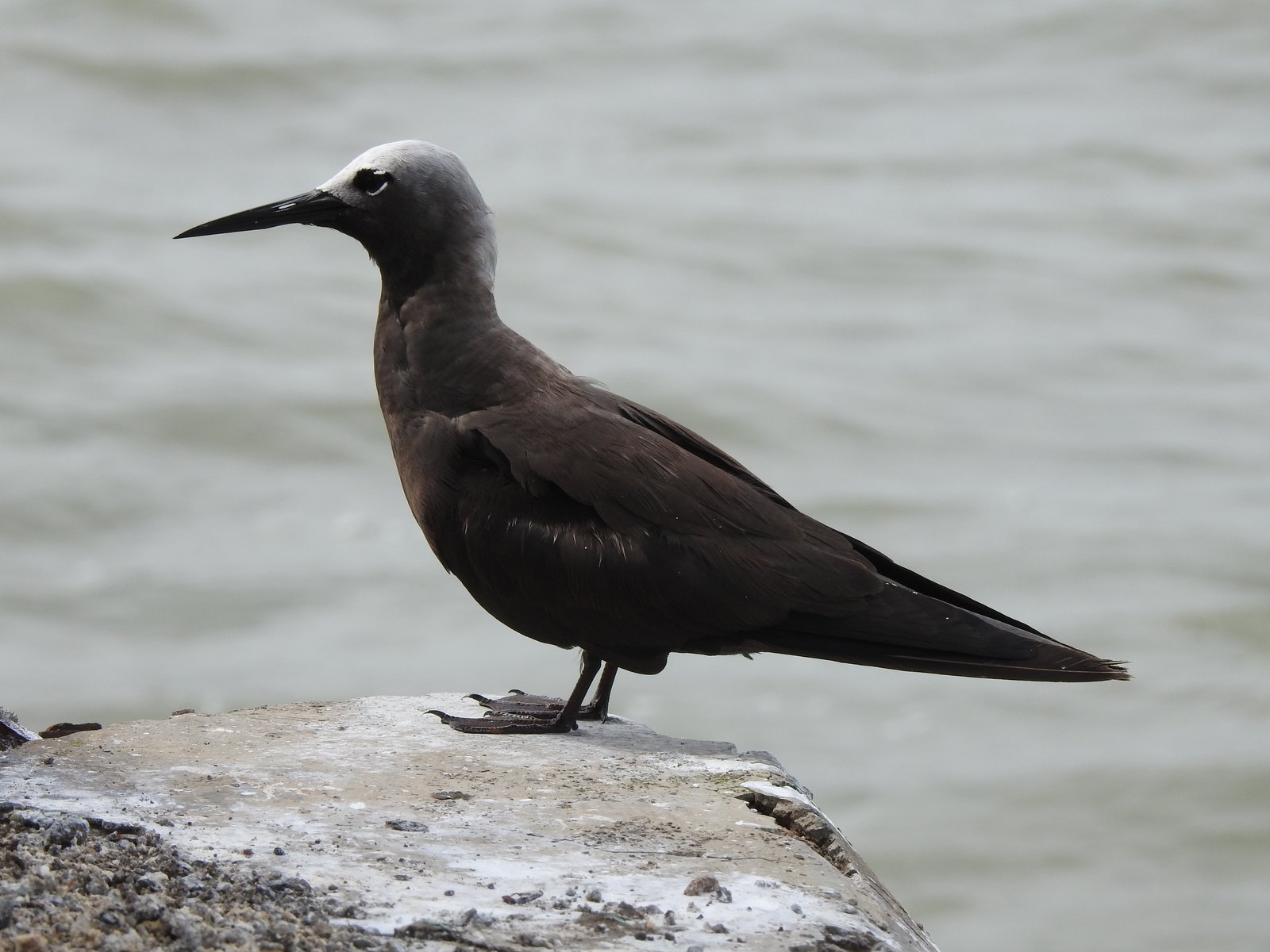
Dark greyish-brown, with a pale grey cap that blends gradually into the grey nape and mantle without a sharp border; the forehead is hardly whiter than the crown. Lores black, with a narrow white crescent below the eye. The black bill is long and strikingly thin, about as long as the head. Upperwing almost uniformly dark, without a paler bar across the coverts; underwing dark. The tail is long and wedge-shaped with a notch. Juveniles have a browner cap.
Confusion species
Brown Noddy (Anous stolidus) is larger and bulkier, warmer brown, with a whiter forehead that contrasts sharply with the black lores, a shorter and thicker bill and a paler brown bar on the upperwing. At a distance the size difference in mixed flocks is the best feature. Juvenile Sooty Terns (Onychoprion fuscatus) have a pale belly and a forked tail.
Habitat
Open, warm sea, often far offshore; in the region mainly in the cool upwelling waters of the south-west monsoon. Rests on buoys, fish cages and floating objects. Elsewhere it breeds in colonies in trees and bushes on tropical islands.
Where the bird is most at home, classified by the habitats of North Africa and the Middle East.

Range and movements
In the region a rare, irregular visitor to the Gulf of Oman and the Arabian Sea. In the United Arab Emirates eleven records were known up to 2024, all off the east coast; in summer and autumn 2024 up to 21 birds at once stayed at the fish farms off Ras Dibba, from July to December. In Oman there are a few records at sea. There are no certain records from the Red Sea, the Persian Gulf or Yemen. Beyond the region it breeds on islands in the Indian Ocean, from the Seychelles, the Maldives and Chagos to Mauritius and Rodrigues, and off the west coast of Australia.
How and when to look
A boat trip from Dibba to the fish farms off Ras Dibba (UAE and Musandam) in late summer gives the best chance; check every noddy there carefully for size, bill and cap.
Conservation status
Not globally threatened. It is unclear whether the increasing number of records in the Gulf of Oman reflects an expansion of its range at sea or mainly more pelagic trips and better identification. It does not breed in the region.
Scientific name
Anous tenuirostris | (Temminck, 1823)
Temminck described the species in 1823 as Sterna tenuirostris; because it was later moved to another genus, the author and year stand in brackets. The genus Anous was introduced in 1826 by Stephens. Anous is Greek for 'stupid, silly' — for the tameness with which noddies allowed sailors to approach and catch them. tenuirostris comes from the Latin tenuis, 'thin, slender', and rostrum, 'bill' — for the thinner bill than that of Brown Noddy. The specimen the first description was based on came from Seychelles.