All species › Woodpeckers and allies › Woodpeckers › Lesser Spotted Woodpecker
Lesser Spotted Woodpecker | Dryobates minor
Kleine bonte specht | Pico menor
The smallest woodpecker of the region, barely bigger than a sparrow. Here it lives only in the humid forests of northern Algeria and north-west Tunisia, as the endemic subspecies ledouci, and is scarce and hard to find: it feeds high in the canopy, on thin twigs where larger woodpeckers do not go.
Voice
A high, weak, falcon-like series kee-kee-kee-kee, neither rising nor falling, mainly in spring; also a soft kik, weaker than that of Great Spotted. The drum roll is light, rattling and longer than that of Great Spotted, often in two parts.
Recording: Thomas Bergman — CC BY-NC-SA 4.0 · shortened to the first 60 s, mono · xeno-canto
Identification
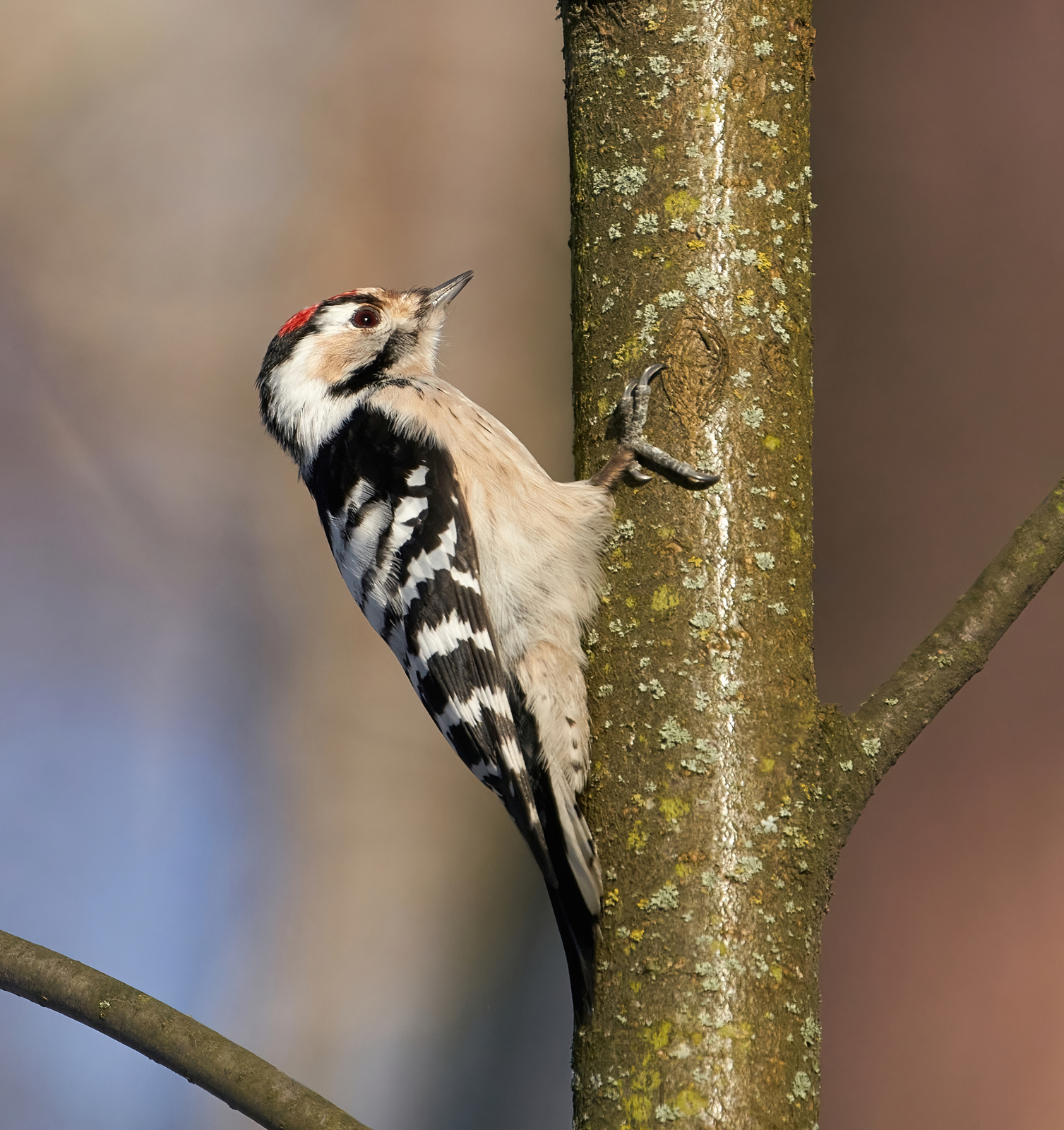
Sparrow-sized, with a short, pointed bill. Pied, without white shoulder patches, but with the back and wings broadly barred white. The face is off-white with a black moustache that does not reach the bill. Underparts off-white to buffish with fine black streaks on the flanks; undertail white, without red. The male has a red crown bordered black, the female an off-white to brownish forecrown and black hindcrown. The North African race ledouci is somewhat browner and more heavily streaked below than European birds.
Confusion species
Great Spotted Woodpecker (Dendrocopos major) is much larger, with big white shoulder patches, a black back and red undertail coverts. Its behaviour, creeping about thin twigs in the canopy, can suggest a tit or Eurasian Nuthatch (Sitta europaea); in Kabylia it shares its forest with Algerian Nuthatch (Sitta ledanti).
Habitat
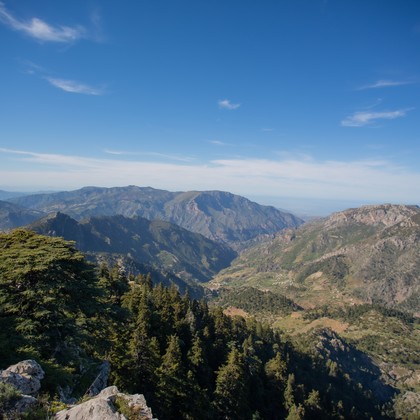
Humid broadleaved and mixed woodland with much old and dead wood: cork oak and Algerian oak (Quercus canariensis) forest, alder, poplar and ash woods along streams and rivers, and woods around lakes. Feeds high in the canopy and on thin dead branches; excavates its nest hole in soft, rotten wood. From lowlands into the mountains.
Where the bird is most at home, classified by the habitats of North Africa and the Middle East.

Range and movements
In the region only the subspecies ledouci, in northern Algeria and north-west Tunisia: in the humid forests of Kabylia, the Edough massif near Annaba, the El Kala area and scattered through the wooded Tell, and in Tunisia in the Kroumirie and Mogods. It has not been confirmed breeding in Morocco, and is absent from Libya, Egypt, the Levant, Iraq and Arabia. Beyond the region it breeds from Britain and Spain through Europe and Turkey, the Caucasus and northern Iran to Siberia, Korea and Japan.
- Resident
- Summer visitor (c. Oct–Mar)
- Winter visitor (c. Apr–Sep)
- Passage (Mar–Apr, Oct–Nov)
- dark = core range, pale = thinly spread
How and when to look
Search in early spring, when the trees are still bare and the birds call and drum, in the cork oak and alder woods around Aïn Draham in the Tunisian Kroumirie or in El Kala National Park in Algeria. Check the thinnest twigs in the canopy and listen for the high, falcon-like kee-kee-kee.
Conservation status
Not globally threatened, but declining in much of Europe. In North Africa scarce and little studied; the isolated population depends on humid broadleaved forest with old and dead trees, which is shrinking through logging, forest fires, overgrazing and drought.
Scientific name
Dryobates minor | (Linnaeus, 1758)
Linnaeus described the species in 1758 as Picus minor; because it was later moved to another genus, the author and year stand in brackets. The genus Dryobates was introduced in 1826 by Boie. Dryobates is Greek, from druos 'woodland, tree' and batēs 'walker': the bird that works its way over timber. minor is Latin for 'smaller', for the size of the smallest European pied woodpecker. The specimen the first description was based on came from Sweden.