All species › Woodpeckers and allies › Woodpeckers › Syrian Woodpecker
Syrian Woodpecker | Dendrocopos syriacus
Syrische bonte specht | Pico sirio
The pied woodpecker of the Middle East, replacing Great Spotted Woodpecker here. It lives in the Mediterranean zone of the Levant and in the valleys of northern Iraq, and is at home among people: in orchards, olive groves, parks, gardens and along lines of trees in villages and towns.

Voice
The call is a soft, slightly muffled kyuk or chuk, less sharp than the kik! of Great Spotted, running into a rattling kwirrr when excited. The drum roll lasts longer than that of Great Spotted and fades away at the end; heard mainly from January to April.
Recording: András Schmidt — CC BY-NC-SA 4.0 · converted to mono · xeno-canto
Identification
Pied, the size of Great Spotted Woodpecker but with a slightly longer bill and a strikingly open white face. The black moustache does not reach the nape, so cheek and neck side form one white area. Large white shoulder patches, white-barred flight feathers and little or no white in the outer tail feathers. Underparts dirty white to buffish, undertail coverts pale pink rather than scarlet. The male has a red nape patch, the female no red, juveniles a red cap and often a pinkish breast band.
Confusion species
Great Spotted Woodpecker (Dendrocopos major) occurs in the region only in the Maghreb and so does not overlap; it has a black moustache that reaches the nape, scarlet undertail coverts and more white in the tail. Lesser Spotted Woodpecker (Dryobates minor) is much smaller, with a white-barred back and no white shoulder patches. Red-capped juveniles may suggest Middle Spotted Woodpecker (Dendrocoptes medius), a species of Turkey and Iran not recorded in the region; it has a smaller bill and no black moustache reaching the bill.
Habitat
Semi-open, wooded farmland and built-up areas: orchards with almond, walnut, mulberry and fruit trees, olive groves, gardens, parks, cemeteries and roadside trees, also eucalyptus and pine plantations and open oak and pistachio woodland. Avoids closed forest. In Israel from sea level to Mount Hermon; in the mountains up to about 2,000 m.
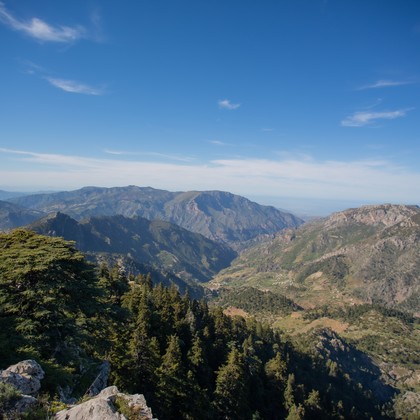
Where the bird is most at home, classified by the habitats of North Africa and the Middle East.


Range and movements
Breeds in the Mediterranean zone of the Levant: in Israel from Galilee and the Golan through the coastal plain, the Shephelah and the hills of Samaria and Judea south to the northern edge of the Negev around Beersheba, and locally in the Jordan Valley; in Lebanon on the coastal strip, Mount Lebanon and the Beqaa; in western Syria from the coast and the Ansariyya mountains to around Damascus and Aleppo; and in north-west Jordan in the highlands of Irbid, Ajloun and Amman. Also in northern and north-eastern Iraq in the valleys of Kurdistan. Absent from Egypt, Sinai and the Arabian Peninsula. Beyond the region from south-east Europe, Turkey and the Caucasus to Iran.
- Resident
- Summer visitor (c. Oct–Mar)
- Winter visitor (c. Apr–Sep)
- Passage (Mar–Apr, Oct–Nov)
- dark = core range, pale = thinly spread
How and when to look
In Israel it is fairly common in the gardens and parks of Jerusalem, the kibbutzim of Galilee and the olive groves of the Shephelah. In early spring listen for the long, fading drum roll on a dead branch or telegraph pole, then check the neck side and the undertail.
Conservation status
Not globally threatened. In the Levant it has declined locally through the loss of traditional orchards and the use of pesticides, but adapts well to urban parks and gardens. Little is known about current numbers in Iraq and Syria.
Scientific name
Dendrocopos syriacus | (Hemprich & Ehrenberg, 1833)
Hemprich & Ehrenberg described the species in 1833 as Picus syriacus; because it was later moved to another genus, the author and year stand in brackets. The genus Dendrocopos was introduced in 1816 by Koch. Dendrocopos is Greek, from dendron 'tree' and kopos 'striking'. syriacus is Latin for 'Syrian'; the type specimen came from Mount Lebanon, then counted as part of Syria. The specimen the first description was based on came from Mount Lebanon.