All species › Waders, gulls and terns › Gulls and terns › Little Gull
Little Gull | Hydrocoloeus minutus
Dwergmeeuw | Gaviota enana
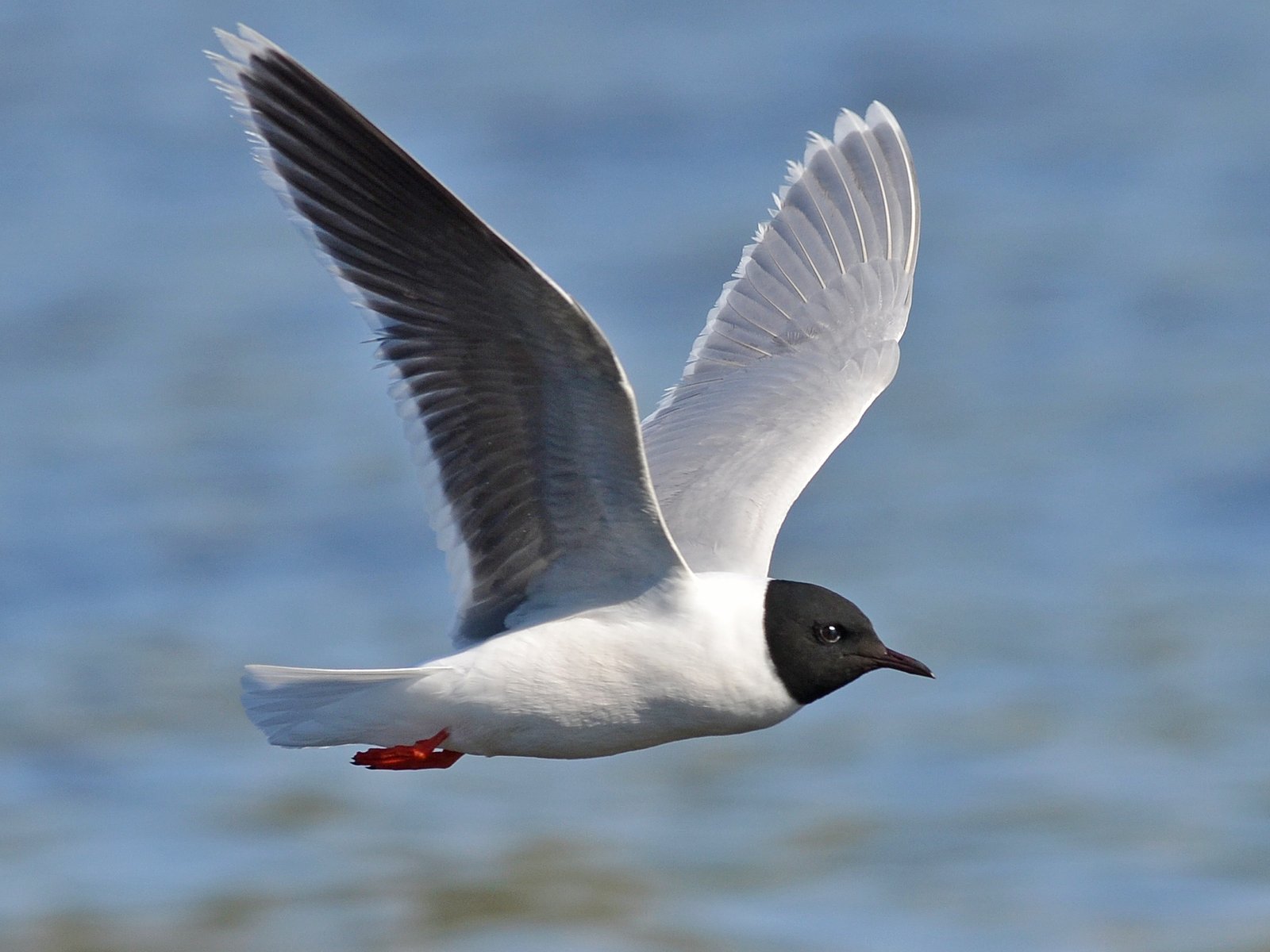
The smallest gull in the world, which feeds over the water with a light, tern-like flight. It breeds in eastern Europe and western Siberia and winters largely at sea in the Mediterranean, making it a common winter visitor along the coasts of North Africa, Egypt and the Levant.
Voice
Usually silent outside the breeding season. In flocks a high, nasal kek-kek-kek, tern-like in tone, and a drawn-out kyeh-kyeh.
Recording: Stanislas Wroza — CC BY-NC-SA 4.0 · shortened to the first 60 s, mono · xeno-canto
Identification
Tiny and compact, with rounded wingtips, a fine dark bill and red legs. Breeding adults have a full black hood without a white eye-ring; in winter the head is white with a dark crown spot and ear spot. The upperwing is uniformly pale grey with a white trailing edge and no black in the wingtip; the underwing is strikingly sooty black. First-year birds show a black W across the upperwing, a dark crown and ear spot and a narrow black tail band, with a white underwing. It flies lightly and buoyantly and picks food from the surface, like a Black Tern.
Confusion species
Black-legged Kittiwake (Rissa tridactyla) also shows a black W in its first year, but is larger, with longer, more pointed wings and a black neck band. Black-headed Gull (Chroicocephalus ridibundus) is much larger, with a white wedge on the hand and black wingtip. Sabine's Gull (Xema sabini) has a tricoloured wing pattern and a forked tail. Black Tern (Chlidonias niger) and White-winged Tern (Chlidonias leucopterus) feed in the same way but have narrower, pointed wings.
Habitat
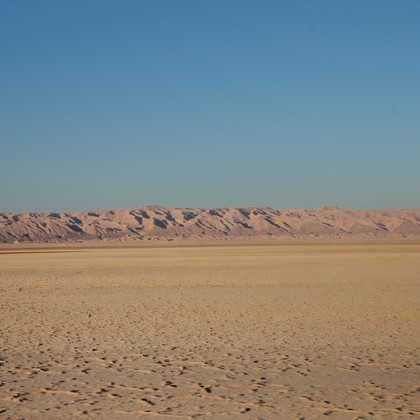
In winter mainly at sea and along the coast, concentrating at river mouths, lagoons, harbours and the Nile delta lakes; on passage also on salt lakes, reservoirs and fishponds inland. Feeds in flocks, often with terns.
Where the bird is most at home, classified by the habitats of North Africa and the Middle East.


Range and movements
A common winter visitor along the coasts of Egypt (Nile delta, Lakes Manzala and Bardawil), Israel, Lebanon and Syria, where in hard winters or onshore gales hundreds to thousands may appear close inshore. Also regular along the coasts of Tunisia (Gulf of Gabès), Libya and Algeria, and at sea off Morocco, both in the Mediterranean and on the Atlantic coast. Inland a passage migrant on salt lakes and reservoirs, including in Israel, Syria and Iraq. In the Gulf a scarce winter visitor in Kuwait, Bahrain, Qatar and the Emirates; rare in Oman and the rest of Arabia. Beyond the region it breeds from the Baltic states and Belarus to western Siberia, and locally in North America, and winters mainly in the Mediterranean, Black Sea, Caspian Sea and Atlantic.
- Resident
- Summer visitor (c. Apr–Sep)
- Winter visitor (c. Oct–Mar)
- Passage (Mar–Apr, Oct–Nov)
- dark = core range, pale = thinly spread
How and when to look
Along the Israeli coast at Ma'agan Michael and Ashdod, and at the harbours of Port Said and Damietta in Egypt, flocks of Little Gulls can be seen from land in winter after a westerly gale. In spring they pass Eilat and the fishponds of the Jordan valley.
Conservation status
Not globally threatened and fairly stable in the long term, although numbers fluctuate strongly. Pollution at sea, oil spills and bycatch are the main risks in the wintering range.
Scientific name
Hydrocoloeus minutus | (Pallas, 1776)
Pallas described the species in 1776 as Larus minutus; because it was later moved to another genus, the author and year stand in brackets. The genus Hydrocoloeus was introduced in 1829 by Kaup. Hydrocoloeus is Greek, from hudor 'water' and koloios 'jackdaw': 'water jackdaw'. minutus is Latin for 'small'; this is the smallest gull in the world. The specimen the first description was based on came from Berezovo, Siberia.