All species › Waders, gulls and terns › Gulls and terns › Black-Legged Kittiwake
Black-Legged Kittiwake | Rissa tridactyla
Drieteenmeeuw | Gaviota tridáctila
A true ocean gull of the North Atlantic, which lives at sea outside the breeding season and hardly ever comes to land. The region lies at the southern edge of its winter range: off Morocco's Atlantic coast it is present at sea every winter, but further east it soon becomes rare.
Voice
Usually silent outside the breeding season. At colonies the nasal kitti-waake that gives it its name.
Recording: Christian Kerihuel — CC BY-NC-SA 4.0 · converted to mono · xeno-canto
Identification
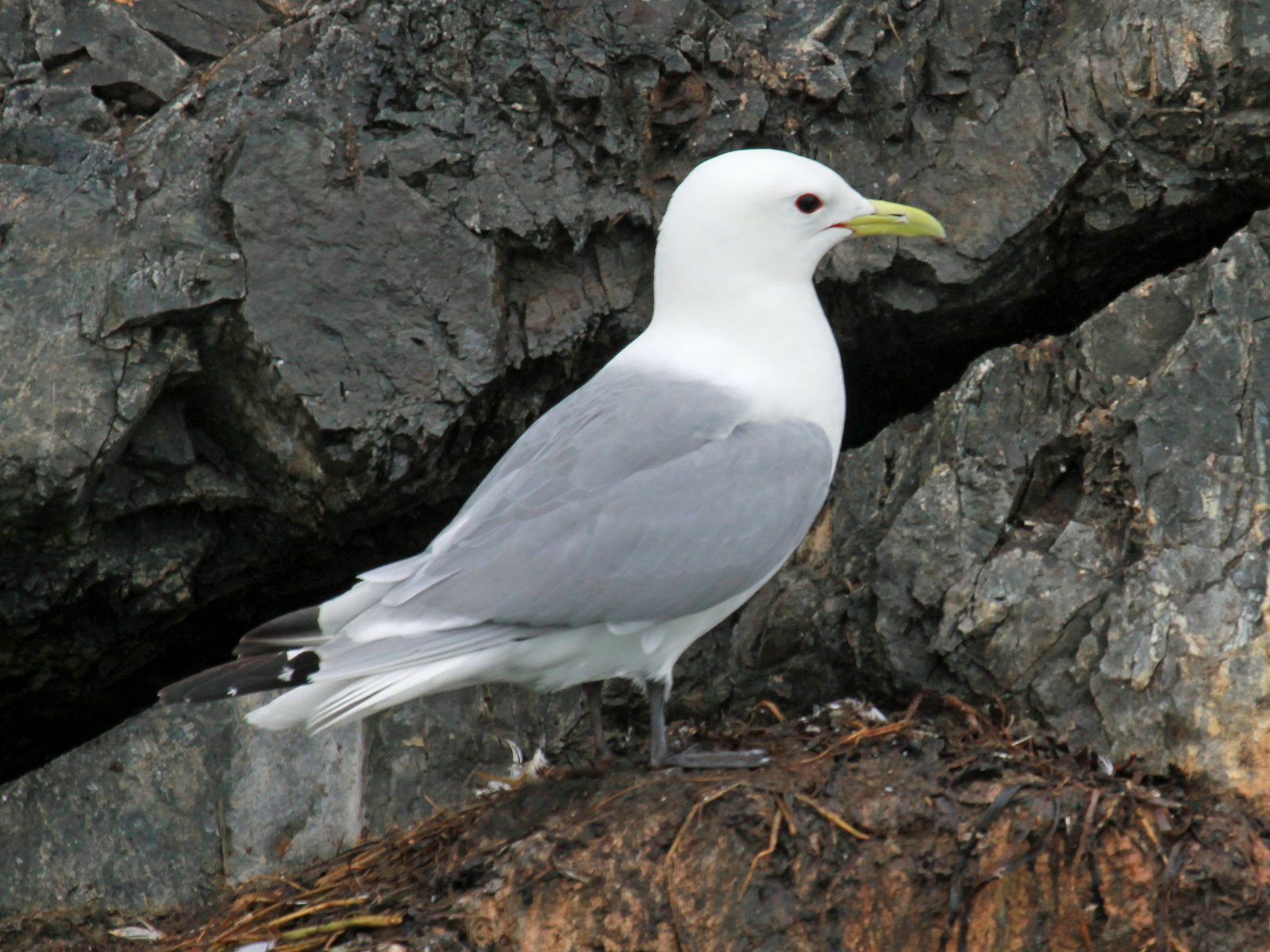
Medium-sized, with a rounded head, a dark eye, an unmarked greenish-yellow bill and short black legs. The mantle is mid-grey and the wingtip is pure black, as if dipped in ink, with no white mirrors. In flight narrow, pointed wings and a stiff, rapid beat; the inner primaries are paler than the mantle. In winter a dark grey spot behind the eye and a grey hindneck. First-year birds show a black W across the upperwing, a black neck band, a black bill and a narrow black tail band.
Confusion species
Common Gull (Larus canus) has longer greenish-yellow legs and white mirrors in the black wingtip. Little Gull (Hydrocoloeus minutus) is much smaller, with rounded wingtips and in adults a dark underwing; young Little Gulls also show a W pattern but lack the black neck band. Sabine's Gull (Xema sabini) shows three sharply defined panels on the wing and a forked tail. Black-headed Gull (Chroicocephalus ridibundus) has a white wedge on the hand and red bill and legs.
Habitat
In winter almost exclusively at sea, often far offshore over the continental shelf and around fishing boats. After severe westerly gales birds sometimes end up in harbours, at river mouths or even on inland waters.
Where the bird is most at home, classified by the habitats of North Africa and the Middle East.


Range and movements
A regular winter visitor at sea off Morocco's Atlantic coast, from Tangier to Agadir and in smaller numbers to Western Sahara; from land usually seen only after storms, with influxes of hundreds in some winters. Scarce in the Strait of Gibraltar and along the Mediterranean coasts of Morocco, Algeria and Tunisia, rare in Libya and Egypt. In Israel and Lebanon a rare winter visitor, with small influxes along the coast in a few winters. In Arabia a vagrant with a handful of records, including in Kuwait, the Emirates and Oman. Beyond the region it breeds around the northern Atlantic and Pacific, from Brittany and Iceland to Svalbard, Alaska and Newfoundland, and winters at sea south to West Africa and Japan.
- Winter visitor (c. Apr–Sep)
- Passage (Mar–Apr, Oct–Nov)
- dark = core range, pale = thinly spread
How and when to look
The best chance is seawatching from a headland on Morocco's Atlantic coast, such as Cap Rhir or Essaouira, or in the harbours of Tangier and Essaouira after a winter westerly gale. Look for the stiff wingbeats and the inky black wingtip.
Conservation status
Globally Vulnerable, owing to a steep decline in breeding populations in the northeast Atlantic, where food shortage caused by rising sea temperatures and changing fish stocks depresses breeding success. In the region, bycatch and pollution at sea are the main concerns.
Scientific name
Rissa tridactyla | (Linnaeus, 1758)
Linnaeus described the species in 1758 as Larus tridactylus; because it was later moved to another genus, the author and year stand in brackets. The genus Rissa was introduced in 1826 by Stephens. Rissa goes back to the Icelandic rita, the local name for the black-legged kittiwake. tridactyla is Greek for 'three-toed', from tri- 'three' and daktylos 'toe': in this gull the hind toe is reduced to a stub. The specimen the first description was based on came from Great Britain.