All species › Waders, gulls and terns › Gulls and terns › Sabine's Gull
Sabine's Gull | Xema sabini
Vorkstaartmeeuw | Gaviota de Sabine
A small, lightly built gull of the high Arctic, which lives at sea outside the breeding season. Birds from Greenland and northeastern Canada migrate across the eastern Atlantic to the upwelling waters off southwestern Africa, passing the coast of Morocco and Western Sahara on the way; there it is a regular, but usually distant, migrant.
Voice
Almost silent outside the breeding season. On the breeding grounds a grating, tern-like kreek-kreek, higher and harsher than Kittiwake.
Recording: Stein Ø. Nilsen — CC BY-NC-SA 4.0 · shortened to the first 60 s, mono · xeno-canto
Identification
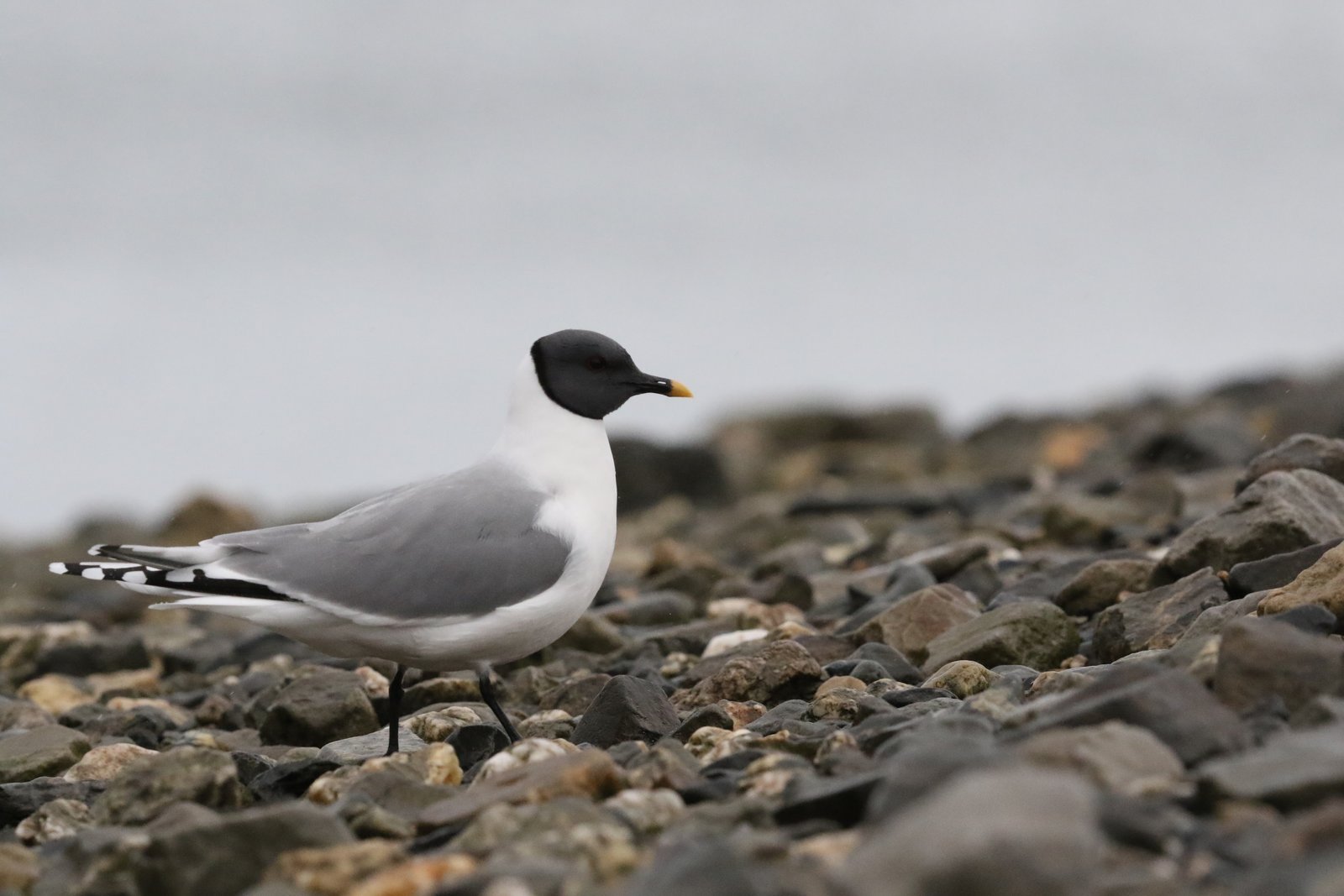
Small, with a forked white tail and long, pointed wings with a unique tricoloured pattern: grey forewing and mantle, black outer primaries and a white triangle formed by the inner primaries and secondaries. Breeding plumage: slate-grey hood with a narrow black lower border, black bill with a yellow tip, dark legs. In winter the head is white with a dark hindneck. Juveniles show the same wing pattern, but with a grey-brown, finely scaled mantle and forewing, grey-brown neck sides and a black terminal tail band. Flight light and tern-like.
Confusion species
Young Black-legged Kittiwake (Rissa tridactyla) has a black W across the wings, a black neck band and a square tail. Young Little Gull (Hydrocoloeus minutus) is smaller, with rounded wingtips and also a W pattern. Adult Black-Headed Gulls (Chroicocephalus ridibundus) have a white wedge on the hand, but no white triangle on the arm. At long range a bird may recall a tern, but the crisp wing pattern stays visible.
Habitat
On migration exclusively at sea, usually far offshore over the continental shelf, often at upwelling, food-rich waters. Comes close inshore, into harbours or exceptionally onto inland waters only after severe storms.
Where the bird is most at home, classified by the habitats of North Africa and the Middle East.

Range and movements
A regular migrant at sea off the Atlantic coast of Morocco and Western Sahara, in autumn from August to October and in smaller numbers in April and May; rarely seen from land, mostly in onshore winds, but on pelagic trips off Agadir and Dakhla sometimes in small groups. A vagrant in the Strait of Gibraltar and the Mediterranean. In Israel a few records: two in the Gulf of Aqaba at Eilat (1989 and 1992) and one in spring 2009 at Ma'agan Michael on the Mediterranean. Exceptional elsewhere in the Middle East. Beyond the region it breeds on the Arctic tundra of Alaska, Canada, Greenland, Svalbard and Siberia and winters at sea off southwestern Africa and the west coast of South America.
- Winter visitor (c. Oct–Mar)
- Passage (Mar–Apr, Oct–Nov)
- dark = core range, pale = thinly spread
How and when to look
A pelagic trip or a seawatch from a headland on Morocco's Atlantic coast in September, after a stiff southwesterly, gives the best chance. Look among the skuas and terns for a small gull with a striking black, white and grey wing pattern.
Conservation status
Not globally threatened, with a large, remote breeding population. Potential risks lie mainly on the breeding grounds (climate change in the Arctic) and in pollution and bycatch in the wintering areas.
Scientific name
Xema sabini | (Sabine, 1819)
Sabine described the species in 1819 as Larus Sabini; because it was later moved to another genus, the author and year stand in brackets. The genus Xema was introduced in 1819 by Leach. Xema appears to be an invented name without meaning; William Leach introduced it in 1819 without explanation. sabini honours the British polar explorer Edward Sabine (1788–1883), who collected the first specimens on islets off the west coast of Greenland; his brother Joseph described the species from that material. The specimen the first description was based on came from the Sabine Islands, Greenland.