All species › Waders, gulls and terns › Sandpipers and snipes › Little Stint
Little Stint | Calidris minuta
Kleine strandloper | Correlimos menudo
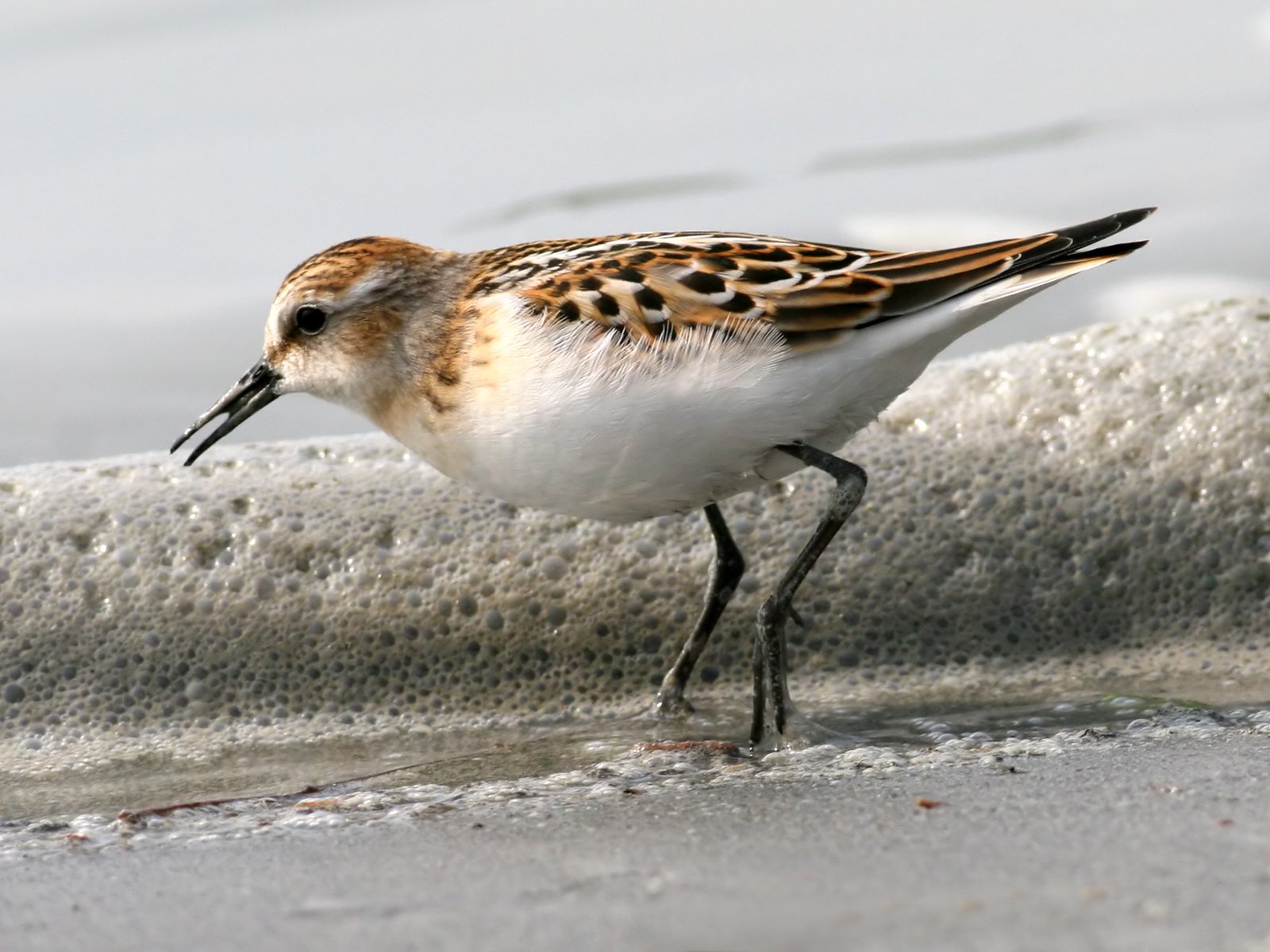
The smallest and one of the most numerous sandpipers of the region, a busy, sparrow-sized bird that runs over the mud pecking rapidly. It winters in large numbers along the Nile, in the Gulf and at almost every shallow water in Arabia.
Voice
A short, sharp tit or stit, often in short series tit-tit-tit on taking off; flocks give a soft twittering.
Recording: Stanislas Wroza — CC BY-NC-SA 4.0 · converted to mono · xeno-canto
Identification
Very small, with a short, straight, fine black bill and black legs. In winter plumage grey-brown above with dark shaft streaks, white below with grey breast sides. Juveniles in late summer are strikingly warm-toned, with a white V on the mantle, rufous-fringed feathers and a split white supercilium. In breeding plumage (April–May) rufous-orange on head, breast and upperparts, with a white throat. In flight a narrow white wing bar and grey outer tail feathers.
Confusion species
Temminck's Stint (Calidris temminckii) is plainer grey-brown, with a full grey breast band, yellow or greenish legs, a longer tail and white outer tail feathers; it feeds more slowly and more at vegetated edges. Dunlin (Calidris alpina) is clearly larger with a longer, decurved bill. Red-necked Stint (Calidris ruficollis), a rare vagrant in the region, has shorter legs, a longer primary projection and in breeding plumage an all-red throat without white.
Habitat
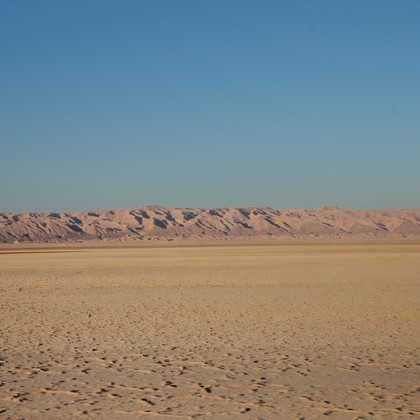
Shallow water with soft mud: salt pans, sebkhas, coastal lagoons and mudflats, but also sewage ponds, fish ponds, reservoirs, irrigation channels and oasis pools deep in the desert. It feeds with quick, short pecks, often in loose flocks among other waders.
Where the bird is most at home, classified by the habitats of North Africa and the Middle East.


Range and movements
On passage throughout the region, including straight across the Sahara and the Arabian desert, where it may turn up at any pool. Winters in Morocco (Atlantic coast and Souss-Massa), Algeria and Tunisia (chotts, Sfax salt pans, Gulf of Gabès) and along the Libyan coast; in Egypt common in the Nile Delta, along the Nile and at Aswan, and on the Faiyum lakes. In the Middle East it winters in Israel (Eilat, Jordan Valley), Iraq (southern marshes) and abundantly in the Gulf states, Saudi Arabia, Oman and Yemen, also on Socotra. Beyond the region it breeds on the tundra from northern Norway to eastern Siberia and winters in sub-Saharan Africa, the Middle East and South Asia.
- Resident
- Summer visitor (c. Oct–Mar)
- Winter visitor (c. Apr–Sep)
- Passage (Mar–Apr, Oct–Nov)
- dark = core range, pale = thinly spread
How and when to look
The salt pans of Eilat, the Al Ansab sewage lagoons (Muscat) and the lagoons of Abu Dhabi hold hundreds in winter, easily watched at close range. Look for the warm-toned juveniles in August–September; large flocks regularly hold a Temminck's Stint or, in Arabia, a rarer Asian species.
Conservation status
Not globally threatened and numerous. In the region it locally benefits from artificial waters such as sewage ponds, fish ponds and salt pans, but suffers from drainage, pollution and coastal development, especially in the Gulf and on the Egyptian delta lakes.
Scientific name
Calidris minuta | (Leisler, 1812)
Leisler described the species in 1812 as Tringa minuta; because it was later moved to another genus, the author and year stand in brackets. The genus Calidris was introduced in 1804 by Merrem. Calidris goes back to Ancient Greek kalidris or skalidris, a name Aristotle used for an unidentified grey waterside bird. minuta is Latin for 'small', after the size of these smallest European stints. The specimen the first description was based on came from Hanau, Germany.