All species › Waders, gulls and terns › Sandpipers and snipes › Pectoral Sandpiper
Pectoral Sandpiper | Calidris melanotos
Gestreepte strandloper | Correlimos pectoral
An American-Siberian sandpiper that reaches the region as a rare passage migrant, usually as a juvenile in autumn. It turns up at fresh and brackish water, from Morocco's Atlantic coast to the Gulf.
Voice
A dry, rattling krrrt or trrip, lower and fuller than the call of Curlew Sandpiper.
Recording: JAYRSON ARAUJO DE OLIVEIRA — CC BY-NC-SA 4.0 · converted to mono · xeno-canto
Identification
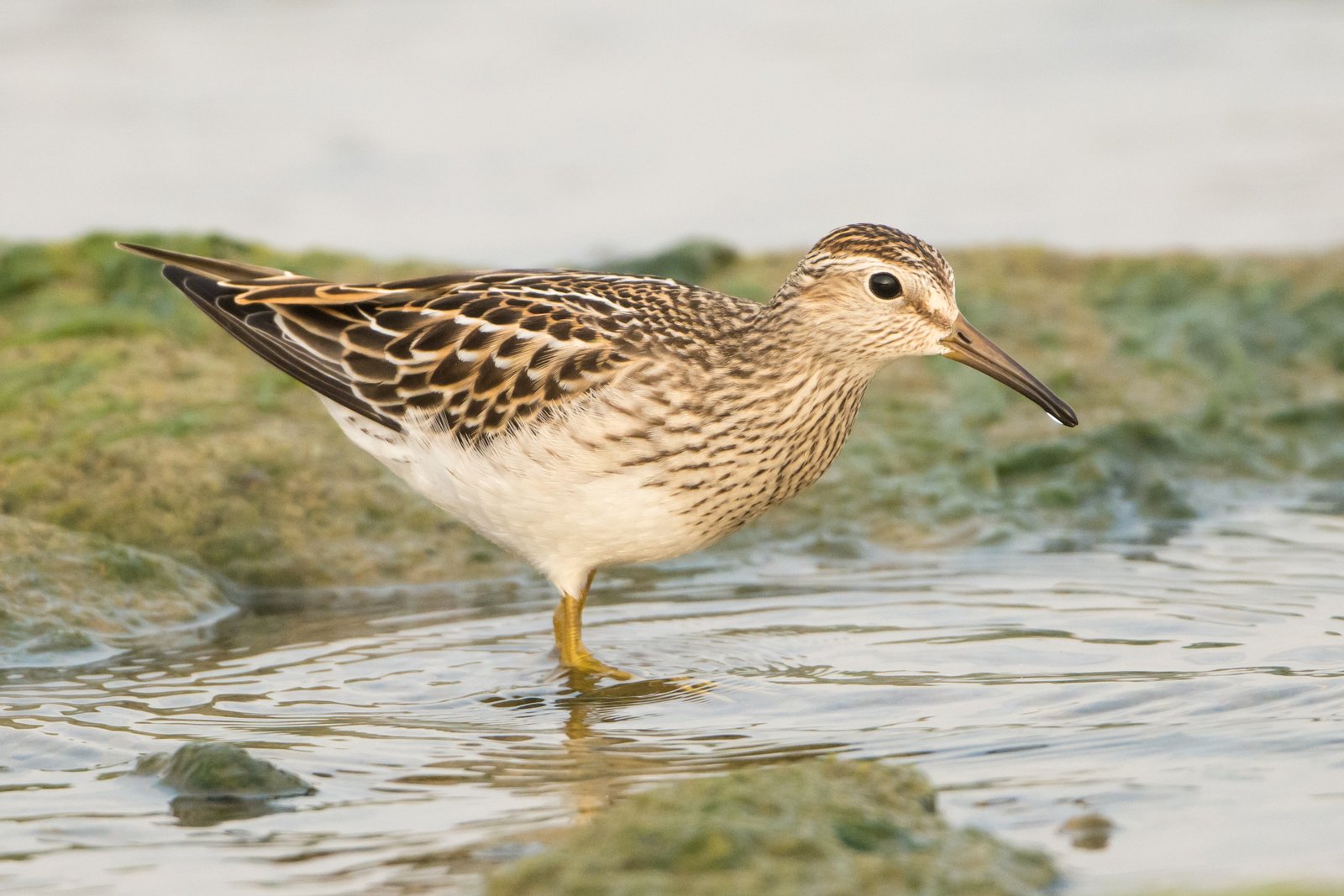
A medium-sized, rather long-necked sandpiper with a short, slightly decurved bill with a yellowish base and yellow-green legs. The key feature is the densely brown-streaked breast, cut off sharply and straight against the white belly. The upperparts are brown with black feather centres and rufous fringes; juveniles show a white V on the mantle and a dark, slightly capped crown with a faint supercilium. In flight a faint wing bar and white rump sides with a black central stripe.
Confusion species
Ruff (Calidris pugnax) is larger, with a smaller head, longer legs and a plain breast without a sharp border. Curlew Sandpiper (Calidris ferruginea) has a longer, evenly decurved bill, black legs and a white rump. Sharp-tailed Sandpiper (Calidris acuminata), an extremely rare vagrant elsewhere in Arabia, has a rufous cap, a striking white supercilium and a breast without a sharp border. Dunlin (Calidris alpina) is smaller and has black legs.
Habitat
Grassy and vegetated margins of shallow fresh or brackish water: sewage ponds, fish ponds, reservoirs, salt-pan edges and wet fields. It often feeds in the vegetation at the water's edge, where it can stay hidden for long periods.
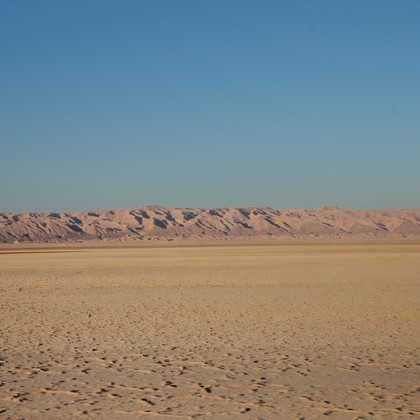
Where the bird is most at home, classified by the habitats of North Africa and the Middle East.


Range and movements
Rare, but to be expected throughout the region. In Morocco there were seven accepted records up to 1998, including two juveniles at the Oued Souss estuary near Agadir in September–October 1998; a few more since. Israel had thirteen records up to 2014, spread over spring and autumn, mainly at Eilat (KM20 salt pans), Ma'agan Michael and in the Jordan Valley. Kuwait has two records (2011 and 2021, Jahra Pools). In Oman an accidental vagrant; in the Emirates rare but almost annual. A few records also from Tunisia, Egypt and Saudi Arabia. Beyond the region it breeds on the tundra of northern Siberia and Arctic North America and winters in South America and Australasia; vagrants reach Europe annually.
- Summer visitor (c. Apr–Sep)
- Passage (Mar–Apr, Oct–Nov)
- dark = core range, pale = thinly spread
How and when to look
Check the vegetated edges of sewage ponds and fish ponds in September–October: the chances are highest in the Emirates (for example Al Wathba and the Al Ain sewage ponds) and at Eilat. The sharp breast border only becomes obvious once the bird steps out of the vegetation.
Conservation status
Not globally threatened. In the region a rare passage migrant, whose number of records is rising with the number of birders and the spread of artificial fresh water in Arabia.
Scientific name
Calidris melanotos | (Vieillot, 1819)
Vieillot described the species in 1819 as Tringa melanotos; because it was later moved to another genus, the author and year stand in brackets. The genus Calidris was introduced in 1804 by Merrem. Calidris goes back to Ancient Greek kalidris or skalidris, a name Aristotle used for an unidentified grey waterside bird. melanotos is from Greek melas 'black' and notos 'back', so 'black-backed'. The specimen the first description was based on came from Paraguay.