All species › Owls › Typical owls › Long-Eared Owl
Long-Eared Owl | Asio otus
Ransuil | Búho chico
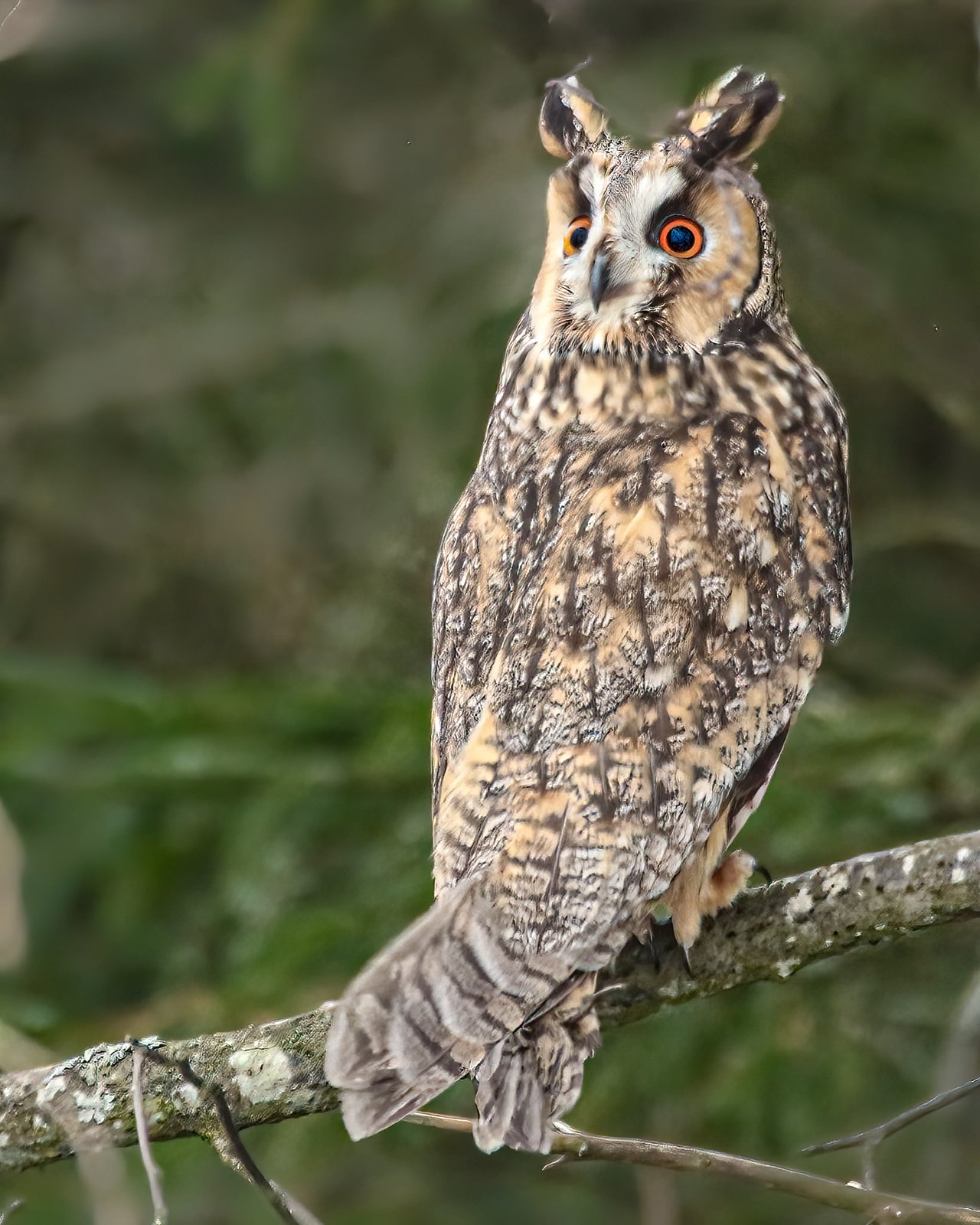
A slender, medium-sized owl with long ear tufts and orange eyes, which hunts strictly in darkness and by day sits well hidden in a dense tree. In the region it breeds in the Maghreb and the Levant; in winter birds from the north join them, sometimes roosting together in small groups.
Voice
The male’s song is a soft, low, muffled hoo, repeated every two or three seconds and carrying far on still nights. Young beg with a high, squeaky pee-eh, like a rusty hinge, which betrays their presence at night in early summer.
Recording: Romuald Mikusek — CC BY-NC-SA 4.0 · shortened to the first 60 s, mono · xeno-canto
Identification
Slender and upright, with long, erect ear tufts and an orange-brown facial disc with a white X between the orange eyes. Upperparts grey-brown and finely mottled, underparts buff with dark streaks down to the belly, combined with fine cross-bars. In flight an orange patch on the primaries, a dark carpal patch and a finely barred wingtip without a clear white trailing edge. When alarmed it stretches tall and thin.
Confusion species
Short-eared Owl (Asio flammeus) has very short ear tufts, yellow eyes in black patches, an almost unstreaked belly and a white trailing edge to the wing; it often hunts in daylight over open country. Eurasian Eagle-Owl (Bubo bubo) and Pharaoh Eagle-Owl (Bubo ascalaphus) also have ear tufts but are much larger and heavier. Eurasian Scops-Owl (Otus scops) is much smaller, with yellow eyes.
Habitat
Copses, woodland edges and lines of trees next to open country: conifers, cypresses and eucalyptus, olive groves, orchards, poplar rows along rivers, parks and cemeteries. Breeds in old crow and magpie nests. In winter birds roost communally in dense trees, also in villages. Hunts at night over fields and open ground for voles and other small rodents.
Where the bird is most at home, classified by the habitats of North Africa and the Middle East.



Range and movements
Breeds in northern Morocco and the Atlas, northern Algeria and northern Tunisia; in Libya scarce and mainly in the Jebel Akhdar. In the east it breeds in Israel and Samaria and Judea, Lebanon, western Syria, northern Jordan and northern Iraq. In winter birds from Europe and Asia arrive in the Maghreb and the Levant. In Egypt a scarce winter visitor to the Nile delta and Nile valley. On the Arabian Peninsula a scarce to rare winter visitor and passage migrant in Kuwait, Saudi Arabia, Bahrain, Qatar, the Emirates and Oman; no certain record is known from Yemen. Beyond the region from Europe and the Canary Islands to Japan, and in North America.
- Resident
- Summer visitor (c. Oct–Mar)
- Winter visitor (c. Apr–Sep)
- Passage (Mar–Apr, Oct–Nov)
- dark = core range, pale = thinly spread
How and when to look
In Israel winter roosts in dense cypresses and pines at kibbutzim and in cemeteries are well known; look for pellets and droppings beneath a tree. In the Maghreb listen in May–June for begging young in olive groves and pine woods. Approach roosting birds carefully and keep your distance.
Conservation status
Not threatened. Road traffic, rodent poison and the felling of trees and windbreaks take their toll; in Israel the species has benefited from tree planting and plantations.
Scientific name
Asio otus | (Linnaeus, 1758)
Linnaeus described the species in 1758 as Strix Otus; because it was later moved to another genus, the author and year stand in brackets. The genus Asio was introduced in 1760 by Brisson. Asio is the Latin name of a horned or eared owl. otus is from Greek ōtos, the name of a small eared owl. The specimen the first description was based on came from Sweden.