All species › Passerines › Crows and jays › Maghreb Magpie
Maghreb Magpie | Pica mauritanica
Maghrebekster | Urraca magrebí
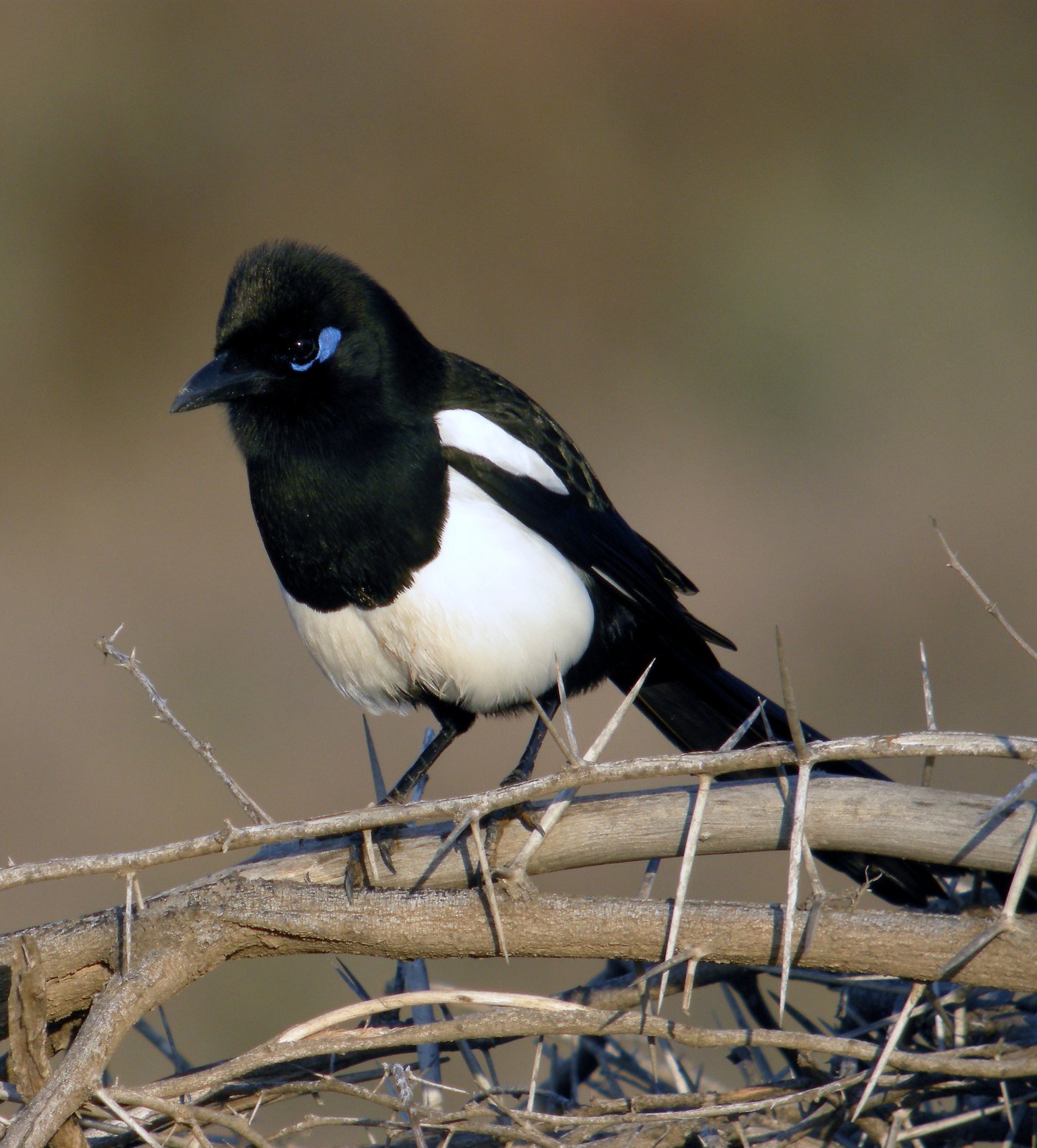
The magpie of north-west Africa, recently recognised as a separate species and with its entire world range within this guide. At first sight an ordinary magpie, but with a bright blue patch of bare skin behind the eye. In Morocco it is a familiar sight in orchards, fields and village edges.
Voice
A harsh, rattling chak-chak-chak like Eurasian Magpie, especially when mobbing cats, snakes or raptors; also softer guttural and chattering sounds between partners.
Recording: Stanislas Wroza — CC BY-NC-SA 4.0 · shortened to the first 60 s, mono · xeno-canto
Identification
44–50 cm, half of it tail. Black with a blue-green gloss on wings and tail, a white belly and white scapular patches, and a bare, sky-blue patch of skin behind and below the eye. Compared with Eurasian Magpie the white on belly and scapulars is smaller, the primaries show less white, the rump is black without a pale band, and the wings are shorter, making the long tail look even longer. Sexes alike. Juveniles have a shorter tail, less gloss and a dull, barely blue face patch.
Confusion species
Only Eurasian Magpie (Pica pica) is similar, but it does not occur in north-west Africa: it has a feathered black face without blue skin (southern Spanish birds sometimes show a small blue spot), more white on scapulars and primaries, and a greyish-white band across the rump.
Habitat
Semi-open farmland with trees: olive and almond groves, argan woodland, cereal fields with scattered trees, cactus hedges, oases and palm groves, and the edges of villages and towns; from sea level to about 2,300 m. Avoids closed forest and true desert. The nest is a large, domed ball of twigs in a thorny tree, olive or date palm.
Where the bird is most at home, classified by the habitats of North Africa and the Middle East.


Range and movements
Endemic to the Maghreb. In Morocco widespread north and west of the Sahara: the Atlantic plains, the Haouz around Marrakech, the Souss, the Middle Atlas and the oases along the southern edge of the Atlas; a single record from Western Sahara. In Algeria in the north, from the coast across the Tell to the high plateaus and the northern edge of the Sahara. In Tunisia scarce and scattered, with a recent decline. There are no certain recent records from Libya.
- Resident
- Summer visitor (c. Apr–Sep)
- Winter visitor (c. Oct–Mar)
- Passage (Mar–Apr, Oct–Nov)
- dark = core range, pale = thinly spread
How and when to look
In Morocco it is seen everywhere in the Haouz and the Souss; to see the blue patch you need to get close, easiest in the gardens and palm grove of Marrakech or along the roads in the Souss near Taroudant, where it perches on wires and fences.
Conservation status
Not globally threatened (IUCN 2023) and common in Morocco. Declining in Tunisia, where many nests fail through predation by Great Gray Shrikes, snakes and rats, and Great Spotted Cuckoo (Clamator glandarius) lays its eggs in its nests. Because it was long treated as a subspecies of Eurasian Magpie, little separate research exists.
Scientific name
Pica mauritanica | Malherbe, 1845
Malherbe described the species in 1845 and placed it straight away in the genus where it still stands. The genus Pica was introduced in 1760 by Brisson. Pica is the Latin word for the magpie. mauritanica means 'of Mauretania', the Roman province in north-west Africa where the bird occurs. The specimen the first description was based on came from Oran and Annaba, Algeria.