All species › Tubenoses › Petrels and shearwaters › Manx Shearwater
Manx Shearwater | Puffinus puffinus
Noordse pijlstormvogel | Pardela pichoneta
The classic black-and-white shearwater of the North Atlantic, which passes along Morocco's Atlantic coast on its way to and from its wintering grounds off South America. In the region it is mainly a bird of winter seawatching at Agadir and Tarfaya; in the Mediterranean it is outnumbered by Yelkouan Shearwater and is exceptional.
Voice
Almost always silent at sea. At the breeding colony a hoarse, retching crowing in a fixed rhythm at night, kah-kah-kooroo, from burrows and in flight; not heard in the region.
Recording: Anthony McGeehan — CC BY-NC-SA 4.0 · shortened to the first 60 s, mono · xeno-canto
Identification
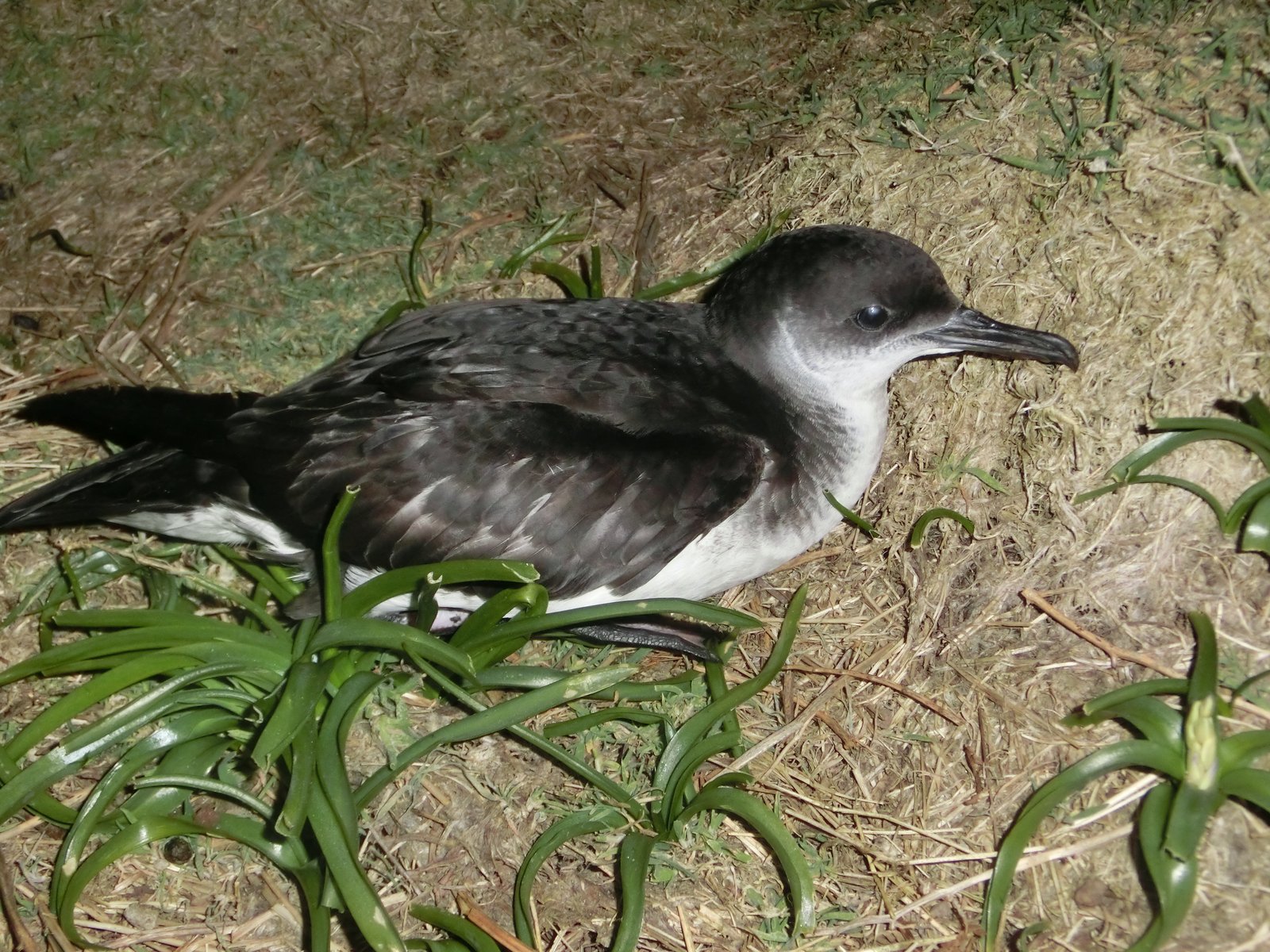
Medium-sized and slender, with long, narrow, straight wings and a short tail. Uniformly black above and bright white below, with a sharp border running below the eye so that the face looks dark; behind the neck the white curves up slightly. The underwing is white with a narrow, crisp dark margin and dark tip, the axillaries are white and the undertail coverts pure white. Bill thin and dark, legs pink. The flight defines the picture: a few quick, stiff beats then a long glide just above the waves, the bird tilting to show alternately the black upperside and the white underside.
Confusion species
Yelkouan Shearwater (Puffinus yelkouan) is the main pitfall: the western form (Balearic Shearwater), far commoner off Morocco's Atlantic coast, is browner above and dirty brownish-white below, with dark axillaries, dark undertail and a diffuse head-throat border; the eastern form in the Mediterranean is browner above, has a broader dark underwing margin and flies with faster beats and shorter glides. Barolo Shearwater (Puffinus baroli) is much smaller, with a white face around the eye, short rounded wings and a whirring flight. Scopoli's Shearwater (Calonectris diomedea) is much larger and brown-grey, with a yellow bill and a lazy, sailing flight. Sooty Shearwater (Ardenna grisea) is all dark with a silvery underwing band.
Habitat
Open sea over the continental shelf and its edge, also close inshore in bays and off headlands, especially in strong onshore winds. Feeds on small shoaling fish such as sardines and anchovies, plunging from the surface or diving from a swimming position. Breeds in burrows on islands outside the region.
Where the bird is most at home, classified by the habitats of North Africa and the Middle East.

Range and movements
Morocco: regular passage migrant and winter visitor off the Atlantic coast, from the Strait of Gibraltar south to Tarfaya and the waters of Western Sahara, mostly September to April; in Agadir bay small groups of ten to twenty are often present in winter. Scarce in the Strait of Gibraltar and along Morocco's Mediterranean coast. Algeria, Tunisia and Libya: exceptional in the Mediterranean part of the region, with only a few records. Israel: one accepted record, at Eilat in June 2014. Not recorded in the other countries of the region. Beyond the region it breeds on islands in the North Atlantic, most numerously in Britain and Ireland, also in Iceland, the Faroes, Brittany, the Azores, Madeira and the Canaries and in small numbers in north-eastern North America; it winters off South America, chiefly off southern Brazil and Argentina.
- Resident
- Summer visitor (c. Oct–Mar)
- Passage (Mar–Apr, Oct–Nov)
- dark = core range, pale = thinly spread
How and when to look
Look for it in winter in Agadir bay, where groups can be seen from the harbour and from boats; seawatching at Tarfaya harbour also produces birds in autumn. Use the crisp black and white and the white undertail to separate it from the far commoner western form of Yelkouan Shearwater.
Conservation status
Not globally threatened; most of the world population breeds on a handful of islands off Britain and Ireland. Threats include introduced rats and other predators on the breeding islands, artificial light that disorients fledglings, bycatch in fishing gear and oil pollution. No particular threats are known within the region itself.
Scientific name
Puffinus puffinus | (Brünnich, 1764)
Brünnich described the species in 1764 as Procellaria puffinus; because it was later moved to another genus, the author and year stand in brackets. The genus Puffinus was introduced in 1760 by Brisson. Puffinus comes from English puffin and its variants, the name for the cured nestling of the shearwater, once a delicacy. The specific name repeats the genus name. The specimen the first description was based on came from the Faroe Islands and Norway.