All species › Tubenoses › Petrels and shearwaters › Wedge-Tailed Shearwater
Wedge-Tailed Shearwater | Ardenna pacifica
Wigstaartpijlstormvogel | Pardela del Pacífico
A large, slender shearwater of the tropical Indian and Pacific Oceans, with a long, pointed tail and a relaxed, floating flight. In the region a scarce visitor to the Arabian Sea, mainly off Oman.
Voice
Silent at sea. At the colony at night a long, moaning and wailing oo-OO-ah.
Recording: Kathryn Hodder — CC BY-NC-SA 4.0 · shortened to the first 60 s, mono · xeno-canto
Identification
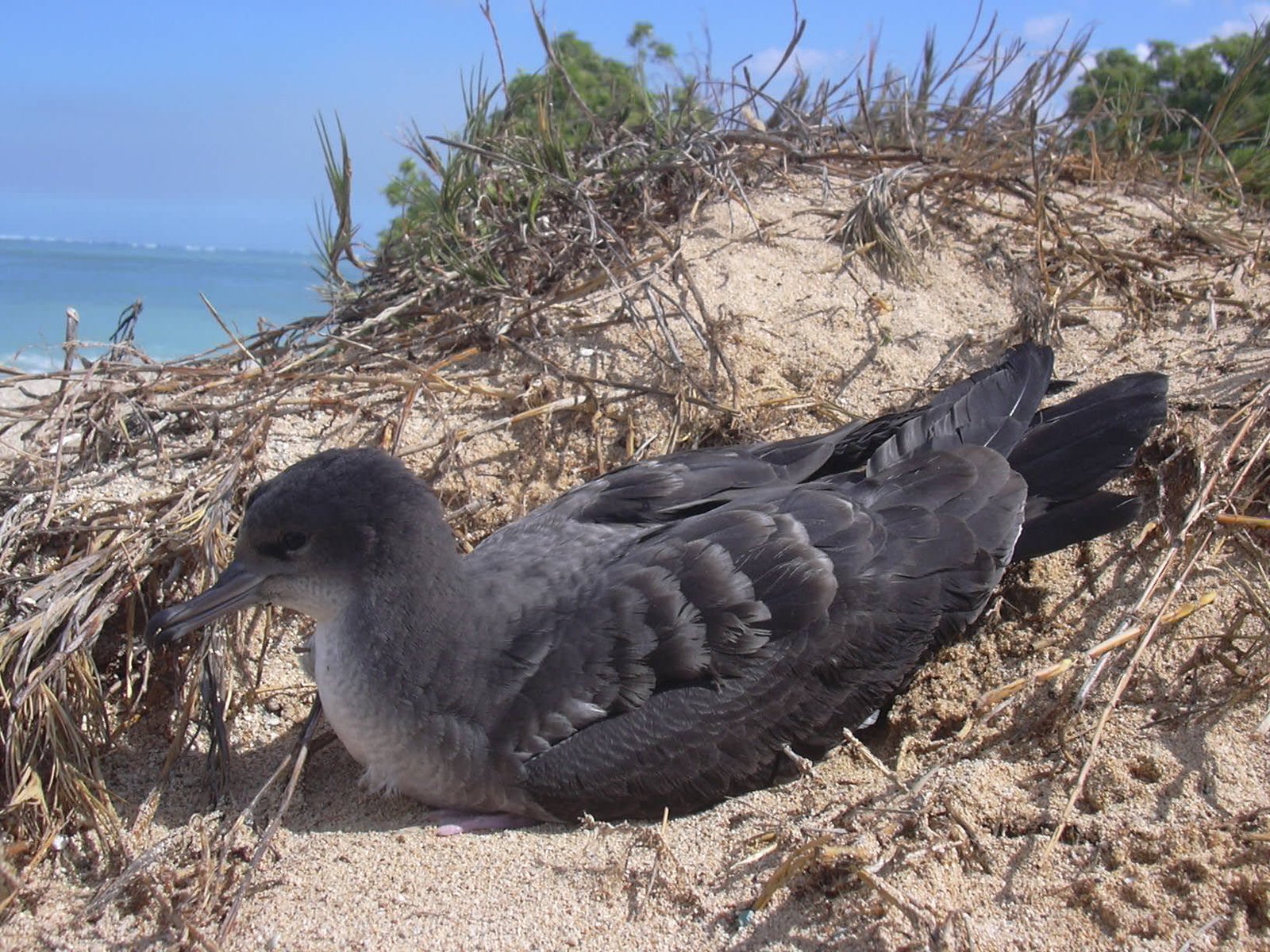
Slim and elongated, with a rather small head, broad wings held forward at the carpal and a long, wedge-shaped tail usually held closed and pointed. In the Indian Ocean mainly the dark morph occurs: all dark chocolate-brown, the underwing slightly paler on the greater coverts. The pale morph is grey-brown above and white below. The bill is slender, grey to dull pink with a dark tip; the legs are flesh-coloured. Flies low and slowly, with loose beats and long glides on slightly bowed wings, less stiffly than other shearwaters.
Confusion species
Flesh-footed Shearwater (Ardenna carneipes), far commoner in the Arabian Sea, is bulkier and broader-winged, with a shorter, rounded tail, a thicker flesh-coloured bill with a black tip, strikingly pale feet and a heavier flight. Sooty Shearwater (Ardenna grisea) has silvery underwings, a short tail, a black bill and a fast, stiff flight. Jouanin’s Petrel (Bulweria fallax) is much smaller, with a short, heavy black bill.
Habitat
Warm, open ocean; sometimes comes closer inshore, especially in strong monsoon winds. Feeds in groups over shoals of predatory fish and dolphins. Breeds in burrows on tropical islands.
Where the bird is most at home, classified by the habitats of North Africa and the Middle East.

Range and movements
In the region almost confined to Oman, where just over sixty records were known by 2016, mainly at sea off Dhofar and Masirah; rarely close inshore. In the Gulf of Oman off the east coast of the Emirates a very rare, not annual visitor in May and June: there was one record before 2013, after which an influx that year produced up to eight birds on a single boat trip. There are a few reports from the waters of Yemen and Socotra; not recorded elsewhere in the region. Beyond it, it breeds throughout the tropical and subtropical Indian and Pacific Oceans, nearest in the Seychelles, the Mascarenes and the islands off Western Australia.
- Summer visitor (c. Oct–Mar)
- dark = core range, pale = thinly spread
How and when to look
The best chance is on pelagic trips off Dhofar during the summer monsoon, or from Fujairah and Dibba in May and June. Check every dark shearwater among the Flesh-Footed Shearwaters for tail shape and bill colour.
Conservation status
Not globally threatened, with a very large population, though rats, cats and lighting affect some colonies. In the region a scarce visitor with no breeding sites.
Scientific name
Ardenna pacifica | (Gmelin, 1789) (GBIF: Puffinus pacificus)
Gmelin described the species in 1789 as Procellaria pacifica; because it was later moved to another genus, the author and year stand in brackets. The genus Ardenna was introduced in 1853 by Reichenbach. Ardenna goes back to Artenna, the spelling the Italian naturalist Ulisse Aldrovandi used for a seabird in 1603 and which Reichenbach cited when naming the genus. pacifica is Latin for 'of the Pacific Ocean', after its range. The specimen the first description was based on came from Pacific Ocean; later restricted to the Kermadec Islands.