All species › Waders, gulls and terns › Sandpipers and snipes › Marsh Sandpiper
Marsh Sandpiper | Tringa stagnatilis
Poelruiter | Archibebe fino
A slender, pale Tringa with a needle-fine bill and very long legs, well seen in the region on passage and in winter, from the Nile Delta to the Gulf and the coasts of Oman. The region lies right on the route between the steppes of eastern Europe and Central Asia and the wintering grounds in East Africa.
Voice
A sharp, high tew, often given singly and sometimes in a quick series of two or three: tew-ew-ew. It sounds like a shortened, thinner version of the Common Greenshank call, less full and faster. On passage this flight call is almost all you hear.
Recording: Julien Birard — CC BY-NC-SA 4.0 · converted to mono · xeno-canto
Identification
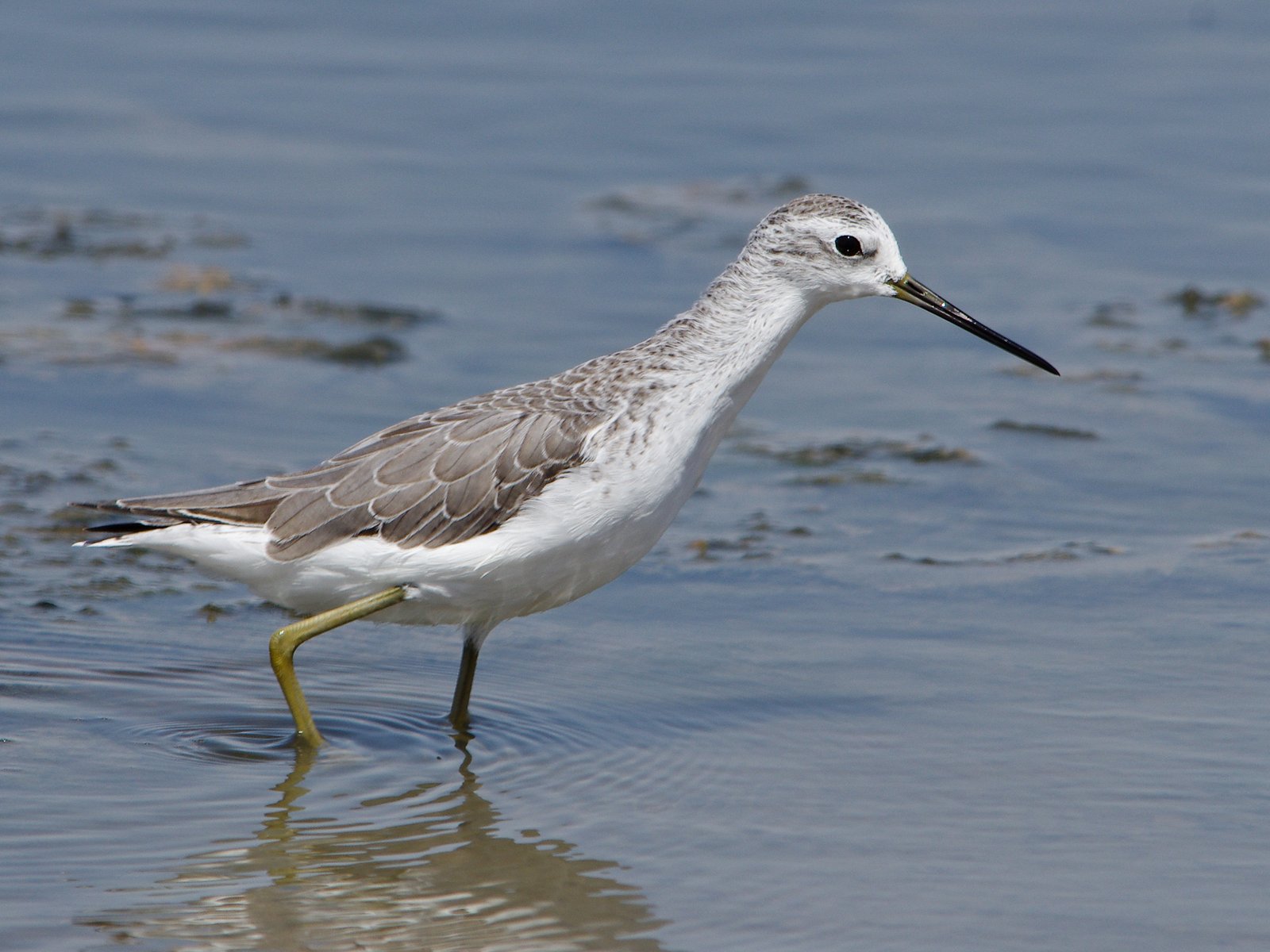
Slim and finely built, with a dead-straight, needle-fine dark bill on a small, rounded head and long olive-green to yellowish-green legs. In winter plumage very pale: white forehead and cheeks, plain pale grey upperparts and pure white underparts, so it stands out at a distance. In breeding plumage (March – May) the mantle and scapulars are grey-brown with black spots and the neck and flanks finely streaked. In flight a long white wedge reaching far up the back, an almost unbarred white tail and toes projecting well beyond the tail.
Confusion species
Common Greenshank (Tringa nebularia) is the first comparison: much larger, with a heavier, slightly upturned bill, a thicker neck and grey-green legs, and a loud call of three equal notes. Wood Sandpiper (Tringa glareola) is browner and spotted, with a white rump but no back wedge and shorter legs. Lesser Yellowlegs (Tringa flavipes), a vagrant, has canary-yellow legs, a slightly sturdier bill and a square white rump without a back wedge.
Habitat
Shallow fresh, brackish and saline water with a soft muddy edge: salt pans and sebkhas, fish ponds, sewage ponds, flooded fields, creeks and lagoons with muddy margins. It feeds wading in a few centimetres of water, picking quickly from the surface with strikingly long strides.
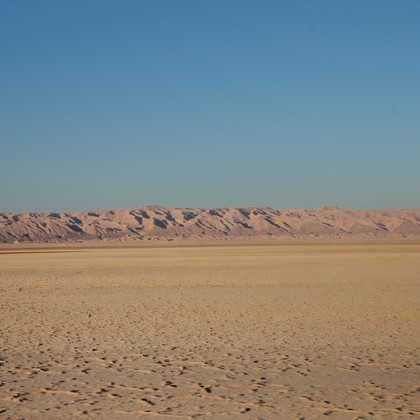
Where the bird is most at home, classified by the habitats of North Africa and the Middle East.


Range and movements
Passage migrant and winter visitor in the east and centre of the region, scarcer to the west. Egypt: on passage and in winter in the Nile Delta (Manzala, Burullus), along the Nile, at Lake Qarun and along the Red Sea. In Israel and Jordan a common migrant in the Jordan and Beit She'an valleys and at Eilat, with wintering birds on fish ponds. Iraq: on passage and in winter in the Mesopotamian marshes. Arabia: in the Emirates a fairly common but local passage migrant and winter visitor, with a few oversummering; also in Kuwait, Qatar, Bahrain, Saudi Arabia, Oman (including Barr al Hikman and the creeks of Dhofar) and Yemen. Scarce in the Maghreb: in Tunisia on passage on sebkhas and salt pans, in Algeria and Morocco a migrant in small numbers. Libya: scarce. Breeds from eastern Europe and the Ukrainian steppes to Central Asia and Mongolia; also winters in sub-Saharan Africa, South Asia and Australia.
- Resident
- Summer visitor (c. Apr–Sep)
- Winter visitor (c. Oct–Mar)
- Passage (Mar–Apr, Oct–Nov)
- dark = core range, pale = thinly spread
How and when to look
In March – April and August – September small groups often stand among Common Greenshanks at Eilat and on the fish ponds of the Beit She'an Valley. In winter the lagoons of Ras al Khor in Dubai and Al Wathba near Abu Dhabi are good sites. Listen for the flight call and watch for the white back wedge as it flushes.
Conservation status
Not globally threatened (LC), with most of the population in the steppe belt of eastern Europe, western Siberia and Central Asia, where drainage of steppe lakes and drought are the main concerns. In the region the large wetlands of the Nile Delta and Mesopotamia suffer from drainage and pollution; fish ponds, salt pans and sewage works, on the other hand, offer new staging sites.
Scientific name
Tringa stagnatilis | (Bechstein, 1803)
Bechstein described the species in 1803 as Totanus stagnatilis; because it was later moved to another genus, the author and year stand in brackets. The genus Tringa was introduced in 1758 by Linnaeus. Tringa is the Neo-Latin name Aldrovandi gave to the green sandpiper, after Ancient Greek trungas, a thrush-sized, white-rumped, tail-bobbing wading bird mentioned by Aristotle. stagnatilis is Latin, from stagnum 'pool, marsh', and means 'of the pools'. The specimen the first description was based on came from Germany.