All species › Waders, gulls and terns › Sandpipers and snipes › Green Sandpiper
Green Sandpiper | Tringa ochropus
Witgat | Andarríos grande
A dark, skittish sandpiper that flies up calling loudly when disturbed, flashing a brilliant white rump against almost black wings. In the region it is a widespread passage migrant and winter visitor which, more than other Tringa sandpipers, also uses small waters in the desert: a pool in a wadi, an irrigation channel in an oasis or a leaking water pipe.
Voice
On take-off a loud, clear, exultant tluee-weet-weet, the first note highest, often repeated as the bird climbs away. When alarmed also a sharp tweet. The call is one of the best identification features: no other Tringa sounds so clear and jubilant.
Recording: Stanislas Wroza — CC BY-NC-SA 4.0 · converted to mono · xeno-canto
Identification
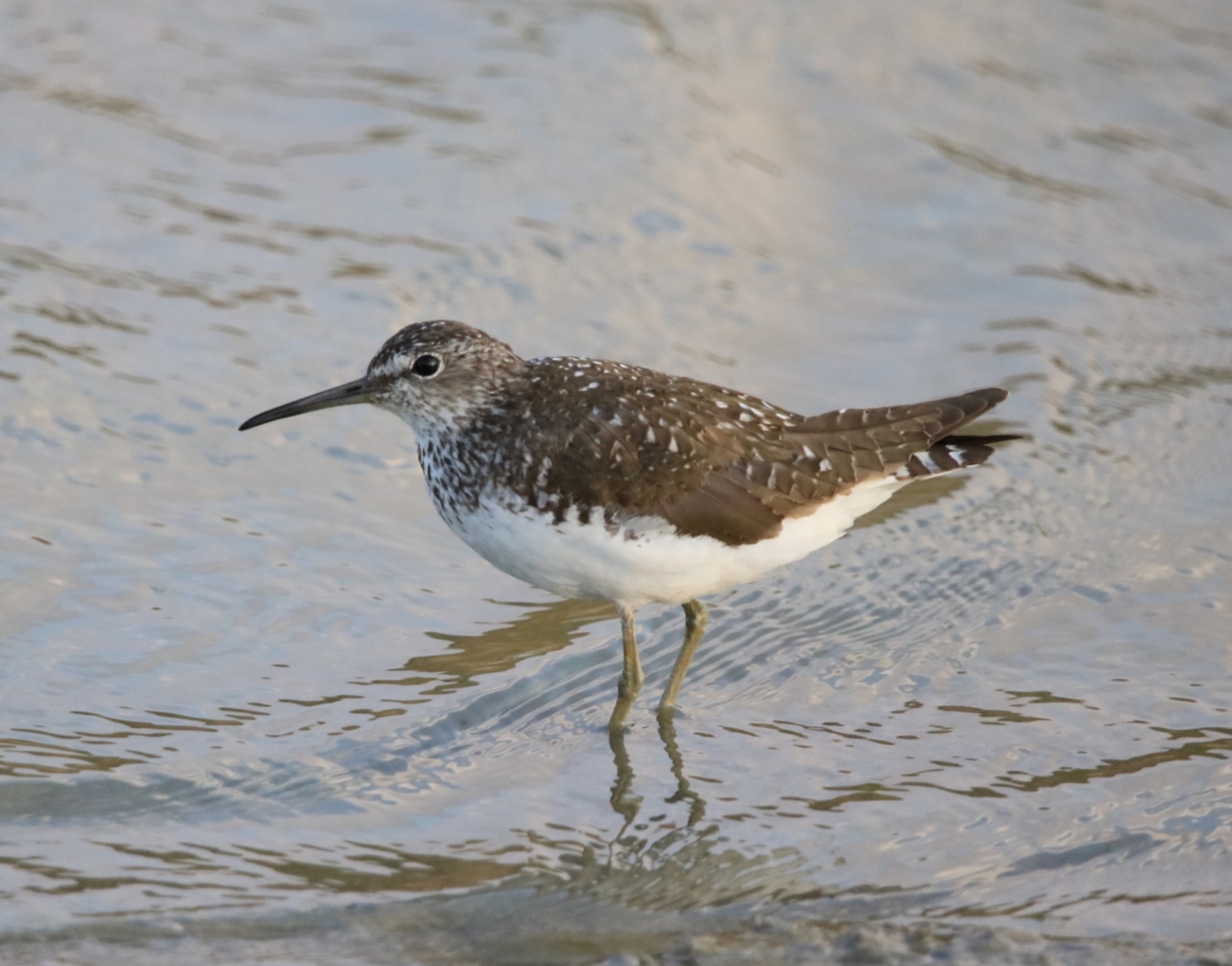
Medium-sized and rather compact, with a straight, medium-length bill and greenish legs. Upperparts dark olive-brown with fine pale spots, barely visible in winter; head, neck and breast darkly streaked and sharply demarcated from the white belly. A short white supercilium in front of the eye and a white eye-ring. In flight very contrasting: dark upperwing and blackish underwing, a brilliant white rump and a white tail with a few broad black bars at the tip. Flies fast, often zigzagging and climbing steeply.
Confusion species
Wood Sandpiper (Tringa glareola) is slimmer and paler brown with obvious pale spots on the upperparts, a long white supercilium reaching behind the eye and a pale grey underwing; it calls a high, dry chiff-chiff-chiff. Common Sandpiper (Actitis hypoleucos) constantly bobs its rear, flies low with stiff, flickering wingbeats and lacks a white rump. Lesser Yellowlegs (Tringa flavipes), a vagrant, has long yellow legs and a paler, spotted back.
Habitat
Small freshwater sites with muddy or stony edges, often sheltered: ditches and irrigation channels, pools in wadis, oases and date palm groves, fish ponds, sewage ponds and the banks of rivers and reservoirs. Largely avoids open tidal flats and salt pans. Usually alone or a few birds scattered along a shore.
Where the bird is most at home, classified by the habitats of North Africa and the Middle East.


Range and movements
Passage migrant and winter visitor across almost the whole region, from late June to April. In the Maghreb it winters widely along rivers and in oases of Morocco, Algeria and Tunisia, also south of the Atlas; in Egypt fairly common in the Nile Valley and Delta and at the oases of the Western Desert. In the east it winters in the Jordan Valley, Lebanon, Syria and Iraq, and widely in Arabia: in the Emirates a fairly common passage migrant and winter visitor, and also in Oman, Saudi Arabia, Kuwait, Qatar and Yemen, where it turns up on irrigation pools and inland sewage ponds. On passage it crosses the Sahara and the Arabian deserts on a broad front. Breeds in the swampy forests of northern and eastern Europe and the taiga to eastern Siberia; also winters in western and southern Europe, tropical Africa and South Asia.
- Resident
- Summer visitor (c. Apr–Sep)
- Winter visitor (c. Oct–Mar)
- Passage (Mar–Apr, Oct–Nov)
- dark = core range, pale = thinly spread
How and when to look
In the desert, look for it wherever water leaks: a broken irrigation pipe, a livestock trough or a pool in a wadi. It often flushes before you see it; listen for the clear call and follow it with binoculars until it lands. In the oases of southern Morocco and at the sewage works of the Gulf states it is almost guaranteed in winter.
Conservation status
Not globally threatened (LC) and stable to slightly increasing on the European breeding grounds. In the region it depends on scattered small waters, which are disappearing as groundwater falls and oases dry out, but it also finds new staging sites at sewage works, fish ponds and irrigation schemes.
Scientific name
Tringa ochropus | Linnaeus, 1758
Linnaeus described the species in 1758 and placed it straight away in the genus where it still stands. He introduced the genus Tringa in that same work. Tringa is the Neo-Latin name Aldrovandi gave to the green sandpiper, after Ancient Greek trungas, a thrush-sized, white-rumped, tail-bobbing wading bird mentioned by Aristotle. ochropus is Greek, from ōkhros 'ochre' and pous 'foot', hence 'ochre-foot'. The specimen the first description was based on came from Sweden.